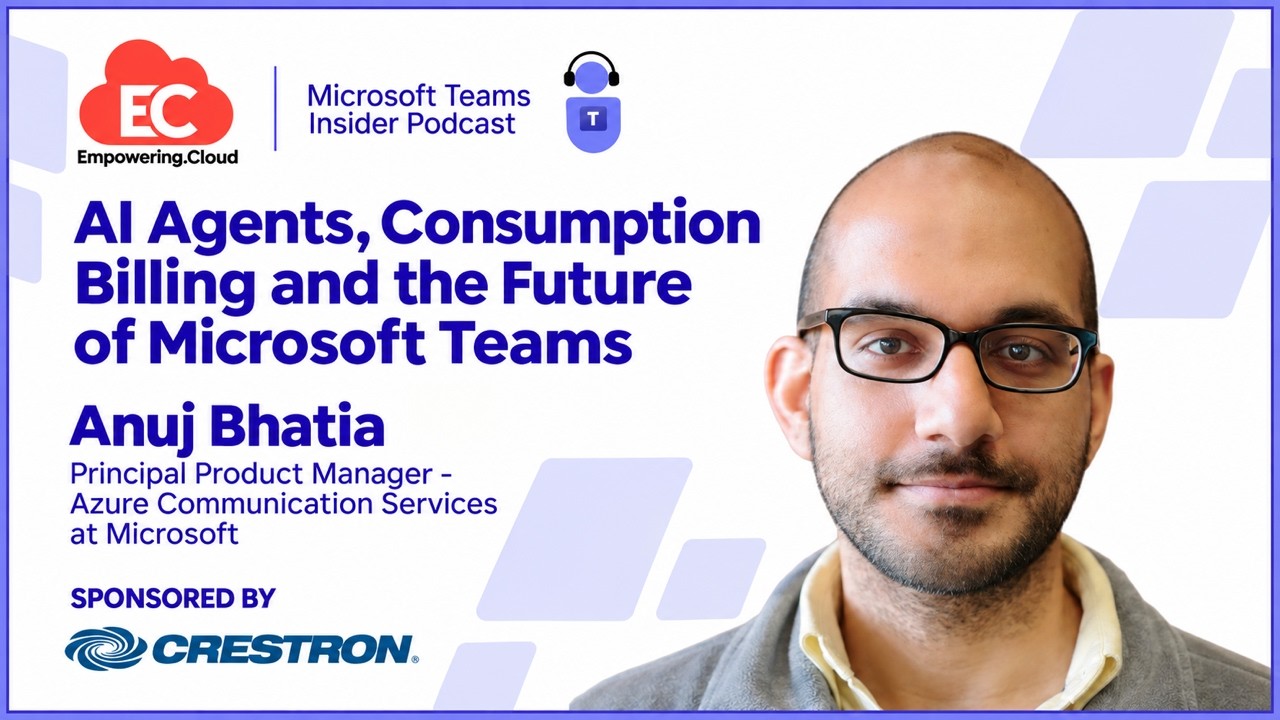
AI Agents, Consumption Billing and the Future of Microsoft Teams
Anuj Bhatia, Principal Product Manager in Microsoft's IC3 team, on putting AI agents onto Teams and Dynamics 365 communications channels securely, how AI changes leadership and knowledge work, and why consumption billing is replacing per-seat pricing for AI.
Prefer audio?
Who should listen: Microsoft 365 and Teams service owners, IT and security leads putting AI agents onto chat, phone and email channels, and anyone planning how to budget for consumption-billed AI.
Guest: Anuj Bhatia — Principal Product Manager, IC3, Microsoft
IC3 is the Microsoft team that ships the real-time communications channels underneath Microsoft Teams and Dynamics 365, and almost every AI scenario in those products now runs across its platform. Anuj Bhatia walks through what changes when agents, not just people, use those channels, why AI puts a spotlight on leadership and clear writing, where personal agents could matter most, and why he thinks consumption billing will beat per-seat pricing for AI.
Many thanks to Crestron, sponsor of this episode.
Key insights
- IC3 ships the communications channels that power Microsoft's first-party apps, Teams and Dynamics 365 included. Bhatia was struck by how much is invested in one secure, compliant platform across the company rather than five different versions of telephony and chat, and that common foundation is what AI features are now layered on. ▶ 1:34
- An email auto-reply bot sounds simple, but because LLMs are non-deterministic, an inbound email carrying a prompt injection could instruct it to send out trade secrets. Email is a channel that can exfiltrate data from the tenant to an external sender, so the work is limiting who can send externally and enforcing data loss prevention and IP protection in the runtime at tenant policy level. ▶ 4:12
- Customers arrive saying "I just want to reduce my support inquiries" and only then hit the implementation detail. Bhatia sees IC3's job as getting those decisions down to no more than ten steps of buttons and toggles, with regulatory and sovereignty rules on what data can be collected and sent handled underneath. ▶ 5:39
- Tom's point: email is asynchronous, so there is time to generate an answer, check it and double-check it. Post-meeting recap was the first big win, but real-time scenarios such as Facilitator and Dynamics 365 Contact Center need all the same security work done live. ▶ 6:38
- Tom is hearing Work IQ land in enterprises as a team concept rather than personal productivity: using the full history of a project's meetings, chat and email so the whole team runs better, and being able to ask why a decision was made three meetings ago and get the answer. ▶ 8:10
- Bhatia's view is that AI puts a spotlight on leadership. A leader with good judgement who draws out quieter voices has their reasoning codified in recaps that thousands of people can check; a leader who waffles leaves a recap that nobody can follow, and the confusion multiplies across the organisation. ▶ 9:11
- Coding tools like GitHub Copilot already judge individual contributors on the quality of their instructions, and leaders are now getting the same feedback loop: teams come back next week, not six months later, when a direction is unclear. Clear, crisp writing becomes more important, because a planning document becomes the spec thousands of people work from. ▶ 11:17
- Citing investor Paul Kedrosky, Bhatia explains why coding agents succeeded commercially first: coding is expansive and has a compiler or tests to verify the output. Most knowledge work is compressive with no functional verification step; even in sales, closing a $100,000 deal does not tell you whether it should have been $1 million. ▶ 15:31
- On personal agents, Bhatia is cautious about consumer success but sees the pattern clearly in areas like healthcare: booking a doctor's appointment with full context sent to the electronic health record should just be easy. Tom's framing: swap the word "agent" for "personal coach" and the use case gets clearer. ▶ 23:23
- Consumption billing puts positive pressure on AI scaling: if people pay more for more value, providers can keep investing in better models. It also pushes buyers to ask whether they need the frontier model every time, and developers are already using a top-end model as the coordinator with cheaper sub-agents and classifier-style models doing the volume work, such as deciding whether a tool call should run. ▶ 29:40
- Bhatia questions the longevity of any vendor that insists on $50-75 a seat because that is the only model it knows. Under consumption billing, a customer that is not getting value simply stops paying that month, which forces the platform to improve every year; seat renewals create the same pressure, but with a much slower feedback loop. ▶ 32:10
- Bhatia thinks the industry is distracted by how impressive the technology is. People underrate how much time goes on calling support numbers, and how much businesses spend just being available; the goal in the contact centre is not to remove the human, but to resolve the issue as fast as is reasonable and leave more time for the human connection. ▶ 37:16
Insights summarised by AI from the episode transcript, reviewed by the Empowering.Cloud team.
Listen: Apple Podcasts · Spotify · Other platforms



Comments ()