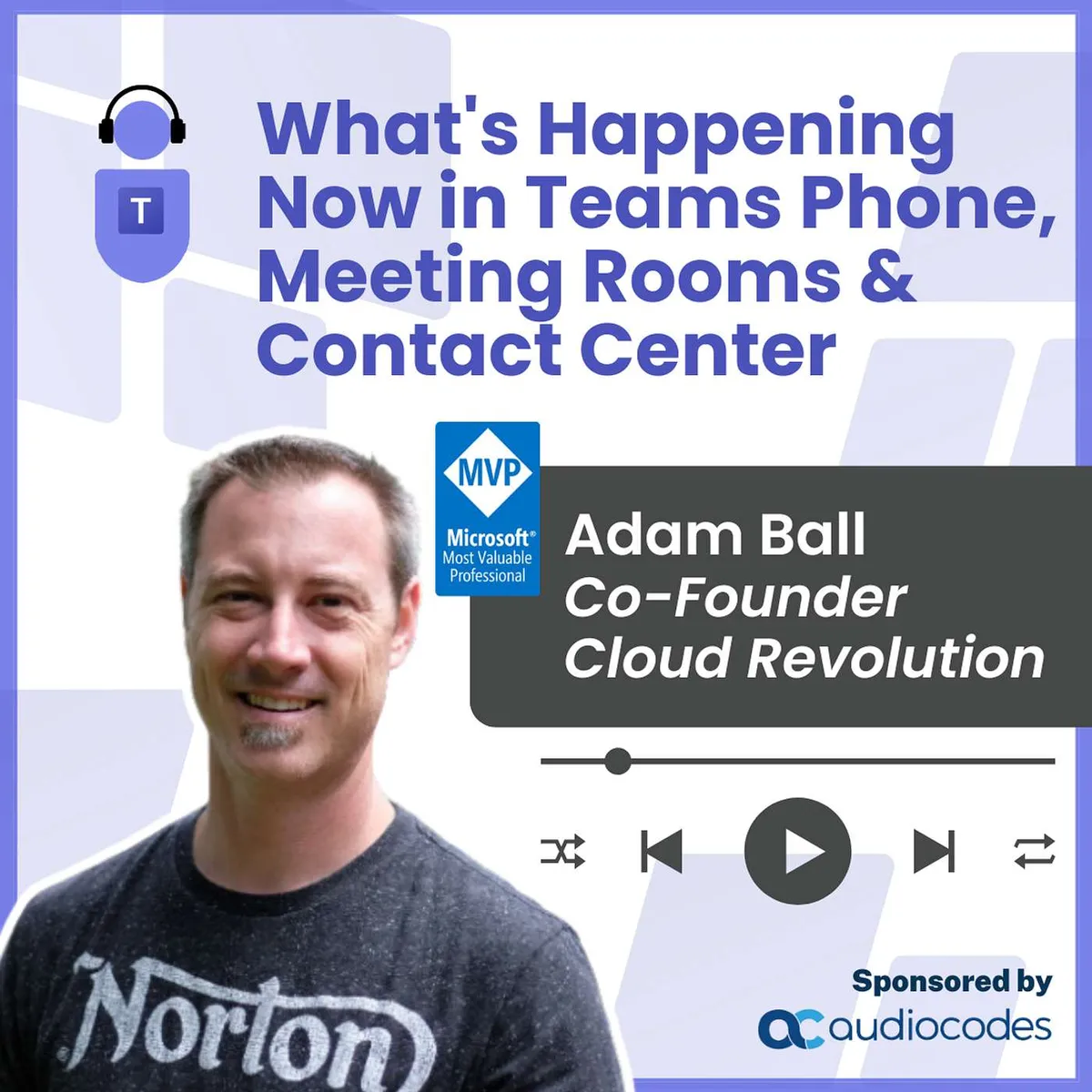
What's Happening now in Teams Phone, Meeting Rooms and Contact Center with Cloud Revolution's Adam Ball
Adam Ball is a Microsoft MVP, co-founder of US systems integrator Cloud Revolution and one of the organisers of the CommsVNext conference. He shares what he is seeing across Teams Phone migrations, contact centre modernisation and meeting room deployments, including why cloud-to-cloud moves now…
Who should listen: Microsoft 365 service owners planning Teams Phone or cloud-to-cloud voice migrations, UC architects weighing calling plans against direct routing as a service and shared calling, and AV professionals costing meeting room rollouts at scale.
Guest: Adam Ball — Co-founder, Cloud Revolution
Adam Ball is a Microsoft MVP, co-founder of US systems integrator Cloud Revolution and one of the organisers of the CommsVNext conference. He shares what he is seeing across Teams Phone migrations, contact centre modernisation and meeting room deployments, including why cloud-to-cloud moves now outnumber true legacy replacements.
Many thanks to AudioCodes, sponsor of this episode.
Key insights
- Cloud Revolution structures engagements around three pillars in sequence: Teams Phone first, then meeting rooms once calling has landed, then contact centre/customer experience — where the answer is deliberately platform-agnostic because plenty of customers want cloud contact centre without Teams integration.
- An integrated contact centre is not a prerequisite for a Teams telephony customer — running contact centre side by side is a valid architecture, and many customers move purely to escape on-premises patching, uptime and 'care and feeding' rather than for Teams integration.
- Ball argues multi-tenant scale is what makes cloud contact centre compelling: the volume of aggregated data across tenants is what unlocks meaningful AI, and current bank IVRs with 'semi-AI' voice recognition still fall over as soon as a call deviates from the expected path.
- Phone migrations that go fast do better. Big-bang cutovers (one current project is 4,000–5,000 seats after two or three pilot sites) avoid the cost and confusion of running two worlds and free the project team for other work — telephony is a commodity to the average HR or finance user.
- The 'legacy to Teams' framing is outdated — most customers are already on a modern UC platform, so the growth area is cloud-to-cloud migration, driven by three-year contracts expiring, cost consolidation of paying for two platforms, and removing the context-switch of a second app.
- SBC deployments are now rare — Cloud Revolution has deployed only a dozen or so in five years and is cloud-first, though direct routing as a service remains commercially attractive at scale because concurrent-call pricing beats per-user-per-month for large orgs with low real-world concurrency.
- Handset and calling-plan counts are collapsing: one 12,000-seat customer went from near-universal handsets to 4,000 phones, and a 1,000-user customer using under 30,000 minutes a month needed roughly 10 calling plans with shared calling instead of 1,000 — a 100x reduction that undermines carrier per-user-per-month deals.
- Around 80–90% of rooms can be served by a bar-based kit; bars break down between medium and large rooms because the only way to reach the back row is more volume, which blasts those nearest the bar — pushing you to semi-custom builds with Shure ceiling tiles or Logitech ceiling mics.
- Room project economics have inverted — services recently cost almost twice the equipment on one job, because a technician on site is billed at half a day or a full day regardless of a 20-minute bar mount. Batch 3–10 rooms per building per visit to optimise the professional services spend.
Insights summarised by AI from the episode transcript, reviewed by the Empowering.Cloud team.
Listen: Apple Podcasts · Spotify · Other platforms



Comments ()