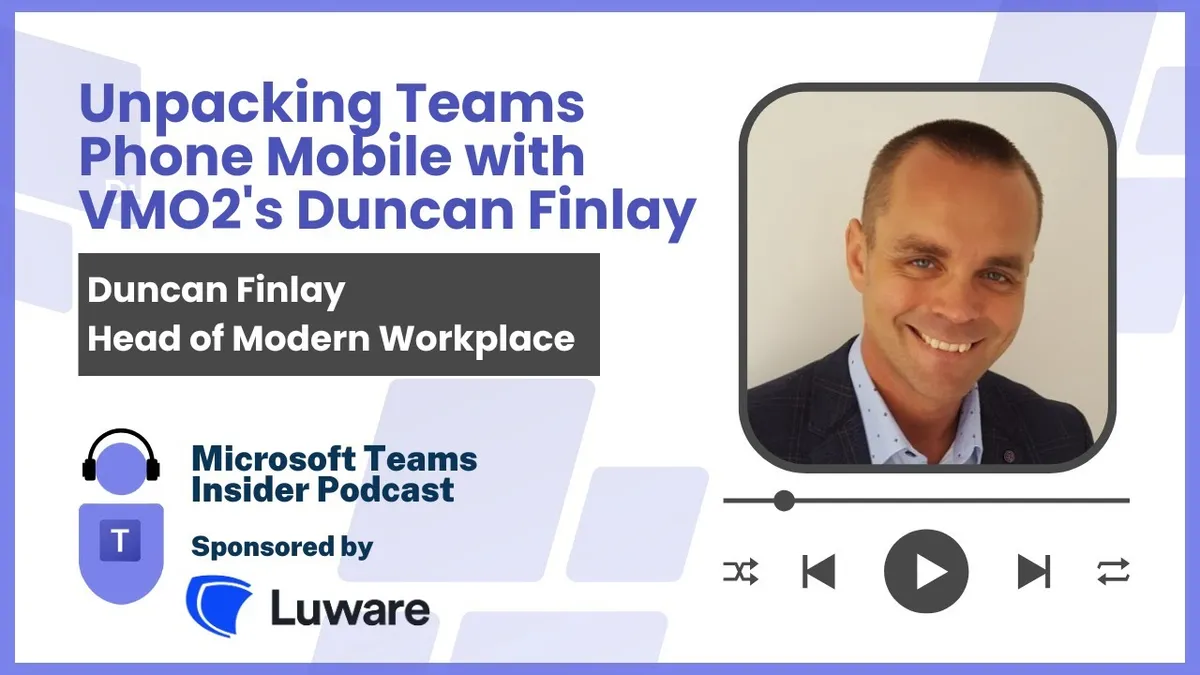
Unpacking Teams Phone Mobile with VMO2's Duncan Finlay
Duncan Finlay leads the modern workplace portfolio at Virgin Media O2, which has become the third UK operator to go live with Teams Phone Mobile. He talks through the commercial pitch, why the total cost of ownership argument beats a feature list, the personas the service suits, and the…
Prefer audio?
Who should listen: Microsoft 365 service owners weighing up Teams Phone Mobile against operator connect or direct routing, UC architects planning PSTN and legacy voice switch-off migrations, and telco/partner sales teams building the business case for fixed-mobile convergence.
Guest: Duncan Finlay — Head of Modern Workplace Portfolio, Virgin Media O2
Duncan Finlay leads the modern workplace portfolio at Virgin Media O2, which has become the third UK operator to go live with Teams Phone Mobile. He talks through the commercial pitch, why the total cost of ownership argument beats a feature list, the personas the service suits, and the PingCo-built automation engine behind VMO2's provisioning.
Many thanks to Luware, sponsor of this episode.
Key insights
- The VMO2 modern workplace portfolio spans legacy voice network products being switched off, IP voice, UC and contact centre, and managed mobility, plus Copilot, Intune and Defender work with Microsoft — deliberately positioned as persona-based propositions (field worker, hybrid worker) rather than product silos. ▶ 5:39
- Finlay argues the winning opening line is total cost of ownership, not features: customers already pay for Microsoft licences and mobile, so a small incremental fee lets them strip out ISDN, SIP, on-prem PBX, associated licences and desk phones. Leading with 'uplift calls and CLI' loses the room. ▶ 15:23
- Tom notes Teams Phone Mobile typically carries a carrier uplift of roughly four to ten dollars per user per month, which is why adoption has been slower than expected — the business case has to be built on operational saving and one-number management, not the feature set. ▶ 14:52
- The licensing arithmetic behind the opportunity: ~20 million Teams Phone monthly active users against 40 million-plus E5 seats, implying roughly 20 million users already entitled to Teams Phone who have not activated it — many likely mobile-first rather than fixed-line heavy. ▶ 11:47
- Over 60% of VMO2's customer base is dealing with a legacy technology transition right now — 3G switch-off, PSTN/legacy voice switch-off, or IPVPN to SD-WAN migration — and that transition trigger is the natural entry point for the Teams Phone conversation. ▶ 10:45
- The single biggest market education problem is customers replying 'I've already got it' — confusing Teams Phone Mobile with the Teams mobile app. Finlay's advice is to start by explaining what it isn't, then cover native network integration: single presence, single voicemail, moving calls between Teams and the handset. ▶ 20:29
- VMO2 partnered with Microsoft accelerator partner PingCo to build an automation engine over Operator Connect and Teams Phone Mobile, fully automating setup and MACD from a single pane of glass — Finlay's pitch is 'up and running in minutes, not months'. ▶ 22:33
- Tom's observation on where the difficulty has moved: Lync/Skype projects were six weeks of design and a twelve-month server rollout with telco connection comparatively easy; now the UCaaS platform is credit-card deployed and the hard part is gateways, lines, number porting and telco rules. ▶ 26:37
Insights summarised by AI from the episode transcript, reviewed by the Empowering.Cloud team.
Listen: Apple Podcasts · Spotify · Other platforms


Comments ()