Unifying UCaaS and CCaaS: Teams Phone Extensibility, Unify and Dynamics 365 Contact Center
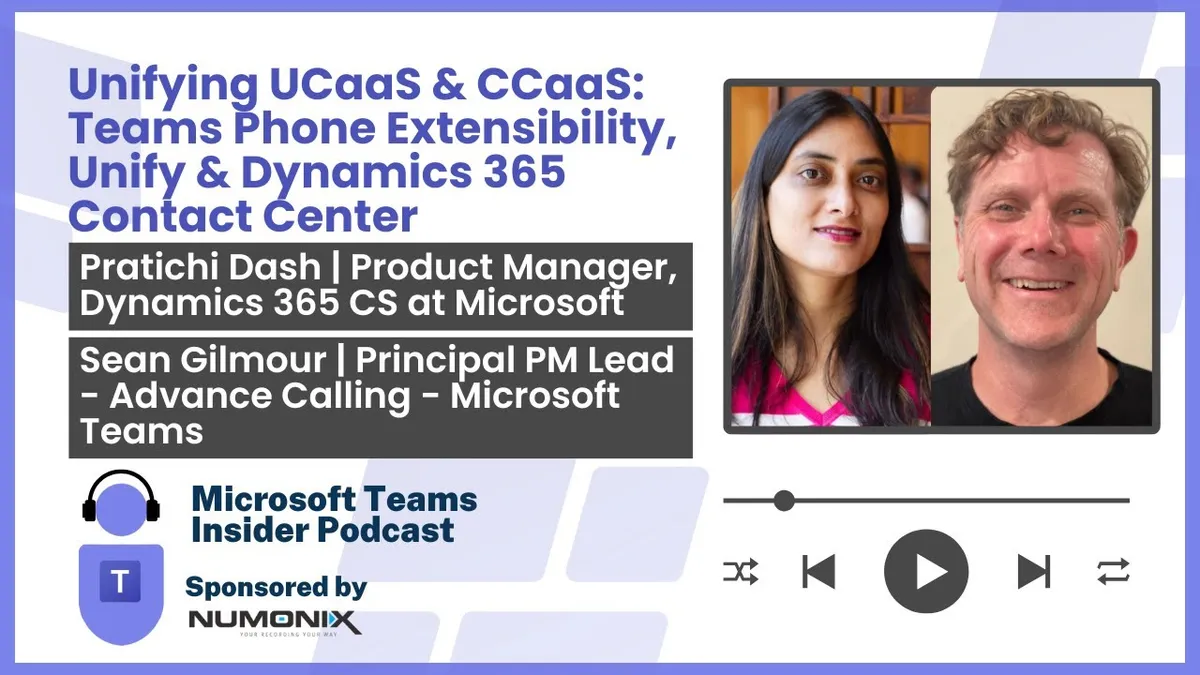
Sean Gilmour, Principal Product Manager Lead for Advanced Calling in Microsoft Teams, and Pratichi Dash, Product Manager for Dynamics 365 Contact Center Voice and Conversational AI, unpack what Teams Phone Extensibility (TPE) and the Unify certification actually are and how they differ.
Prefer audio?
Who should listen: Microsoft 365 service owners, Teams Phone and voice architects, and contact centre leads evaluating Teams-integrated CCaaS models (Connect, Extend, Unify) or planning a Dynamics 365 Contact Center telephony design.
Guest: Sean Gilmour and Pratichi Dash — Principal Product Manager Lead, Advanced Calling (Microsoft Teams); Product Manager, Dynamics 365 Contact Center Voice and Conversational AI, Microsoft
Sean Gilmour, Principal Product Manager Lead for Advanced Calling in Microsoft Teams, and Pratichi Dash, Product Manager for Dynamics 365 Contact Center Voice and Conversational AI, unpack what Teams Phone Extensibility (TPE) and the Unify certification actually are and how they differ. They cover Dynamics 365 Contact Center's move onto TPE, coexistence with Azure PSTN and Azure Direct Routing, and where AI, intelligent IVR and citizen agents fit next.
Many thanks to Numonix, sponsor of this episode.
Key insights
- TPE is the technology layer (built on Azure Communication Services) that extends Teams Phone to non-Teams clients; Unify is the certification you take that integration through. Unify is the successor to the Power model, which was always the promise of ACS integrated into Teams Phone. ▶ 3:37
- The driver is a single phone system with one administrative surface — shared policy, emergency calling and (over time) compliance recording configured once rather than twice across contact centre and Teams. ▶ 2:37
- Certified Unify partners so far include Landis, Edify and AudioCodes, with more in the pipeline; Microsoft says there are no plans to deprecate or end-of-life Connect or Extend, as all three programmes serve distinct customer needs. ▶ 4:09
- Dynamics 365 Contact Center launched on ACS Direct Offer and Direct Routing, then shipped TPE support in August; the win is reusing an existing Teams Phone estate and Operator Connect carrier relationships (now ~115 operators) instead of standing up a second set of SBCs and trunks. ▶ 7:14
- Azure PSTN and Azure Direct Routing will coexist with TPE for the foreseeable future, but Microsoft is strongly recommending TPE as the primary telephony path for new Dynamics 365 Contact Center deployments. ▶ 8:45
- Dynamics 365 Contact Center is going through the same Unify certification as third-party vendors — no inside track on ACS capabilities — which Microsoft frames as a platform-company level playing field, and means features requested by the Dynamics team benefit the whole ecosystem. ▶ 9:47
- Practical AI today is agent-assist: Copilot alongside the human agent with conversation summaries, translation and guidance, addressing agent turnover and training cost, with the fully self-serve voice agent/IVR loop maturing alongside it. ▶ 16:27
- The Queues app is explicitly not a contact centre — it is positioned for back-office 'citizen agents' at level two/three whose job is not full-time call handling; at-scale, single-pane-of-glass needs point to a certified contact centre. ▶ 21:35
- Future TPE endpoints go beyond contact centre: third-party intelligent IVRs, auto attendants and attendant consoles could fan calls out to CCaaS or UCaaS endpoints, including transfers between two different vendor endpoints (for example a Dynamics region to a Landis region) without routing through a Teams client. ▶ 19:32
- A Forrester Total Economic Impact study on Teams Phone Extensibility is publicly available, citing around 345% ROI over three years plus reduced downtime and faster setup. ▶ 26:12
Insights summarised by AI from the episode transcript, reviewed by the Empowering.Cloud team.
Listen: Apple Podcasts · Spotify · Other platforms



Comments ()