Understanding E911 in Microsoft Teams with Eric Marsi
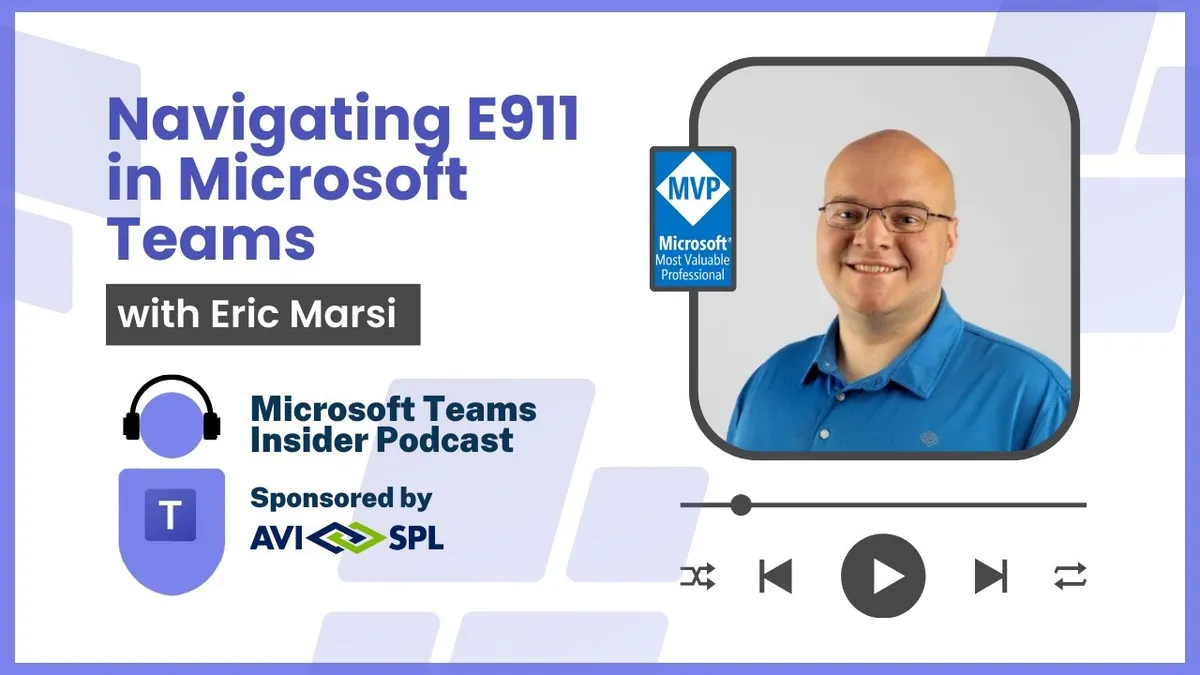
Eric Marsi, a multi-time Microsoft MVP and senior Microsoft consultant at ConvergeOne, walks through how E911 works in Microsoft Teams Phone — from US federal and state law through to the dynamic location matching order of BSSID, switch port, switch chassis and subnet.
Prefer audio?
Who should listen: Microsoft 365 service owners, UC architects and consultants deploying Teams Phone in the United States, plus network teams responsible for the wireless, switching and subnet data that underpins dynamic emergency calling.
Guest: Eric Marsi — Senior Microsoft Consultant and Microsoft MVP (M365 Apps & Services), ConvergeOne
Eric Marsi, a multi-time Microsoft MVP and senior Microsoft consultant at ConvergeOne, walks through how E911 works in Microsoft Teams Phone — from US federal and state law through to the dynamic location matching order of BSSID, switch port, switch chassis and subnet. He also covers emergency calling policies, external lookup mode, and the liability consultants and organisations carry if the configuration is wrong.
Many thanks to AVI-SPL, sponsor of this episode.
Key insights
- The US has the strictest emergency calling laws of any country, and states layer their own requirements on top of federal law — Carrie's Law and RAY BAUM's Act are the two federal anchors, so check state-specific rules before designing any location database. ▶ 2:01
- Around 90% of customers Marsi migrates had a legacy phone system that supported E911 but never deployed it, so the bar rises sharply at the point of moving to Teams rather than staying the same. ▶ 3:02
- Teams direct routing needs a certified E911 provider (Intrado ERS, RedSky or Bandwidth) as the middleman to the PSAPs. If the location is dynamically known, Intrado routes straight to the nearest PSAP; if it isn't, the call is screened by Intrado's global call centre to establish the address first. ▶ 3:33
- Teams matches location in a fixed order — BSSID, then switch port (via LLDP), then switch chassis ID, then subnet — and every match must ALSO match a configured external public IP, otherwise a home 192.168.0.0/24 could be mistaken for a corporate network of the same range. ▶ 13:48
- BSSID data entry varies by vendor: Cisco Meraki derives BSSIDs such that every single one must be added per access point, while Cisco Catalyst or Aruba APs allow a single MAC with a wildcard. Assume four BSSIDs per AP where you have two SSIDs across 2.4GHz and 5GHz radios. ▶ 7:37
- Civic address = the building (street address plus lat/long); locations = sublocations within it. A single-floor building under 60,000 sq ft needs no location; above 60,000 sq ft federal rules require the floor to be split (e.g. sixth floor north/west/east). Chicago, Illinois drops that threshold to 40,000 sq ft. ▶ 8:39
- Design new buildings with a subnet per floor rather than relying on LLDP — LLDP is a bandaid that can fail, port assignments get changed by junior network engineers, and subnet-per-floor also improves CQD reporting and other Teams Admin Center features. ▶ 14:18
- Exclude full-tunnel VPN pools and VDI subnets from the Teams location database, otherwise every remote user worldwide is reported as sitting in the corporate office hosting the VPN concentrator or virtual desktops. ▶ 16:19
- Build an emergency calling policy per site so local security or reception get the high-priority Teams notification showing who called, from what number and which floor, plus a global catch-all policy for users whose location can't be determined. Enable external lookup mode so remote users can confirm an address via Windows Location Services or manual entry. ▶ 17:50
- Marsi will not enable a user for Teams Voice — even in a pilot — until E911 data is in place; there have been multiple US cases where individuals were tried and found guilty for misconfiguration. Take a backup of the tenant's emergency configuration at project handover as a point-in-time record. ▶ 21:25
Insights summarised by AI from the episode transcript, reviewed by the Empowering.Cloud team.
Listen: Apple Podcasts · Spotify · Other platforms


Comments ()