Understanding AI Assisted Tech and the European Accessibility Act
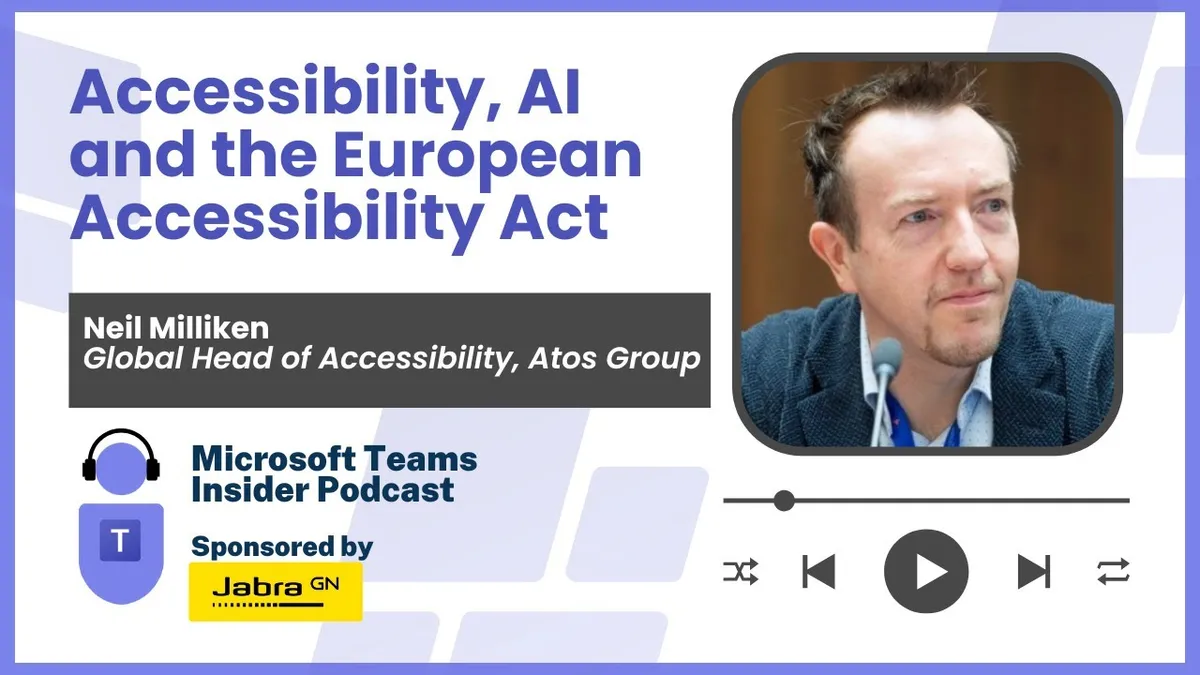
Neil Milliken, Global Head of Accessibility at Atos and co-host of the AXSChat podcast, has spent 25 years in assistive technology and now owns accessibility policy, compliance and services for the French-headquartered digital transformation group.
Prefer audio?
Who should listen: Microsoft 365 service owners, UC/AV procurement leads and IT compliance teams who need to understand accessibility requirements in device and software selection, and anyone assessing their organisation's exposure to the European Accessibility Act.
Guest: Neil Milliken — Global Head of Accessibility, Atos
Neil Milliken, Global Head of Accessibility at Atos and co-host of the AXSChat podcast, has spent 25 years in assistive technology and now owns accessibility policy, compliance and services for the French-headquartered digital transformation group. He explains how AI-era features such as dictation and captions moved from niche assistive tools to mainstream productivity, and what the European Accessibility Act means for private sector organisations and their supply chains.
Many thanks to Jabra, sponsor of this episode.
Key insights
- Speech recognition persisted for 25 years in only three user groups — the judiciary, doctors and people with disabilities — because each had a strong enough reason to tolerate clunky training-based systems. Those niche use cases became the foundation of today's natural language interfaces. ▶ 4:40
- Audio input quality is now a productivity issue, not just an accessibility one: better sound in means better recognition accuracy, which directly affects the quality of meeting transcripts and AI-generated notes. ▶ 8:47
- Hearing support is converging with enterprise audio — headsets that run a hearing test and match output to the user's ear acoustics, and hearing aids that Bluetooth-connect directly to a phone so audio streams straight into the aid during a Teams call. Hearing tech still lags vision, where most existing accessibility standards focus (screen readers, low/no vision). ▶ 11:18
- Headset selection should be need- and context-based rather than one-size-fits-all: over-ear noise cancelling for distractible users in open-plan offices, buds for travel, a desktop microphone for home working. Milliken pairs headsets with white noise apps to protect flow. ▶ 13:53
- Design for three disability types — permanent, temporary (an injury) and situational (carrying shopping, driving). The interaction pattern is identical whichever applies, which is why accessibility features have a far wider user base than expected. ▶ 15:55
- The European Accessibility Act is a market access directive covering computers, operating systems, mobile devices, banking and retail systems across private as well as public sector. Non-conformance with EN 301 549 — including packaging and instruction manuals — means no CE certificate and no right to sell into the EU. UK organisations serving EU citizens are still in scope. ▶ 17:26
- Firms claiming they are out of scope because they don't sell direct will still be caught by contractual flow-through: their customers are already embedding EAA requirements into RFIs and RFPs, creating a halo effect beyond Europe. ▶ 20:32
- Start with free tooling and IAAP guidance rather than panic-buying consultancy; automated checkers mainly cover websites and only go so far. The most common systemic failure is colour contrast in marketing-owned brand style guides — legibility is the single biggest accessibility issue. ▶ 24:40
Insights summarised by AI from the episode transcript, reviewed by the Empowering.Cloud team.
Listen: Apple Podcasts · Spotify · Other platforms



Comments ()