Truly Working from Anywhere with Teams Phone Mobile
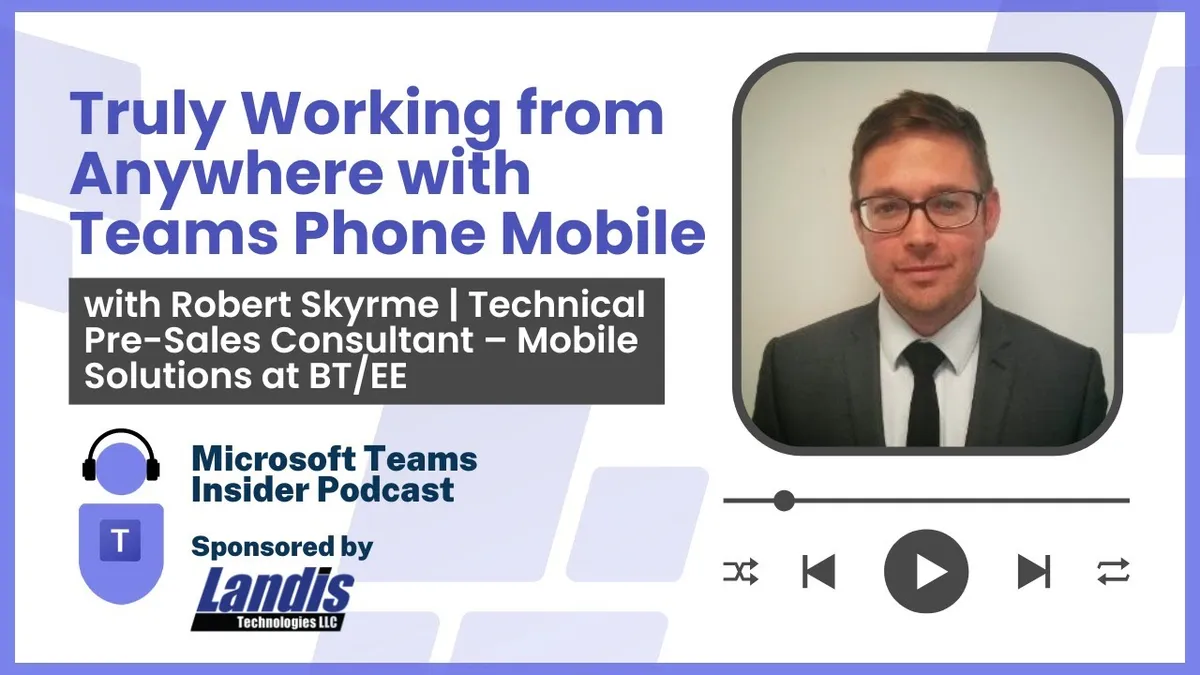
Robert Skyrme is a technical pre-sales consultant for mobile solutions at BT/EE who has worked on Teams Phone Mobile since its launch. He and Tom Arbuthnot cover how the network-level integration actually works, licensing and eSIM provisioning, minute consumption and cost, and the customer use…
Prefer audio?
Who should listen: Microsoft 365 service owners, UC architects and telecoms managers evaluating mobile-first voice strategies, mobile compliance recording, or how Teams Phone Mobile fits alongside existing Operator Connect and direct routing deployments.
Guest: Robert Skyrme — Technical Pre-Sales Consultant, Mobile Solutions, BT/EE
Robert Skyrme is a technical pre-sales consultant for mobile solutions at BT/EE who has worked on Teams Phone Mobile since its launch. He and Tom Arbuthnot cover how the network-level integration actually works, licensing and eSIM provisioning, minute consumption and cost, and the customer use cases BT is seeing in the field.
Many thanks to Landis, sponsor of this episode.
Key insights
- Teams Phone Mobile is not the Teams mobile app — it merges the mobile identity with Teams so the 07 mobile number becomes the single number across the native dialler, desktop, laptop and any signed-in Teams endpoint, removing the second number and second voicemail. ▶ 2:02
- The integration happens at the mobile network core: calls are handled by the mobile network and passed into Teams Phone System, so every call — including native dialler to native dialler — inherits Teams features such as presence and compliance recording. ▶ 4:36
- Calls can be migrated mid-call between the native dialler and Teams (to add video or content sharing) without breaking continuity, and compliance recording follows each leg, so recordings do not need to be reassembled after the fact. Both parties must be Teams Phone Mobile users to escalate to a Teams call. ▶ 6:37
- BYOD is supported for the handset but not the SIM — the organisation must supply a business SIM. eSIM makes this easy: a secondary Teams Phone Mobile line can be pushed remotely, and a drop-shipped corporate device can be unboxed, activated with work credentials, pull down the eSIM and MDM policies, and be live in minutes with no IT involvement. ▶ 10:10
- On Microsoft licensing, the Teams Phone licence (included in E5) is all that's needed — the separate zero-cost legacy SKU previously required to activate has been folded into the Phone System licence. BT then applies a per-month 'enabler' (deliberately not called a licence) that publishes the mobile number into Teams admin centre for assignment. ▶ 13:15
- Provisioning is comparable to Operator Connect — no SBCs or IP addressing, just a couple of clicks — a marked contrast to traditional Teams voice deployments. BT will take deals from two users up to 20,000, with commercials shifting by scale. ▶ 12:45
- Skyrme is cautious on hard cost savings: outbound Teams soft-phone calls now consume mobile minutes (Teams-to-Teams and Wi-Fi calls do not), and any savings are more likely to come from productivity and dropping legacy SIP trunks or separate mobile recording systems than from the bill itself. ▶ 16:50
- Beyond the obvious field, sales and engineering worker use cases, demand is coming from compliance-driven teams (finance, legal) who previously paid for a separate mobile recording system, and from organisations wanting all call records in Teams for CRM integration such as Dynamics. It is not all-or-nothing — direct routing or Operator Connect can stay for static desk users. ▶ 18:55
Insights summarised by AI from the episode transcript, reviewed by the Empowering.Cloud team.
Listen: Apple Podcasts · Spotify · Other platforms


Comments ()