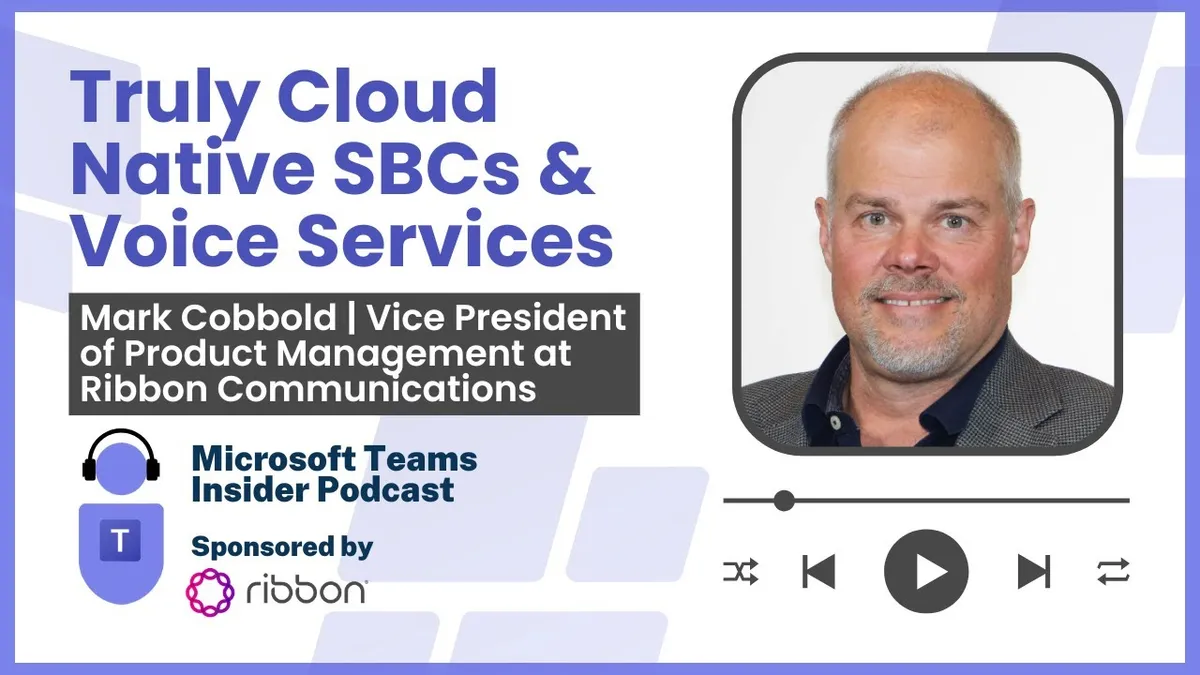
Truly Cloud Native SBCs and voice services with Mark Cobbold at Ribbon
Mark Cobbold, Vice President of Product Management at Ribbon, draws on a career spanning Bell Northern Research, Nortel and Genband to explain how voice networks are moving from physical and virtualised deployments to genuinely cloud-native architectures.
Prefer audio?
Who should listen: Microsoft 365 voice service owners, telco and Operator Connect engineering teams, and UC architects planning a move from physical or virtualised SBCs to containerised, continuously updated voice infrastructure.
Guest: Mark Cobbold — Vice President of Product Management, Ribbon
Mark Cobbold, Vice President of Product Management at Ribbon, draws on a career spanning Bell Northern Research, Nortel and Genband to explain how voice networks are moving from physical and virtualised deployments to genuinely cloud-native architectures. The conversation covers microservices and Kubernetes, public versus private cloud choices for carriers and enterprises, security patching cadence, observability, and the shift from capex to opex.
Many thanks to Ribbon, sponsor of this episode.
Key insights
- Cloud-native does not mean public cloud only — carriers and enterprises run the same containerised functions in private data centres, public cloud or hybrid, with the decision driven by expansion speed and data residency regulation rather than technology. ▶ 5:38
- Products are built so workloads can be repatriated: a core network can sit in a private cloud in the home country while satellite countries spin up in public cloud, then consolidate later. ▶ 7:11
- The CI/CD, test automation and orchestration tooling comes straight from the IT domain, so IT skill sets are now directly portable onto telecom networks — a common toolchain spans private and public cloud deployments. ▶ 7:41
- NIST publishes around 30,000 vulnerabilities a year across the industry; underlying components such as Red Hat Linux need continuous patching, so the old 'get it working then patch once a year' model creates a technical deficit that becomes very hard to dig out of. ▶ 9:12
- Migration testing uses digital twinning to map lab configuration to production, extracting real production call flows and applying machine learning to reduce them to a unique set of test cases for full coverage. ▶ 13:17
- Observability runs on two tracks: a Prometheus backbone collecting fault data from the microservices architecture, and the Ribbon Analytics data lake combining CDRs, call flows and fault reports — with a 'Most Probable Cause' application correlating them to point at the offending network element. ▶ 14:18
- Customers on cloud-native report rolling a new feature across an entire network in three months and a software fix in a week; critical security fixes go out in days, and graveyard-shift maintenance windows disappear. ▶ 16:53
- Commercially it moves capex to an annualised opex model comparable to Microsoft 365 licensing, freeing capital for revenue-generating projects rather than the telecoms network itself. ▶ 15:21
- Kubernetes finally delivers the scale-in/scale-out and lifecycle management that VNF orchestrators never achieved — early virtualisation was effectively one-to-one with hardware. ▶ 21:28
- Ribbon Connect Plus is being built as an SBC-as-a-service offering in public or private cloud so customers do not need to build their own cloud infrastructure; the existing Call Trust service already runs cloud-native on AWS with its own CI/CD pipeline. ▶ 23:01
Insights summarised by AI from the episode transcript, reviewed by the Empowering.Cloud team.
Listen: Apple Podcasts · Spotify · Other platforms


Comments ()