Trends in UCaaS and AI with Craig Durr and Kevin Kieller
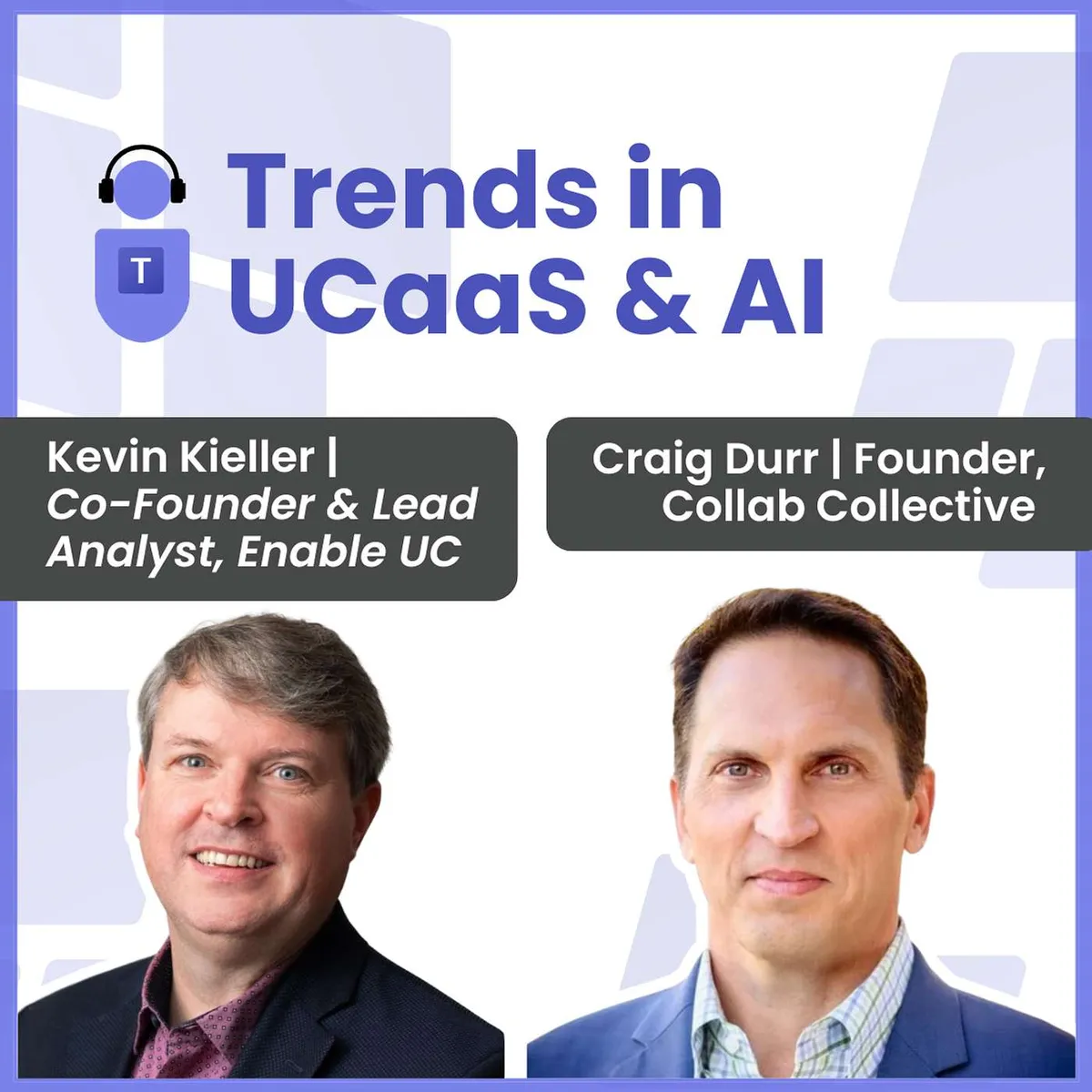
Analysts Kevin Kieller (EnableUC, BC Strategies) and Craig Durr (The Collab Collective) join Tom Arbuthnot live from Comms vNext to compare how the major UCaaS vendors are approaching AI.
Who should listen: Microsoft 365 service owners, UC architects and collaboration leads evaluating AI assistants across Teams, Zoom and Webex, and anyone having to explain Copilot licensing and its limitations to business stakeholders.
Guest: Kevin Kieller and Craig Durr — Co-founder, EnableUC / BC Strategies lead; Chief Analyst and founder, The Collab Collective, EnableUC / The Collab Collective
Analysts Kevin Kieller (EnableUC, BC Strategies) and Craig Durr (The Collab Collective) join Tom Arbuthnot live from Comms vNext to compare how the major UCaaS vendors are approaching AI. The conversation covers context versus model quality, Copilot licensing confusion, usage-based versus outcome-based AI pricing, and why user trust — not features — will decide adoption.
Many thanks to SCB Global, sponsor of this episode.
Key insights
- Kieller argues the AI race is no longer about model quality but about context: retrieval-augmented grounding in a customer's own content makes it "Microsoft's race to lose" for organisations with most of their business data in SharePoint, Exchange and Outlook. Cisco Webex and Zoom are both leaning on Glean to pull that enterprise context in.
- Grounding consistency is a practical trust issue: ask Zoom's AI Companion sidebar for next Friday's weather in Toronto mid-meeting and it answers, whereas Copilot in a meeting is not web-grounded and refuses. End users read that inconsistency as unreliability, not as a design boundary.
- Arbuthnot's view of vendor positioning: Zoom optimises for simplicity (security, simplicity, smart), Microsoft for security and sophistication — solving a problem five different ways, which shows up as multiple differently-scoped Copilots. Google is topping model charts with Gemini 2.5 Pro but failing to land the product conversation.
- Very few enterprises can accurately articulate the difference between Microsoft Copilot (consumer), M365 Copilot Chat (included, enterprise-secure, document upload) and the $30 per user Copilot licence — and many still haven't rolled out the free, licence-included Copilot Chat as a safe alternative to consumer AI tools.
- Monetisation is diverging: Zoom bundles AI Companion at no extra cost but is adding a $12 per user per month AI Companion personalisation SKU; RingCentral's AI receptionist and some Microsoft agents are consumption-based; Zendesk and Intercom charge on outcomes (no fee if a human has to intervene). Kieller opposes usage-based pricing because it creates unbounded liability and actively discourages adoption.
- Microsoft has said reasoning and deep research will be included in the Copilot licence at no additional cost, versus OpenAI's roughly 10 deep research runs on a $20 plan and 120 on the $200 plan — and Nvidia's Jensen Huang has said reasoning can cost ~100x standard inference, so watch how that load is absorbed.
- Intelligent Recap not being editable is called "a total fail" — the pitch is human-in-the-loop but the artefact can't be corrected and persists. By contrast the real-time facilitator agent, which co-edits notes that participants can fix in the moment, actively builds trust.
- Undocumented limits are the biggest trust killer: if Copilot only searches emails or chat back a certain number of days, that boundary needs to be in the docs, or better, surfaced by the assistant itself ("you're asking about meeting content but you're in Word, I can't reach that") rather than silently returning partial answers.
- Durr's framing for measuring AI pilots: score them on repeatable trust, not one-off results — did it give the right answer two or three times? Individual trust releases cognitive load, which scales to team and then organisational productivity; today the cut-and-paste between tools is where users lose faith and revert.
Insights summarised by AI from the episode transcript, reviewed by the Empowering.Cloud team.
Listen: Apple Podcasts · Spotify · Other platforms


Comments ()