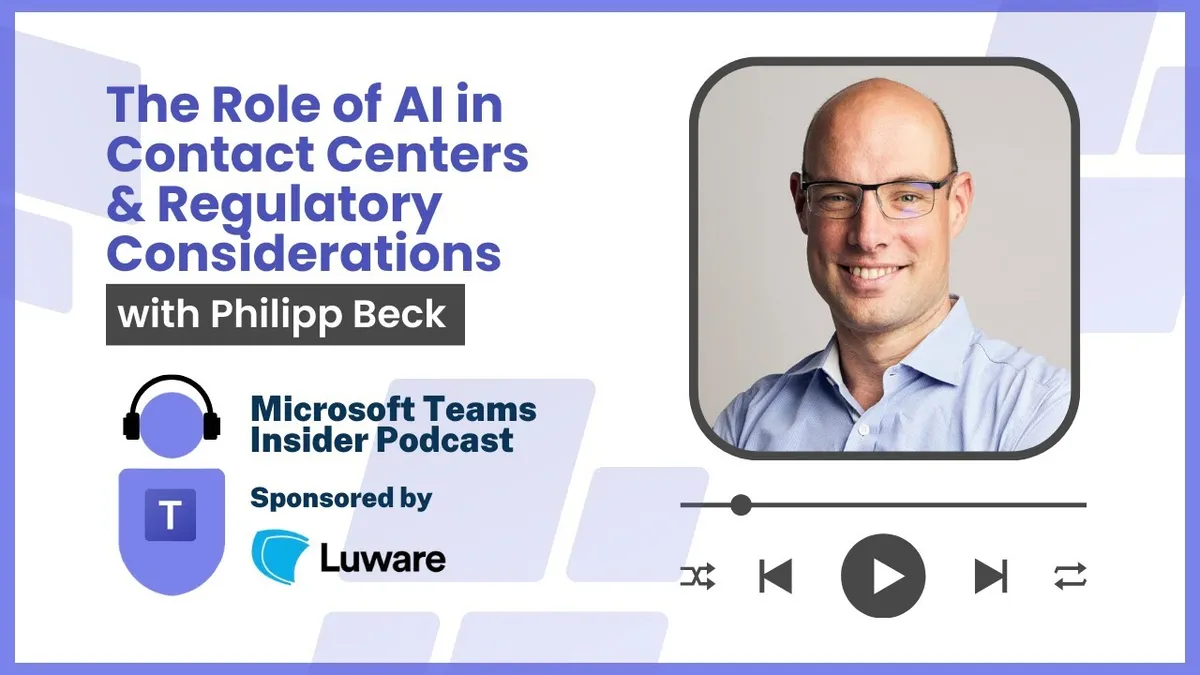
The Role of AI in Contact Centers and Regulatory Considerations with Philipp Beck
Philipp Beck, co-founder of Luware and its CEO for 14 years, talks through the company's rebuild from Skype for Business-era on-premises software to a cloud contact centre platform on the Microsoft stack.
Prefer audio?
Who should listen: Microsoft 365 service owners and UC architects evaluating Teams-integrated contact centre platforms, partners building contact centre practices, and anyone in a regulated industry weighing AI deployment against compliance and data-security requirements.
Guest: Philipp Beck — Co-founder and (outgoing) CEO, Luware
Philipp Beck, co-founder of Luware and its CEO for 14 years, talks through the company's rebuild from Skype for Business-era on-premises software to a cloud contact centre platform on the Microsoft stack. The conversation covers omnichannel feature velocity, the reality of achieving SOC 2 Type 2, Power Automate extensibility, and where AI genuinely adds value in customer service versus where it carries regulatory risk.
Many thanks to Luware, sponsor of this episode.
Key insights
- Rebuilding the platform from scratch for cloud took roughly 2.5 to 3 years before anything was sellable — but the shift means over 70% of Luware's revenue is now recurring rather than perpetual licence sales. ▶ 2:36
- Around 30–40 features shipped in a single year on the cloud platform, with omnichannel the theme: chat, external tasks, and email close behind. The same cadence would be impossible across roughly 7,800 customers on separately patched on-premises deployments. ▶ 4:39
- Rather than rebuild commodity capability, Luware consumes Azure Communication Services for chat and Azure text-to-speech — freeing developers to build contact centre-specific features instead of baseline plumbing. ▶ 5:40
- Getting a certified Power Automate connector through Microsoft's process took four to five months, but it lets customers wire in their own CRM and data lookups for routing decisions without vendor development work — and creates a services margin opportunity for partners beyond licence resale. ▶ 6:43
- Beck's rule of thumb on certification: with ISO 27001 you convince the auditor you're doing it right; with SOC 2 you have to prove it with collected evidence. It was a significant process change for a 130-person company, and filtering Microsoft's 24 certified contact centre providers by enterprise-grade SOC 2 Type 2 shortens the shortlist considerably. ▶ 10:45
- For the next couple of quarters the realistic AI payback is agent efficiency, not customer-facing bots: automated transcription with speaker separation, auto-summaries written into the CRM via Power Automate, and surfacing three candidate FAQ articles to get new starters productive faster. ▶ 14:48
- Use agents to validate AI-suggested answers first; only once accuracy is proven at scale should the bot be moved in front of the customer — and it must hand off cleanly to a human rather than guess when it doesn't know. ▶ 17:51
- Regulated industries face a specific AI problem: when a rule changes at midnight on 1 January, the model cannot keep answering from two years of historical training data. Both agree the only trustworthy approach today is building a second model, testing it exhaustively and cutting over. ▶ 20:27
- An emerging pattern worth watching: AI handling summaries and flagging upsell potential so humans are pulled in only for the revenue conversation — moving the contact centre from cost centre to revenue centre, since AI cannot read what a customer isn't saying. ▶ 24:33
Insights summarised by AI from the episode transcript, reviewed by the Empowering.Cloud team.
Listen: Apple Podcasts · Spotify · Other platforms

Comments ()