The role AV Distribution play in Microsoft Teams Rooms with Jenny Hicks
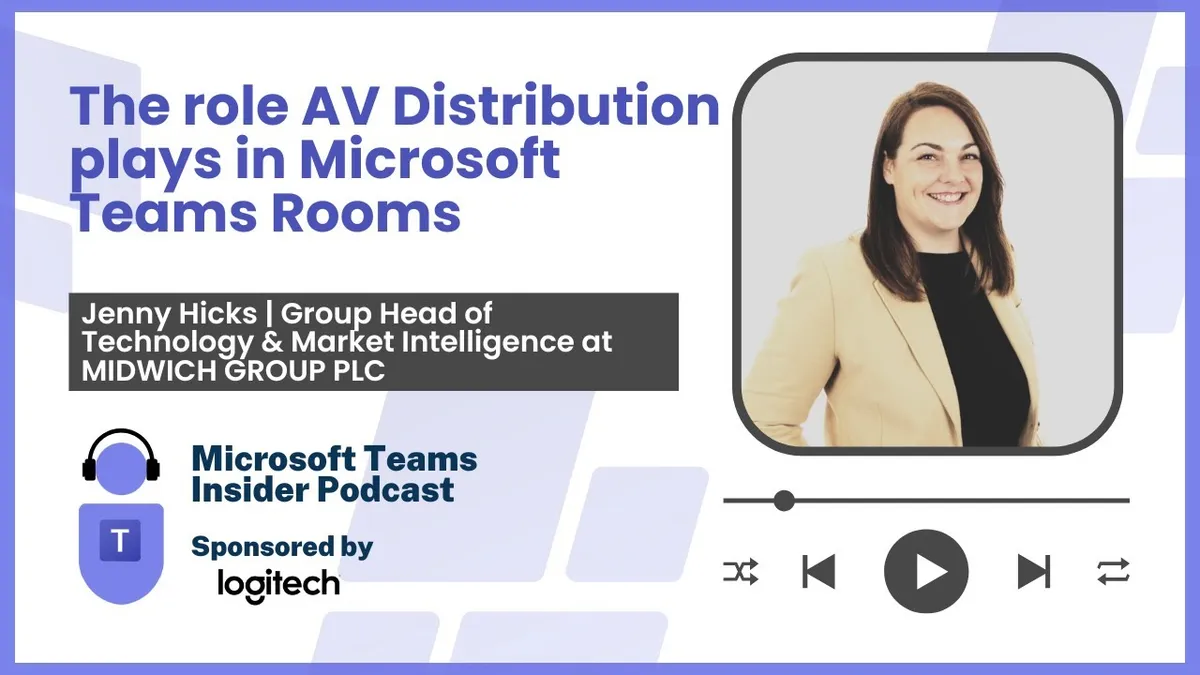
Jenny Hicks is Technical Director at Midwich UK, having moved from mainstream and technical AV into UC as the category became the distributor's second largest.
Prefer audio?
Who should listen: Microsoft 365 service owners and UC/AV professionals who buy or specify meeting room hardware, plus integrators and resellers wanting a clearer view of where distribution adds value and why estate refresh has stalled.
Guest: Jenny Hicks — Technical Director, Midwich UK
Jenny Hicks is Technical Director at Midwich UK, having moved from mainstream and technical AV into UC as the category became the distributor's second largest. She explains what AV distribution actually does for vendors, integrators and end customers, and gives a candid read on why the expected 2025 Teams Rooms refresh never arrived.
Many thanks to Logitech, sponsor of this episode.
Key insights
- Distribution's value to a hardware vendor is logistics plus a sales engine: no manufacturer can hold stock and staff sales teams in every country at an acceptable cost, and no integrator could hit its business volumes if it had to deal with every manufacturer in a system individually. Midwich segments by technology category so a divisional head can compare Logitech, Neat, DTEN and HP Poly in the same conversation. ▶ 10:52
- UC is now a platform-first sale — nine times out of ten the customer already knows the platform and 90% of the time that is Microsoft Teams. Microsoft is pro-distribution precisely because distribution supplies the hardware choice around that decision, and Midwich is extending the same model to software licensing via a marketplace currently live in DACH and planned to go global. ▶ 15:33
- The hardware/software asymmetry is the practical argument for multi-brand sourcing: a licence key can always be generated, but hardware runs out. Post-pandemic shortages taught partners to align to distributors rather than single brands so they never missed a deadline or a sale. ▶ 17:05
- Be cautious with the newest and cheapest video bar entrants — including camera makers coming out of consumer photography — because you cannot be sure they will still be there to support the estate in three or four years. Midwich deliberately curates a good/better/best line-up rather than collecting every available brand. ▶ 21:41
- Certification and the strength of the OEM–platform partnership matter more than headline price: one early bar vendor built its own control panel application, and every Teams update in that period broke something, leaving rooms unusable while the fix was escalated back to the US team. ▶ 22:42
- The refresh cycle predicted for 2025 — driven by the Windows end-of-support date, audio quality and Copilot adoption — simply has not materialised. Buyers are holding off on economic and political uncertainty, unresolved return-to-office space planning, and a reluctance to spend before the next wave of AI capability lands. ▶ 30:58
- ESG reporting is quietly suppressing refresh: replacing working kit only stacks up if energy consumption genuinely falls, there is almost no second-hand market for pre-loved meeting room equipment, and most decommissioned kit goes through standard WEEE rather than back to the manufacturer. Corporates and schools alike are increasingly saying 'if it ain't broke'. ▶ 36:10
- For boardrooms and large sales-floor rollouts today, specify the highest available specification or modular hardware with OPS-style slots — a revolutionary AI application demanding more local horsepower could be a week or two years away, and modular metal-cased systems are also easier to upgrade, repurpose and recycle for value. ▶ 39:42
Insights summarised by AI from the episode transcript, reviewed by the Empowering.Cloud team.
Listen: Apple Podcasts · Spotify · Other platforms


Comments ()