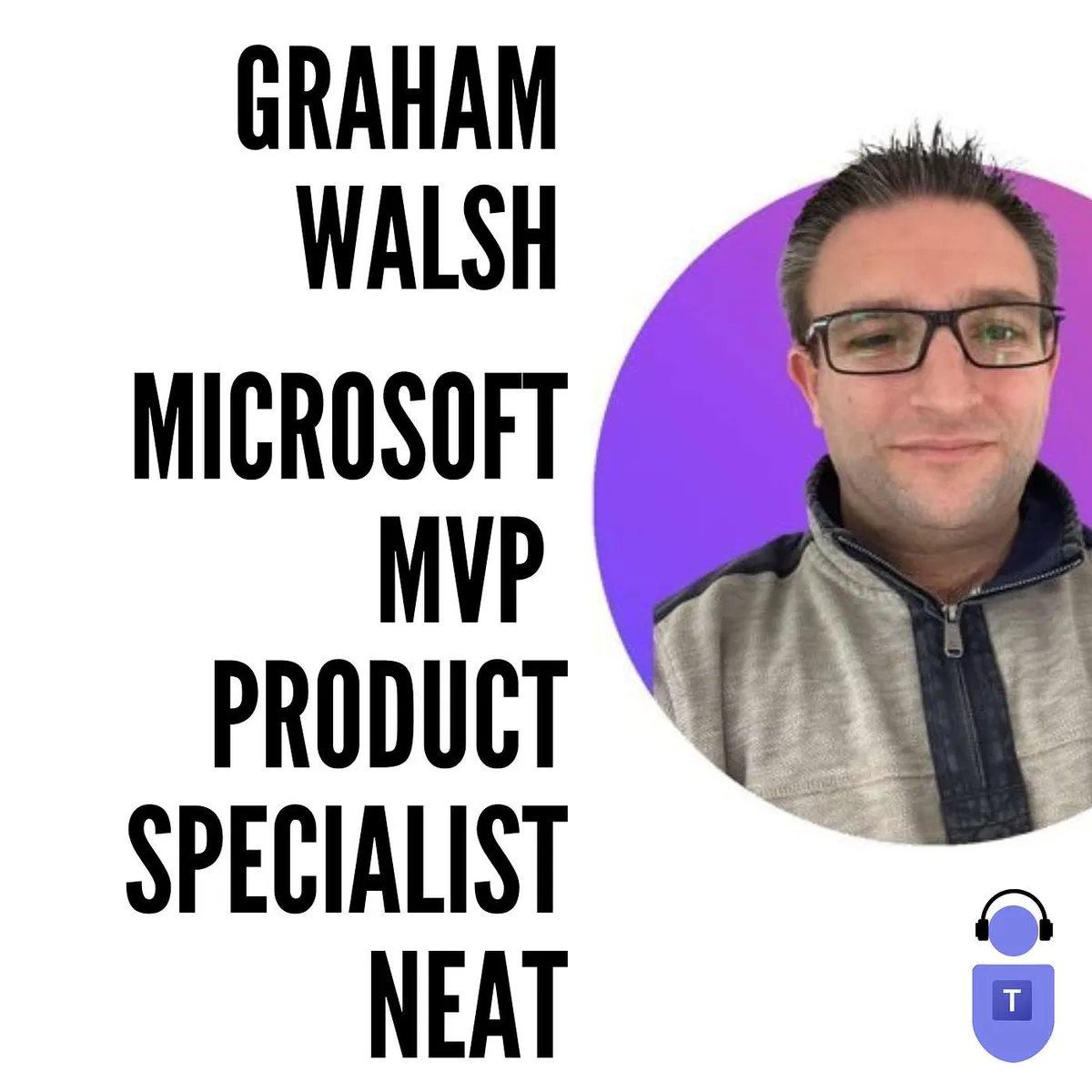
The Graham Walsh talks career, Neat Frame use cases and new Neat Center
Graham Walsh is a Microsoft MVP and Product Specialist at Neat, covering Microsoft Teams devices across EMEA. He walks through his route from telephony and Polycom to Pexip, Crestron and Neat, then digs into where the Neat Frame fits, how the Neat Bar Pro differs from the Bar, and what the…
Who should listen: Microsoft 365 service owners, UC and AV professionals specifying or retrofitting meeting room hardware, and anyone weighing Teams Displays, Android-based Teams Rooms or centre-of-room camera options.
Guest: Graham Walsh — Product Specialist / Strategic Alliances, EMEA, Neat
Graham Walsh is a Microsoft MVP and Product Specialist at Neat, covering Microsoft Teams devices across EMEA. He walks through his route from telephony and Polycom to Pexip, Crestron and Neat, then digs into where the Neat Frame fits, how the Neat Bar Pro differs from the Bar, and what the forthcoming Neat Center centre-of-room camera will add.
Many thanks to Neat, sponsor of this episode.
Key insights
- Neat went from the June 2021 Microsoft hybrid work announcement to a public Teams build in roughly six months, because the hardware already existed for Zoom — certification, TAP testing and customer validation took about three months, with Pad, Bar and Board first out at Enterprise Connect, followed by Bar Pro and Frame. ▶ 6:10
- Neat Frame sits in the Teams Display category, not Teams Rooms, so it behaves as a hybrid of a phone and a personal video device — signed in with a user's own licence for exec desks, or with the Teams shared device licence (around $8/month) for hot-desk booking, where users tap to reserve, sign in at their slot and are auto-signed-out at the end. ▶ 9:07
- Frame is missing direct guest join and proximity join; Walsh names both as his wishlist for the Microsoft product group, and warns practitioners not to mentally treat Frame as a small room system because it is a different stack. ▶ 11:15
- Bar Pro uses a next-generation chipset and two 50MP cameras (wide plus telephoto) to reach roughly 10–11 metres versus about 5 metres on the Bar, with a 16-beam microphone array — so room size and retrofit constraints, not spec sheets, should drive the choice. ▶ 12:29
- Bar Pro's USB port now accepts external audio: connect a DSP directly, or use a USB-to-Dante adapter for networked audio. Plugging in external audio disables the onboard mics and speakers entirely, so the room has to be properly mic'd — it is not a mix of both. ▶ 13:31
- Despite Android MTR's driver limitations, audio devices and third-party touchscreens (Samsung, LG, Yamaha) work over standard HID, so no vendor drivers are needed to attach a DSP or touch display to a Bar or Bar Pro. ▶ 15:05
- Neat Center is an additional camera rather than a replacement: three cameras stitched for 360-degree coverage plus 16 microphones, single PoE LAN connection, and it pairs over the network (same VLAN) to a Bar, Bar Pro or Board rather than cabling directly. Intelligence switches to the front-of-room camera when someone walks to the Board to whiteboard, sending one composed stream into Teams. ▶ 21:32
- Voice-activated meeting start has seen little real-world adoption — smart speaker attribution needs proactive voice enrolment, enterprises are wary of voice prints, and Walsh argues proximity join from a user's own device is the more reliable pattern given accuracy has to be near 100% for business users. ▶ 26:47
Insights summarised by AI from the episode transcript, reviewed by the Empowering.Cloud team.
Listen: Apple Podcasts · Spotify · Other platforms


Comments ()