Telco Infrastructure Evolution - Automation, AI and Containerisation Explained
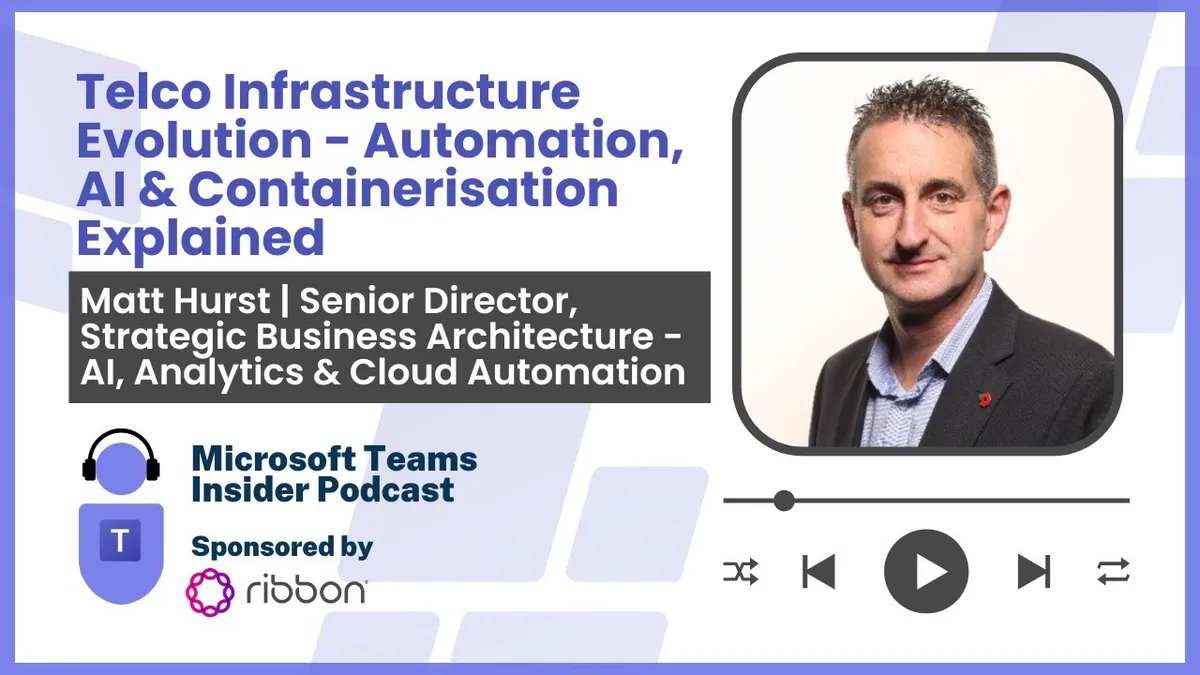
Matt Hurst, Senior Director for Ribbon's AI and automation practice, talks to Tom Arbuthnot about how containerisation, DevOps pipelines and AI are reshaping carrier and large-enterprise voice infrastructure.
Prefer audio?
Who should listen: Telco and service provider architects, Operator Connect and UCaaS providers, and enterprise voice or network teams responsible for SBC estates, patching and security compliance who want a practical grounding in containerisation, infrastructure as code and AI-assisted operations.
Guest: Matt Hurst — Senior Director, AI and Automation Practice (Strategic Business Architecture), Ribbon
Matt Hurst, Senior Director for Ribbon's AI and automation practice, talks to Tom Arbuthnot about how containerisation, DevOps pipelines and AI are reshaping carrier and large-enterprise voice infrastructure. He breaks down what containerisation actually means for an SBC, where automation delivers measurable savings, and why security operations and skills shortages are driving adoption.
Many thanks to Ribbon, sponsor of this episode.
Key insights
- Traditional telco upgrade cycles are the problem automation is aimed at: a full network software upgrade typically takes six to 18 months, which is incompatible with the pace at which Operator Connect and UCaaS providers now need to launch and compete. ▶ 3:04
- The evolution path is physical appliance to VNF (same software stack, just running on a COTS Dell or HP server) to containerised pods, where a session border controller is broken into separate signalling, transcoding and management components that can each be scaled independently. ▶ 5:36
- Transcoding is the classic case for elastic scaling: instead of sizing hardware for peak concurrency and carrying permanent slack, automation learns traffic patterns over time and adds transcoding pods for the daily peak, then spins them back down. ▶ 8:39
- Containerisation is not the same as public cloud. Because Kubernetes is available in both public and private environments, operators can run public cloud in one country and their own data centre in another using the same architecture, avoiding lock-in to either model. ▶ 9:40
- Infrastructure as code means the Git repository, not a six-month-old backup, is the source of truth. Containers pull their configuration on spawn, and the automation stack can periodically compare live devices against the repo to flag or automatically revert manual changes. ▶ 11:44
- The TM Forum defines seven levels of automation from fully manual to fully autonomous networks, and every Ribbon customer sits somewhere on that scale. Tier one European operators are committed to autonomous operation, with the goal of freeing operations staff from manual patching and testing rather than removing headcount. ▶ 14:49
- Test automation builds a digital twin of the network in a lab, and traffic-pattern learning distils real usage into roughly the 500 most typical call flows (refers, internal, external, call hold) as automated test scripts to run against a new software load before production rollout. ▶ 21:55
- With SBC skills thinning out to one or two people in many enterprises, an LLM chatbot trained on vendor documentation plus customer domain knowledge and hooked into the trouble ticketing system lets a junior engineer ask what a 504 error means and where to look next, with full-stack correlation down to a failed router or high memory utilisation. ▶ 23:55
- Engagements start consultatively and deliberately small: identify the business pain, prove ROI on one automation objective rather than attempting a big bang, then scale once the customer sees the benefit. ▶ 17:51
Insights summarised by AI from the episode transcript, reviewed by the Empowering.Cloud team.
Listen: Apple Podcasts · Spotify · Other platforms


Comments ()