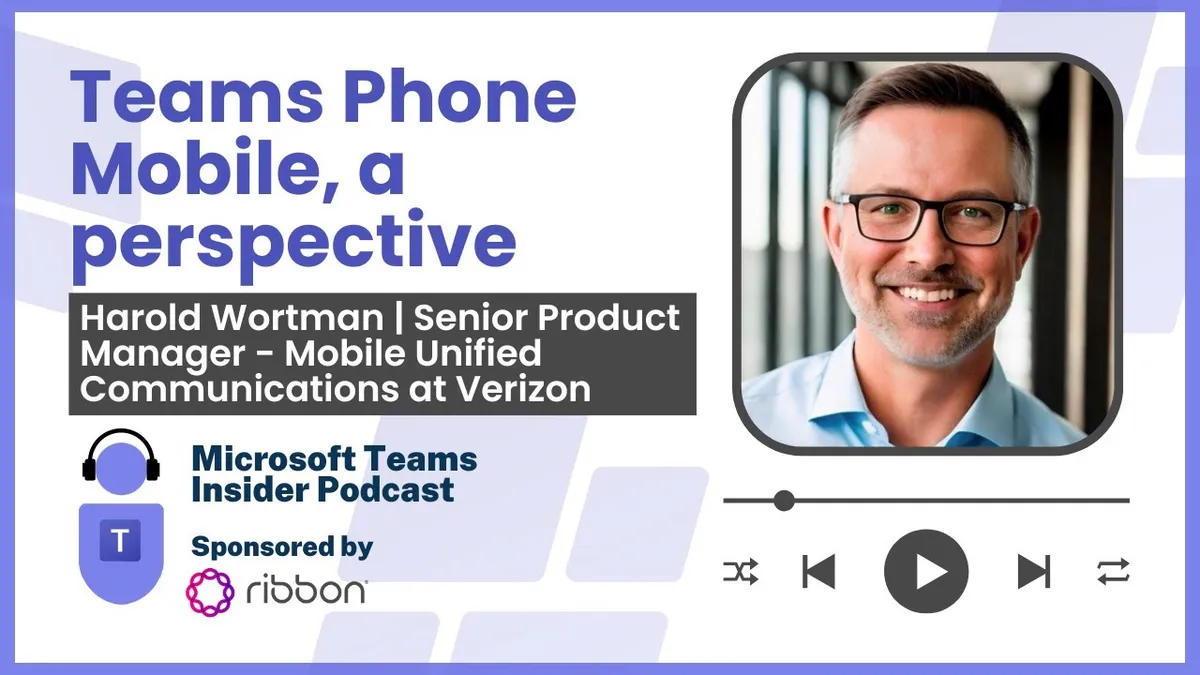
Teams Phone Mobile, a perspective from Harold Wortman, Senior Product Manager, Verizon
Harold Wortman manages Verizon Mobile for Microsoft Teams, Verizon's Teams Phone Mobile offer, and has been involved since the earliest proofs of concept.
Prefer audio?
Who should listen: M365 service owners and telephony leads evaluating Teams Phone Mobile, particularly those weighing it against Operator Connect or direct routing, or trying to bridge separate mobile and IT/UC teams.
Guest: Harold Wortman — Senior Product Manager, Mobile Unified Communications, Verizon
Harold Wortman manages Verizon Mobile for Microsoft Teams, Verizon's Teams Phone Mobile offer, and has been involved since the earliest proofs of concept. He walks through the three-year build, the network features Verizon had to pull back from the Teams client, the organisational blockers slowing enterprise adoption, and where he expects the service to be in five years.
Many thanks to Ribbon, sponsor of this episode.
Key insights
- Verizon's Teams Phone Mobile journey ran roughly three years overall: about nine months of proofs of concept, nine months of development and testing, then 18 months in market — a useful reality check for anyone expecting operator integrations to move at software pace. ▶ 2:00
- This was Verizon's first third-party integration into the routing and control layer of its wireless network, not a SIP trunk. Wortman describes it as getting into the 'brain' of the mobile network, with significant investment split between Verizon and Microsoft. ▶ 5:06
- The original design assumed users would escalate to the Teams app for mid-call control. That failed in practice, so Verizon pulled four to six features — call waiting, three-way calling, transfer — back into its network so they work from the native dialler as well as Teams. ▶ 10:12
- Executive demand drove Apple Watch support: Verizon's NumberShare had to be tested and adjusted for Teams Phone Mobile because customers were saying 'call us back when it works on my watch'. ▶ 11:44
- Calls from internal E3 users with no PSTN licence to Teams Phone Mobile users initially broke, because the call routes over the mobile network and most mobile networks take E.164 rather than SIP addressing. Verizon engineered a back-end fix; other operators may not have. ▶ 14:48
- Teams Phone Mobile is effectively a different product per operator — global customers are having to run separate pilots with each carrier, and Wortman is confident other providers have not made the same network enhancements Verizon has. ▶ 12:44
- The biggest brake on enterprise adoption is org structure: mobile is still owned by a separate department from IT/PBX, with different budget cycles, which has stalled and sometimes killed deals. Sweet spot today is lower enterprise and mid-market. ▶ 17:55
- Trialling is cheap and fast — no contract term, a few dollars per line per month (about $24/month for ten users), enabled as a feature toggle that pushes the number into the tenant in minutes. Verizon has run over 500 customer pilots. ▶ 29:43
- Security and compliance is the strongest accelerator: capturing and archiving mobile voice and SMS in the Microsoft environment customers already manage. Wortman expects 10–20x the current user base in five years, but not primary-mode status for global enterprises given the patchwork of operators. ▶ 22:32
Insights summarised by AI from the episode transcript, reviewed by the Empowering.Cloud team.
Listen: Apple Podcasts · Spotify · Other platforms


Comments ()