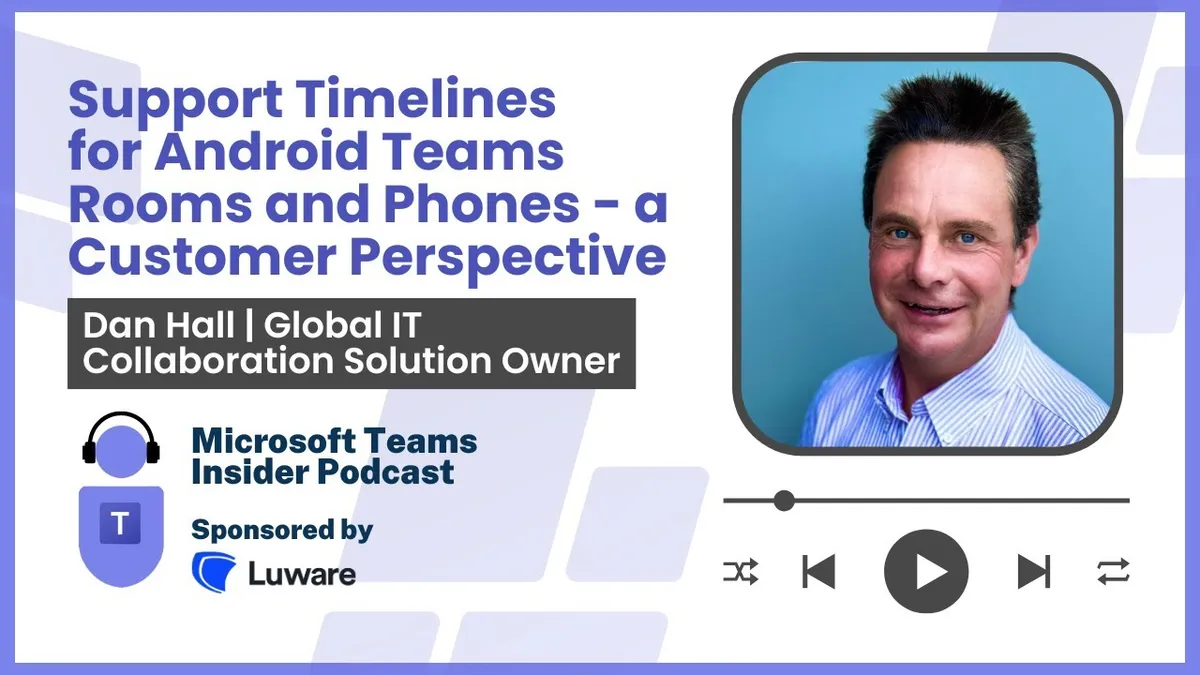
Support Timelines for Android Teams Rooms and Phones - a Customer Perspective
Dan Hall is Global IT Collaboration Solution Owner at a large global manufacturing organisation, running Teams for voice, meetings and rooms after moving off an on-premises Avaya PBX.
Prefer audio?
Who should listen: Microsoft 365 service owners, Teams voice and device administrators, and AV/UC professionals planning Android Teams phone or Teams Rooms purchases and refresh cycles.
Guest: Dan Hall — Global IT Collaboration Solution Owner, A large global manufacturing company
Dan Hall is Global IT Collaboration Solution Owner at a large global manufacturing organisation, running Teams for voice, meetings and rooms after moving off an on-premises Avaya PBX. He shares the practical fallout of Microsoft's deprecation of a messaging service that breaks incoming call notifications on older Android Teams phones, and how certification and chipset timelines should now shape device buying decisions.
Many thanks to Luware, sponsor of this episode.
Key insights
- A message centre post at the end of June flagged the deprecation of a messaging service that stops incoming call notifications reaching older Android Teams phones. The original cut-off of end of July has since moved to end of September, but Hall's team had already replaced every affected handset rather than gamble on the date. ▶ 7:16
- Microsoft's certification clock runs for five years from the release date of the Android OS version on the device, not from when the device was certified or bought. A phone or room bar certified midway through that window may only have two and a half years of joint OEM/Microsoft support left on the shelf. ▶ 10:20
- Hall's buying checklist for Android Teams devices now has four items, and only one is easy to find: the OEM's stated support period, the chipset or system-on-chip (usually not published), the highest Android version that silicon can run, and how long Microsoft will certify that Android version. ▶ 11:53
- The economics bite hardest in rooms: devices still on sale, including through the Microsoft Store, are shipping on Android 10 with certification expiring next year, so multi-thousand-pound bars can carry barely a year of certified life. End-of-line discount deals on room kit are rarely the bargain they look like. ▶ 13:26
- OEMs cannot honestly guarantee future Android upgrades because the Android Open Source Project decides which chipsets are supported. Some are de-risking instead with swap-out commitments — the customer still has a deployment project, but not a hardware bill. ▶ 15:29
- OEMs typically skip Android versions (9 to 11, or 10 to 12) because a version jump is a large build-test-patch-push project with little end-user benefit, which is why apparently new devices still ship on Android 10. ▶ 17:31
- For common area phones that only need push buttons, Hall has used SIP Gateway since launch. Standards-based SIP handsets take the Android OS out of the equation entirely — the only dependency is Microsoft continuing to allow registration — and some OEMs will quote ten-year support, turning the phone into a consumable you replace when it breaks. ▶ 18:33
- Teams admin center will report affected phones as healthy and up to date even when they cannot accept the newer Teams app version the change requires — so device health dashboards will not surface this risk, only the message centre will. ▶ 22:09
Insights summarised by AI from the episode transcript, reviewed by the Empowering.Cloud team.
Listen: Apple Podcasts · Spotify · Other platforms


Comments ()