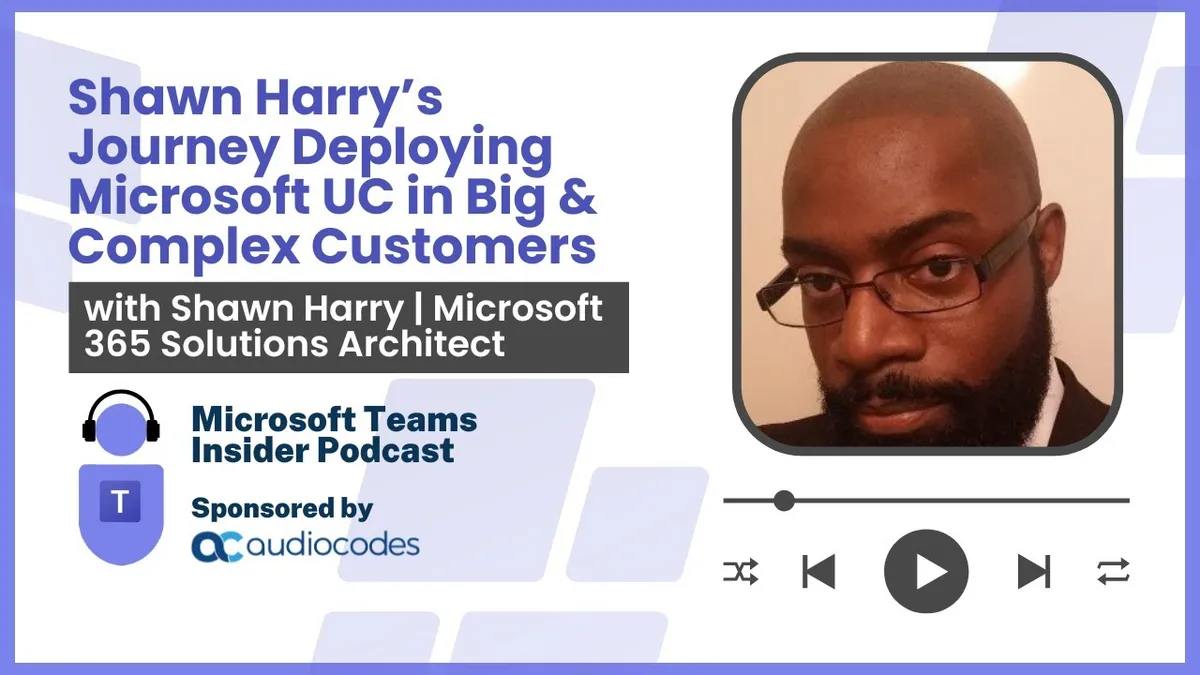
Shawn Harry's Journey Deploying Microsoft UC in Big & Complex Customers
Shawn Harry is an independent Microsoft 365 solutions architect who has worked in the unified communications space since the Exchange 5.5 and OCS days, delivering large Teams deployments for finance, legal and public sector clients.
Prefer audio?
Who should listen: Microsoft 365 service owners, Teams product owners, UC architects and AV integrators working in large, regulated enterprises — particularly anyone building the operating model for evergreen Teams and Teams Rooms management.
Guest: Shawn Harry — Microsoft 365 Solutions Architect (independent consultant), Independent
Shawn Harry is an independent Microsoft 365 solutions architect who has worked in the unified communications space since the Exchange 5.5 and OCS days, delivering large Teams deployments for finance, legal and public sector clients. He talks with Tom Arbuthnot about why cloud UC projects are harder than on-premises ones, the operational reality of evergreen change, and why enterprises need a genuine Teams/M365 product owner.
Many thanks to AudioCodes, sponsor of this episode.
Key insights
- Cloud has not sped up enterprise UC projects — Shawn argues Teams introduces different and often greater complexity than on-premises, because the breadth of M365 integration is not understood by the individual silos being consulted. ▶ 13:14
- An MTR conversation is never just about AV codecs, ceiling mics and room design — as soon as conditional access, Intune and Exchange enter the discussion, AV-focused teams glaze over. Expect to spend significant time doing level-500 knowledge transfer into security and compliance teams. ▶ 13:44
- Feature-parity comparisons with Cisco Call Manager, Avaya and Mitel are largely dead: Teams covers the bulk of use cases with voicemail, auto attendants and call queues, because the experience starts with chat and collaboration rather than voice. Regulated banking scenarios remain the exception, addressed by Verba, Numonix or native Teams recording. ▶ 10:42
- The cloud needs more watering and feeding than on-premises, not less. Microsoft's C-suite pitch of "put the credit card in and we look after it" hides the fact that you need the same headcount doing different work — policies, change management, adoption, training and documentation. ▶ 15:49
- Many organisations run a few steps behind because they lack product management or SME capacity and only react once a Microsoft change causes a major incident. Relying on the Message Centre alone is not enough; Shawn wants CSMs to run regular cadences on impactful phone and MTR changes. ▶ 16:50
- The traditional architect–project–operations handover is broken for Teams: the product changes while you are still deploying it. Tom's argument is that architecture, project and ops now form a continuum, effectively requiring permanent in-house consultancy. ▶ 21:52
- Customers with a genuine M365 product owner show measurably better governance maturity and deployment success; the role sits adjacent to architecture and must feed roadmap changes to service delivery managers and operations. ▶ 23:52
- Building the business case internally means reframing the role: you are not product managing Microsoft's features, you are managing change, deployment, adoption, security risk and governance to maximise a multi-million-pound investment. Security and regulatory risk (e.g. GDPR exposure) tends to be the lever that actually shifts culture. ▶ 24:53
- Shawn's main ask of Microsoft is solution maturity over marketing — capabilities announced one to two years ahead that customers plan critical use cases around still are not shipping, and value articulation for things like Copilot remains too nebulous to translate for engineers and leadership. ▶ 27:58
Insights summarised by AI from the episode transcript, reviewed by the Empowering.Cloud team.
Listen: Apple Podcasts · Spotify · Other platforms


Comments ()