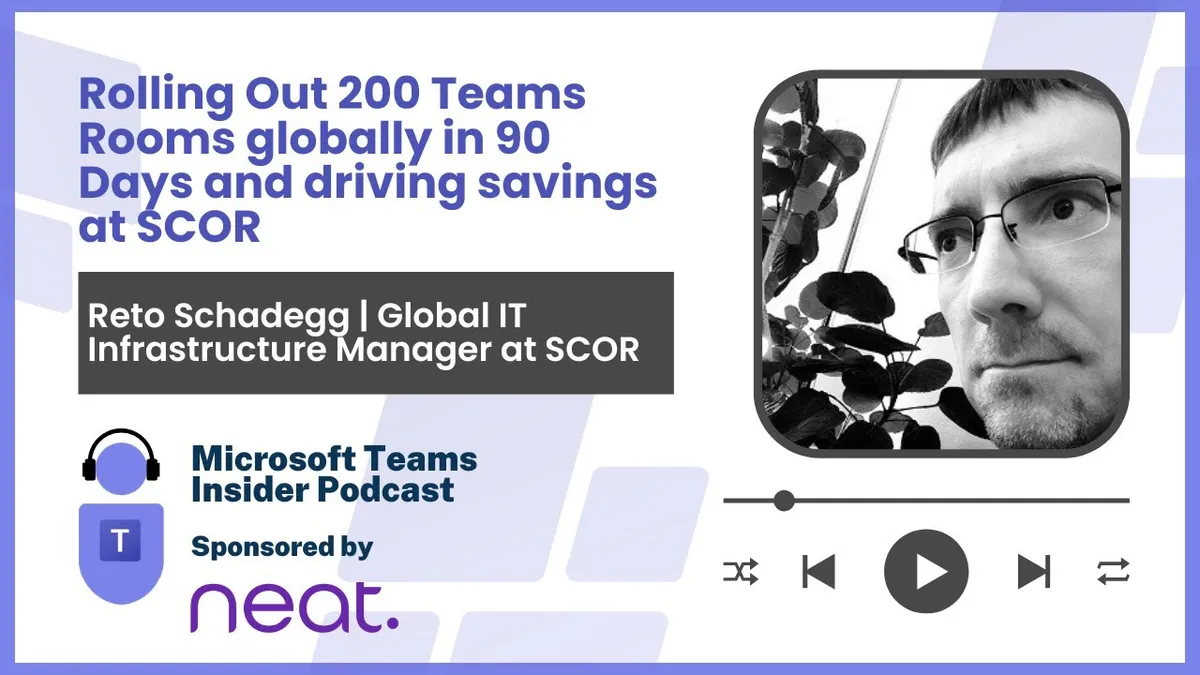
Rolling Out 200 Teams Rooms globally in 90 Days and driving savings at SCOR
Reto Schadegg, Global IT Infrastructure Manager at reinsurance group SCOR, describes replacing the video estate across 200 rooms in 35 offices and around 30 countries inside a 90-day window forced by an expiring backend contract.
Prefer audio?
Who should listen: Microsoft 365 service owners, UC/AV managers and IT infrastructure leads planning a large multi-country Teams Rooms refresh or a Teams Phone migration off a legacy PBX, particularly those needing to build a cost-saving business case or size an ongoing support model.
Guest: Reto Schadegg — Global IT Infrastructure Manager, SCOR
Reto Schadegg, Global IT Infrastructure Manager at reinsurance group SCOR, describes replacing the video estate across 200 rooms in 35 offices and around 30 countries inside a 90-day window forced by an expiring backend contract. He covers device selection, drop shipping, network segmentation, a 40% run-cost reduction and the parallel migration from Avaya to Teams Phone.
Many thanks to Neat, sponsor of this episode.
Key insights
- The 90-day deadline was not a stretch goal but a contract cliff — approval came from top management with only three months left on the existing video backend contract, against an original 6–9 month rollout plan. Standardisation work done back in 2018 (cabling, power, network behind every screen) meant rooms were largely a board-swap. ▶ 4:13
- Vendor selection was done by bringing every vendor's hardware in-house and testing with their own technicians before committing to over 200 rooms. Neat won on hardware plus the level of support given before SCOR was even a customer, and on the ease of reaching senior people at a smaller vendor. ▶ 5:44
- SCOR moved from a single-vendor to a two-vendor strategy: Neat Bar Pro is the main system, with existing HP Poly devices retained until their investment is used up and faded out. ▶ 7:17
- OEM management tooling is now a real selection criterion — Neat Pulse lets the first-line IT support team resolve issues themselves because they can see the state of every room remotely. ▶ 7:49
- Speed came from pushing the vendor for drop shipping direct to sites rather than routing through partners in each country, which adds lead time; local partners quoting four-month availability were bypassed by flying internal resources out instead. ▶ 8:52
- Around 10% of the 200 rooms were large/complex with external audio and were the known pain point; five rooms were still not working at contract end, which was agreed with local management and closed out a month later. ▶ 10:27
- Physical mounting is now the long pole — devices were up and running in under five minutes once installed. SCOR also built a dedicated worldwide network segment purely to host the room devices, which simplifies audits. ▶ 11:31
- Results: 40% reduction in run cost, and day-two operations for 200 rooms handled by first-line IT plus just 1.5 FTE at second line for escalation to the vendor. ▶ 13:02
- The Teams Phone migration off Avaya (with some Alcatel-Lucent) is roughly 90% done and has delivered six-figure savings; at least 50% of users never use their business number in a year, so the next cost step is simply not issuing numbers to those users. Japan, South Korea, India and Brazil remain hard on regulation, porting and call recording — India's regulator-driven model meant an Avaya line is still live purely for recording. ▶ 17:38
- SCOR's standard is softphone plus headset with no desk phones; only a handful of exceptions such as receptionists were given hardware, which also suits hot-desking offices where nobody should have to log into a fixed phone. ▶ 22:48
Insights summarised by AI from the episode transcript, reviewed by the Empowering.Cloud team.
Listen: Apple Podcasts · Spotify · Other platforms



Comments ()