Reinventing Workplace Collaboration with AI
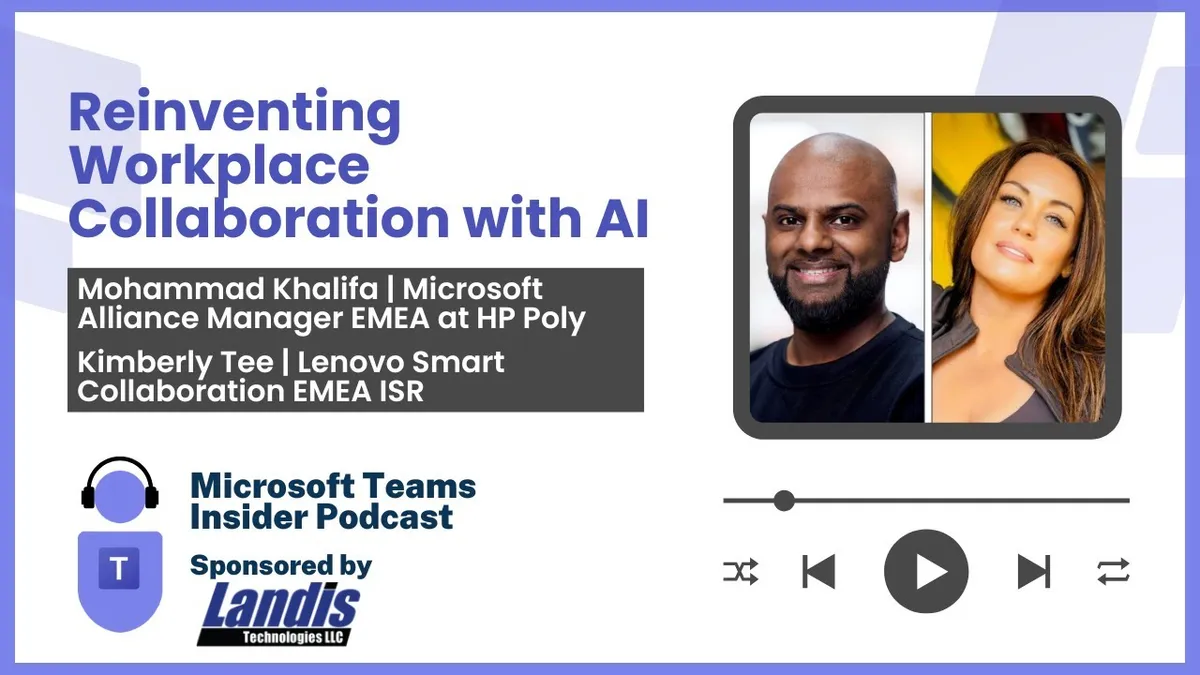
Mo Khalifa, Microsoft Alliance Manager at HP Poly and newly minted MVP, joins Kimberley Tee of Lenovo's EMEA Smart Collaboration team for a two-OEM view of the meeting room market.
Prefer audio?
Who should listen: Microsoft 365 service owners, meeting room and AV leads, and anyone building the business case for AI-enabled rooms against IT security and adoption resistance.
Guest: Mohammed (Mo) Khalifa and Kimberley Tee — Microsoft Alliance Manager (HP Poly) and EMEA Smart Collaboration (Lenovo), HP Poly / Lenovo
Mo Khalifa, Microsoft Alliance Manager at HP Poly and newly minted MVP, joins Kimberley Tee of Lenovo's EMEA Smart Collaboration team for a two-OEM view of the meeting room market. They cover the shift from headline features to refinement, where AI genuinely adds value in rooms, and why cyber security and IT policy are now the biggest brake on adoption.
Many thanks to Landis Technologies, sponsor of this episode.
Key insights
- 2024 brought far fewer headline Teams Rooms features than the Front Row era; the value now sits in refinements such as roster/name display, intelligent speaker and best-face-forward framing. Pitching megapixels stopped working roughly eight or nine years ago — buyers score the in-room experience instead. ▶ 4:36
- The Surface Hub is the cautionary tale: IT and procurement bought the story and deployed widely, but adoption never reached the accountant who had to use it. Any room product whose answer is "we need an adoption programme" will only work in the minority of enterprises that can fund white-glove rollout. ▶ 7:10
- Overlapping OEM and Microsoft camera-control software is creating genuine customer confusion — an OEM ships an intelligent framing/director capability, Microsoft ships its own months later, and the customer has to decide which to use and whether the native one is good enough. ▶ 8:42
- Split AI into two buckets: user-driven (open Copilot, write a prompt) which still needs forward-leaning users, and automatic (framing, transcription, recognition, echo handling) which needs no behaviour change. The room is overwhelmingly the automatic bucket, and that is where the near-term value lies. ▶ 13:19
- Khalifa cites a Microsoft figure that a high-80s percentage of Copilot usage starts in the meeting space, with recap the standout use case because the value is instant and the problem universal. ▶ 16:25
- AI-equipped hardware is hard to sell on paper — a bar with full audio/video AI looks identical on a website to one with a single mic and tinny speakers, so customers need to experience it to understand where the investment goes. ▶ 15:54
- Four to five years into Teams Rooms, OEMs are still arguing that MTR devices are appliances, not PCs or Android phones, and should not attract laptop security policies. That fight with cyber security teams is the real choke point on innovation reaching users. ▶ 22:34
- Voice and face recognition shipped off by default and most admins never enabled it; Microsoft is flipping it to on by default in January, with a policy available now so admins can proactively opt out. Arbuthnot's view: the right move, given most of the 400 million M365 users have no admin tracking every message centre post. ▶ 24:07
- Base Copilot chat is now included in Microsoft 365 at no extra cost with commercial data protection — organisations that withhold it should assume staff are already using consumer Copilot, Gemini or ChatGPT to get their work done. ▶ 26:11
- Device selection has inverted: rather than issuing kit, some customers set a budget by job role (£1,000–£2,000) and let employees choose headsets and cameras from an approved list. ▶ 28:14
Insights summarised by AI from the episode transcript, reviewed by the Empowering.Cloud team.
Listen: Apple Podcasts · Spotify · Other platforms


Comments ()