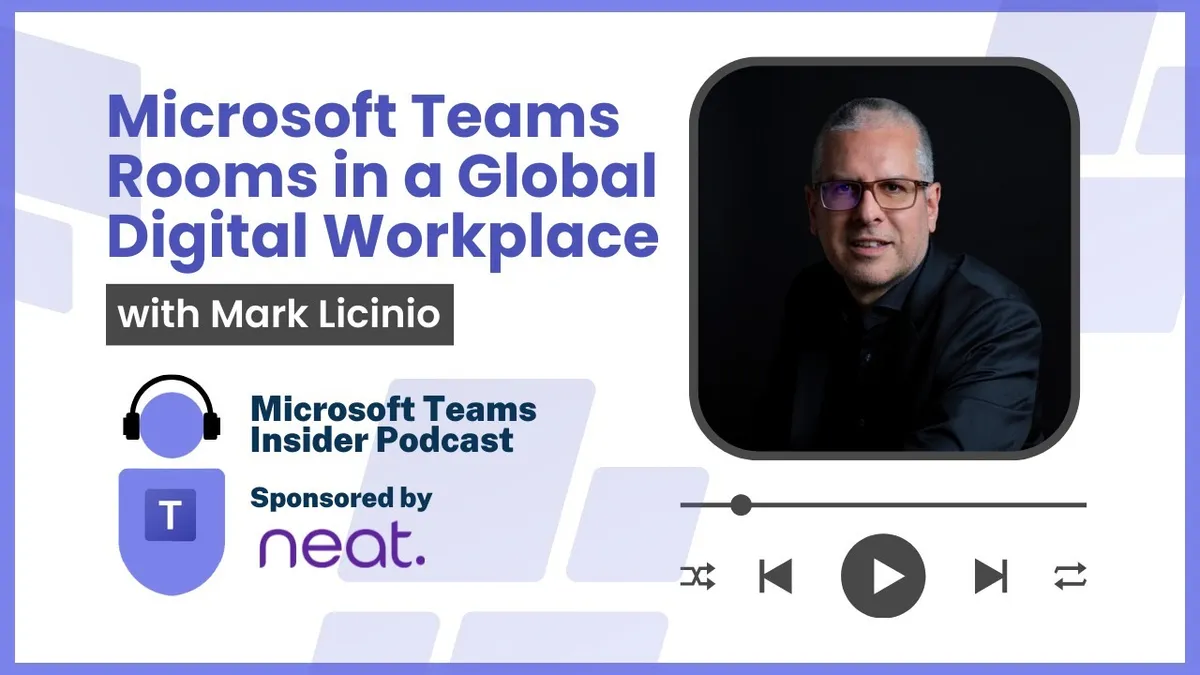
Microsoft Teams Rooms in a Global Digital Workplace
Mark Licinio runs video conferencing and Teams devices within BP's Digital Workplace team, alongside global print and digital signage. He talks through BP's move from Skype for Business and a legacy Poly estate to native Microsoft Teams Rooms across roughly 1,600 rooms, the room blueprints and OEM…
Prefer audio?
Who should listen: Microsoft 365 service owners, digital workplace leads and UC/AV professionals planning or running a large-scale Teams Rooms estate, particularly those weighing single-vendor standardisation against a mixed Android/Windows/BYOD deployment.
Guest: Mark Licinio — Service Owner, Video Conferencing & Teams Devices, BP
Mark Licinio runs video conferencing and Teams devices within BP's Digital Workplace team, alongside global print and digital signage. He talks through BP's move from Skype for Business and a legacy Poly estate to native Microsoft Teams Rooms across roughly 1,600 rooms, the room blueprints and OEM strategy behind it, and how his team tests and operates a deliberately mixed device estate.
Many thanks to Neat, sponsor of this episode.
Key insights
- BP started planning its Teams migration in 2018, migrated users through 2019 and finished just as UK lockdown began in March/April 2020 — meaning the newly built Poly RealPresence Clarity private cloud (three regions, with RealConnect for interop) went live into almost zero room usage. ▶ 2:01
- The business case for native rooms came from leadership, not IT: returning executives compared the 'bowling alley' room layout unfavourably with everyone having their own square at home, and asked what it would take to fix it. Answer: native Teams Rooms. ▶ 3:33
- Room blueprints are three sizes: 2–7 seats is BYOD with a single USB-C cable that also powers the laptop; 8–12 seats is Teams Rooms on Android; large rooms are Teams Rooms on Windows with ceiling microphones. Users are never asked to care about the OS — only whether it's plug in the cable or tap to join. ▶ 6:34
- BP deliberately avoided single-vendor standardisation. The primary driver was supply chain — some products are simply easier to source in one region than another — with a secondary benefit that a firmware or model-specific fault can't take out the entire room estate at once. ▶ 10:11
- Operationally the team stays on Teams Admin Center and the Teams Rooms Pro Management Portal only, and has consciously chosen not to adopt OEM-specific management platforms because making support staff log into multiple portals would be too much of a burden. ▶ 9:40
- Selection criteria for kit are consistency, predictability and reliability rather than feature count; Logitech Sight was assessed on BP's customer acceptance programme and rated well even on pre-release software because it produced 'no real surprises' in the room. ▶ 10:43
- Devices are tested from the far end, not the room — one colleague in the lab, one joining remotely, and vendor demo rooms joined remotely to judge microphones. The team bought £10 cardboard celebrity cutouts to give group framing and speaker tracking enough faces to work with. ▶ 13:15
- Priority order for hybrid room spend is audio, then content, then video. Ceiling microphone arrays are an order of magnitude more expensive, but Teams-certified ceiling tile microphones are rated as excellent; DSP tuning currently sits with BP's global AV integrator, and Mark wants to bring some of that skill in-house. ▶ 15:19
- Large rooms (16–20 seats and boardrooms) remain unsolved for video. Crestron 1 Beyond, Seervision (now with Q-SYS) and Huddly Crew are all being watched, but the deciding factor is a price point that allows mass deployment rather than just the two or three boardrooms BP has. ▶ 18:26
- Mark is comfortable enrolling his face in the Teams tenant and expects Copilot to be what drives voice and face enrolment, because attributing who said what in the room finally gives the individual a personal return for opting in. ▶ 20:02
Insights summarised by AI from the episode transcript, reviewed by the Empowering.Cloud team.
Listen: Apple Podcasts · Spotify · Other platforms


Comments ()