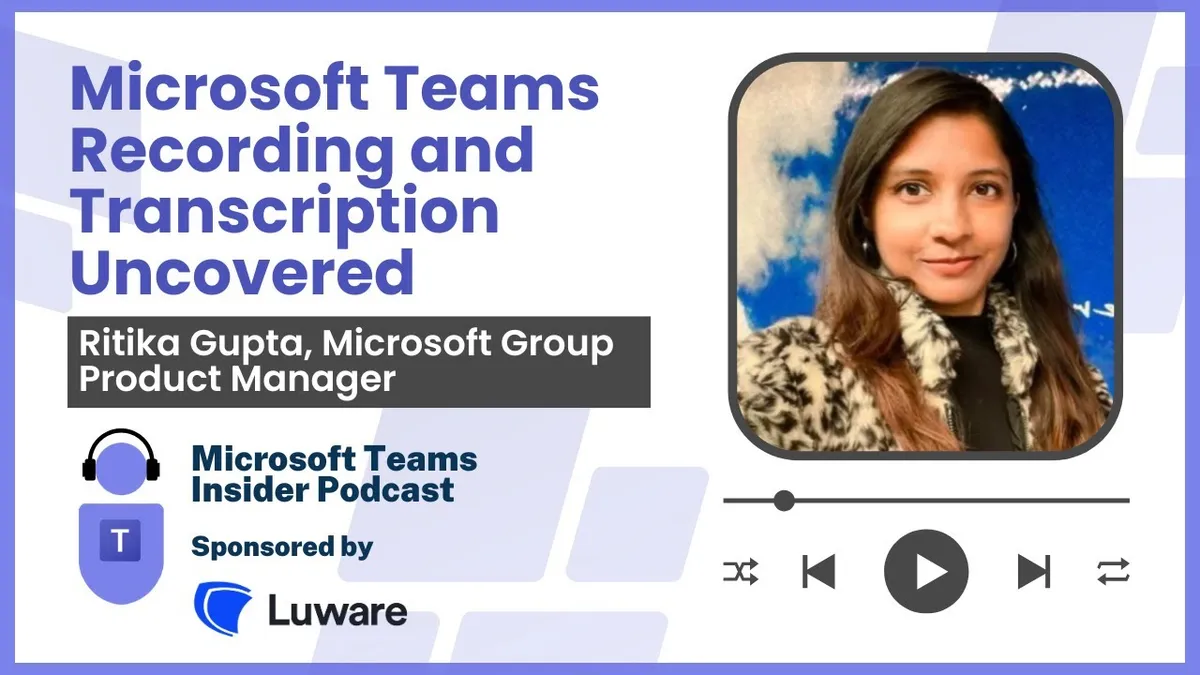
Microsoft Teams Recording and Transcription Uncovered, Ritika Gupta, Microsoft Group Product Manager
Ritika Gupta is the Microsoft Group Product Manager responsible for recording, transcription, interpretation and intelligent recap in Teams meetings. She explains how the speech stack feeds Copilot, facilitator and interpreter agent, why real-time transcription is the hardest quality problem, and…
Prefer audio?
Who should listen: Microsoft 365 service owners, Teams admins and compliance leads setting recording, transcription and consent policy, plus UC/AV professionals dealing with room enrolment, captions and multilingual meeting quality.
Guest: Ritika Gupta — Group Product Manager, recording, transcription, interpretation and intelligent recap for Teams meetings, Microsoft
Ritika Gupta is the Microsoft Group Product Manager responsible for recording, transcription, interpretation and intelligent recap in Teams meetings. She explains how the speech stack feeds Copilot, facilitator and interpreter agent, why real-time transcription is the hardest quality problem, and what admin controls and consent models now exist for recording and transcripts.
Many thanks to Luware, sponsor of this episode.
Key insights
- Recording and transcription have shifted from a nice-to-have feature to a necessity: they are the two most important pieces of grounding data for any AI processing a Teams meeting, which puts new pressure on transcript accuracy across accents, languages, tonality and microphone hardware. ▶ 3:02
- Transcript quality improves as context length grows, so post-meeting re-transcription is materially better than real time. Microsoft has the ability to re-transcribe after the fact and is contemplating exposing it, but real-time transcription still has to be good because in-meeting Copilot depends on it. ▶ 7:42
- Captions and transcription run on essentially the same speech stack, with differences only in real-time behaviour and configurability. The plan is to converge the two experiences so users don't choose, with captions becoming the human-facing real-time surface (with more scrollable context) and transcription becoming an enriched, annotated artefact purely for AI workflows. ▶ 8:42
- Architecture is multi-layered: one model optimised solely for speech-to-text quality, then the text output feeds separate models for facilitator, Copilot and recap summarisation — because in-meeting Copilot has very different latency and context requirements to post-meeting summaries. ▶ 12:46
- Voice and face enrolment in meeting rooms is a small capability with outsized impact on call and summarisation quality; the team is working on subtle in-product prompts (potentially via facilitator) to get users enrolled so speaker attribution in transcripts is reliable. ▶ 11:13
- Model training is constrained to public-domain datasets that don't resemble natural meeting speech, and formal structured meetings differ sharply from open conversation. Some languages are inherently harder — Japanese grammar is effectively flipped, so word-by-word translation fails and near-complete sentences are needed. ▶ 18:25
- A dictionary-based biasing approach is being evangelised so customers can steer the model on internal acronyms and domain terms (the same acronym means different things in accounting versus medicine). The open question is how many IT teams will actually sign up to maintain a dictionary rather than asking Microsoft to make the model smarter. ▶ 22:32
- The last year of compliance work went beyond transcript quality to who can download a transcript, what gets transcribed and what is omitted, plus implicit and explicit consent options — shaped by reviews with responsible AI teams and regional bodies such as the European Union Workers' Council, because there is no global threshold. ▶ 25:07
- Copilot can now run without transcription during a call, keeping the transcript transient, which unblocks organisations with legal restrictions on retaining permanent transcripts while still giving users in-meeting AI. ▶ 29:48
Insights summarised by AI from the episode transcript, reviewed by the Empowering.Cloud team.
Listen: Apple Podcasts · Spotify · Other platforms


Comments ()