Microsoft Teams Queues App Explained — Shared Call History, Copilot, and What's Next
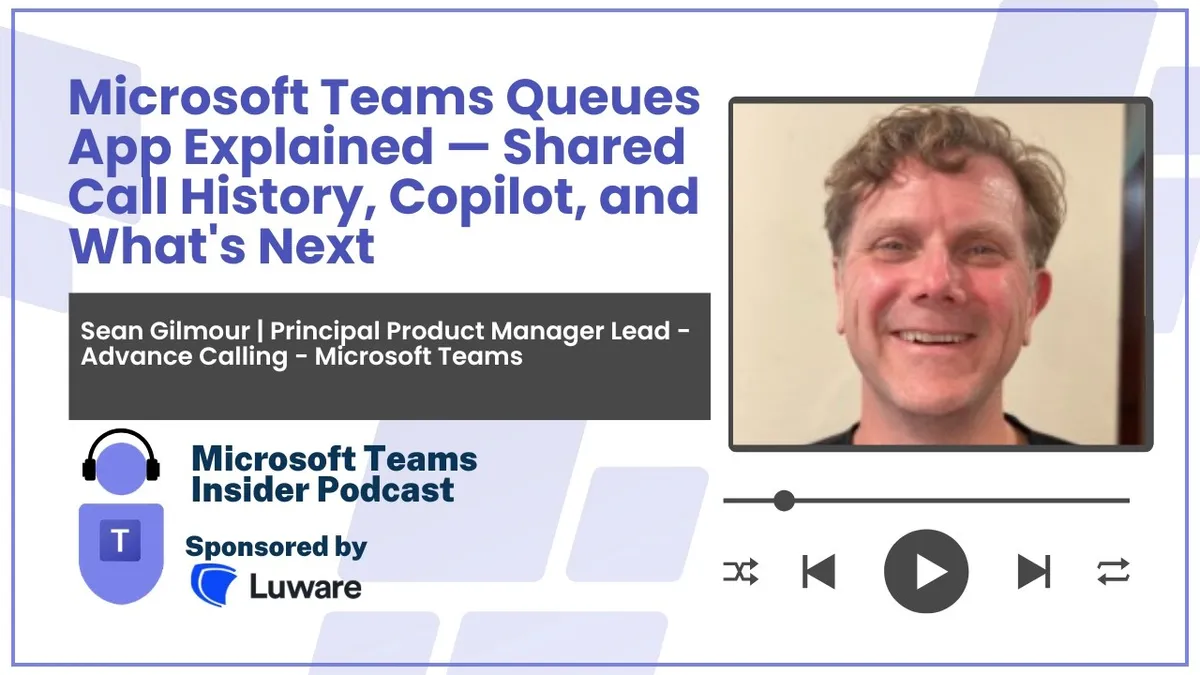
Sean Gilmour, Principal Lead PM for Advanced Calling Experience at Microsoft, owns call queues, auto attendants, the Queues app and the client side of Teams Phone Extensibility.
Prefer audio?
Who should listen: Microsoft 365 service owners, Teams Phone administrators and UC consultants evaluating where native call queues and the Queues app stop and a third-party or Dynamics contact centre starts, plus anyone planning Teams Premium licensing for supervisors and agents.
Guest: Sean Gilmour — Principal Lead PM, Advanced Calling Experience, Microsoft
Sean Gilmour, Principal Lead PM for Advanced Calling Experience at Microsoft, owns call queues, auto attendants, the Queues app and the client side of Teams Phone Extensibility. He walks through why the Queues app was built for "citizen agents", what supervisor and shared call history capabilities now deliver, and where AI, recording and mobile support are heading.
Many thanks to Luware, sponsor of this episode.
Key insights
- The Queues app replaced voice-enabled channels, which Gilmour concedes were "very, very limited" — particularly the channel-based membership model. The redesign targets "citizen agents": HR, internal help desks, nurses, doctors and tier-three specialists who take customer calls alongside another job, rather than full-time contact centre staff. ▶ 3:06
- Delegated admin was the first big supervisor unlock: supervisors can manage office hours, auto attendant routing rules and queue membership without being given Teams admin rights or having to work in the admin centre, removing the ticket-per-change cycle. ▶ 5:40
- Monitor, whisper, barge and takeover — traditionally higher-end contact centre features — are now in the native Teams client. Entitlement is Teams Phone plus Teams Premium, roughly another $10 list per supervisor or agent. ▶ 8:11
- Microsoft is explicitly not positioning the Queues app against Dynamics 365, Genesys, Luware or Landis. The stated model is mix-and-match: a full contact centre fronting the queue, with escalation to Queues app agents (e.g. a fraud or private banking team) via Teams Phone Extensibility. ▶ 9:15
- Queues app on the web still lacks monitor, whisper and barge because the web and desktop media stacks differ; the app is available in GCC, while GCC High and DoD lag due to physically separate infrastructure. A mobile experience is in development but is being designed for on-the-go frontline workers rather than shrunk from desktop. ▶ 14:50
- Shared call history gives agents and supervisors visibility of every call into a queue — not just ones they handled — plus shared voicemails and missed calls with lightweight management: marking an item as reviewed, so teams stop tracking voicemail follow-up in spreadsheets or a ticketing system. ▶ 19:32
- Historical reporting has moved from 27 to 45 days, with the earlier limit driven by legal/customer-data retention constraints rather than engineering. Microsoft intends to extend it further, partly because longer horizons make AI insights more useful. ▶ 28:16
- Compliance recording policies can now be assigned to a call queue rather than to each agent, so only queue calls are captured and personal calls are not. Gilmour signalled that a lighter-weight "this call is recorded for quality purposes" option with transcripts, recaps and CRM push is being worked on — nothing announced yet. ▶ 32:51
- Third-party Teams apps can already be pinned to open automatically when a call queue call arrives (in addition to URL-parameter CRM screen pops), and the team's stated direction is richer third-party plug-ins inside the Queues surface. ▶ 24:41
Insights summarised by AI from the episode transcript, reviewed by the Empowering.Cloud team.
Listen: Apple Podcasts · Spotify · Other platforms



Comments ()