Microsoft Teams Impact on Telephony, Patrick Watson, Head of Research Cavell
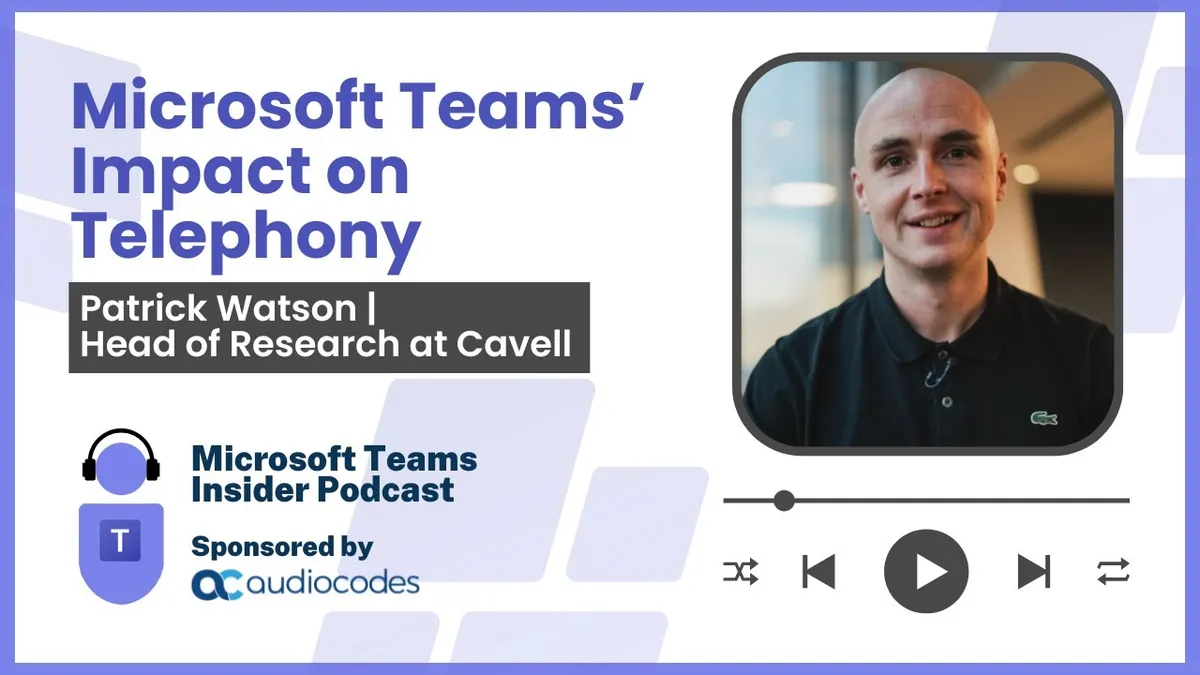
Patrick Watson, Head of Research at Cavell, brings hard market data to the question of how Microsoft Teams has reshaped business telephony. He covers Direct Routing versus Operator Connect adoption, the collapse in DDI concurrency, Teams Phone licensing white space, and why CCaaS pricing has stayed…
Prefer audio?
Who should listen: Microsoft 365 and voice service owners planning Teams Phone migrations, plus telco, service provider and channel teams building Operator Connect, Direct Routing or contact centre propositions who need market sizing and pricing context.
Guest: Patrick Watson — Head of Research, Cavell
Patrick Watson, Head of Research at Cavell, brings hard market data to the question of how Microsoft Teams has reshaped business telephony. He covers Direct Routing versus Operator Connect adoption, the collapse in DDI concurrency, Teams Phone licensing white space, and why CCaaS pricing has stayed buoyant while UCaaS has been commoditised.
Many thanks to AudioCodes, sponsor of this episode.
Key insights
- Cavell builds its Teams telephony splits (Direct Routing, Operator Connect, Teams Phone Mobile, Calling Plans) from anonymised interviews with service providers, telcos and vendors, because Microsoft only publishes headline numbers — and earnings calls are the most reliable public source since those figures must be rigorously checked. ▶ 4:38
- The US accounts for more than a third of Teams telephony users deployed globally, with roughly another third across Western and wider Europe; Direct Routing still dominates the installed base as the most mature option, partly because Skype for Business customers already had SBCs in place. ▶ 6:09
- Operator Connect is forecast to become the majority of deployments long term, and partners in advanced markets (US, UK) that firmed up a channel Operator Connect play saw notable success in the last 12 months — a clear change from 2023. ▶ 6:41
- Roughly 70% of Teams telephony users sit in organisations of 250+ seats (the European enterprise definition). Larger businesses are more likely to use collaboration tools, more likely to use Teams, and then more likely to enable telephony — a compounding effect that skews adoption to enterprise. ▶ 9:15
- Against around 22 million PSTN-enabled Teams users there are an estimated 60 million-plus E5-licensed users globally, leaving a large pool already licensed for Phone System but with no Direct Routing, Operator Connect or Calling Plan attached — though numbers and telco plans still carry incremental cost. ▶ 10:17
- Cavell asked businesses whether they would still buy Teams if it were unbundled from Microsoft 365 at slightly higher cost; over 90% said yes, indicating the pull is integration with the wider Microsoft suite rather than the commercial bundle. ▶ 12:20
- The overall US business telephony market is declining about 7% year on year, driven by concurrency collapse: enterprises where 80% of users had a DDI often migrate only around 20%, with some 10,000-seat estates dropping to 2,000 DDIs, or moving to DDI-on-request. ▶ 14:21
- Cavell has slightly downgraded its Teams telephony forecast — early adopters have moved and the remaining migrations are more complex legacy integrations — but still models around 20% growth in developed markets, well above other PBX solutions in a shrinking market. ▶ 17:26
- Contact centre pricing shows none of the degradation seen in UCaaS: average paid is around $125 per user per month in the US and about $95 (or 80-something euros) in Europe, which is why providers are pivoting to CX. A gap is opening between $25-a-seat top-tier UCaaS and $65–70 entry CCaaS, targeted by 'contact centre light' products. ▶ 21:01
- Consumer perception, not technology, is the brake on AI in contact centres: 45% of consumers said service is worse than three years ago, top frustrations were wait times and rude or poor-quality agent interactions, and 90%+ want a human for emergencies. ▶ 28:15
Insights summarised by AI from the episode transcript, reviewed by the Empowering.Cloud team.
Listen: Apple Podcasts · Spotify · Other platforms



Comments ()