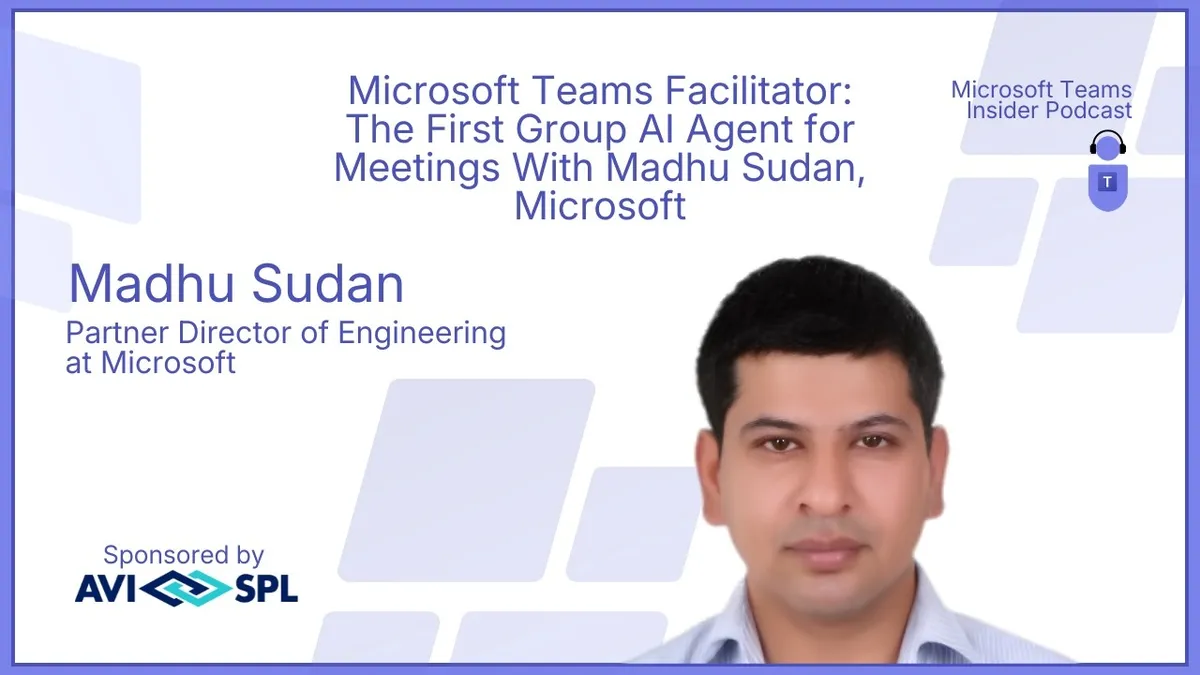
Microsoft Teams Facilitator: The First Group AI Agent for Meetings With Madhu Sudan, Microsoft
Madhu Sudan, Partner Director of Engineering at Microsoft, has worked on the communications stack from Skype through Skype for Business to Teams and now leads AI work in Teams.
Prefer audio?
Who should listen: Microsoft 365 service owners, collaboration architects and UC/AV professionals planning AI agent rollouts in meetings, particularly those assessing data boundaries, permissioning and change management for Teams Facilitator.
Guest: Madhu Sudan — Partner Director of Engineering, Microsoft
Madhu Sudan, Partner Director of Engineering at Microsoft, has worked on the communications stack from Skype through Skype for Business to Teams and now leads AI work in Teams. He explains how Facilitator works as a group-level meeting agent, how its permissioning model differs from one-to-one assistants, and the engineering challenges of running an agent across culturally diverse meetings at scale.
Many thanks to AVI-SPL, sponsor of this episode.
Key insights
- The clearest way to position the two agents to users: Copilot is a private one-to-one assistant where the prompt and response stay between the individual and the model, while Facilitator acts on behalf of the whole group — taking shared notes, answering questions publicly and moderating. ▶ 4:05
- Facilitator can be switched on at scheduling time or mid-meeting via 'Turn on Facilitator' in the More menu, and it recaps decisions and open questions at the halfway point and before wrap-up rather than only at the end. ▶ 6:41
- Real-time notes are co-authorable by participants during the meeting, and in a Teams Room the in-room view automatically switches to show those live notes for in-room attendees. ▶ 7:12
- Beyond note-taking, V1 includes quorum detection and @-mentioning an absent person when the meeting keeps referring to them, plus recaps and follow-up Q&A for late joiners. ▶ 6:11
- The hardest engineering problem was the group permissioning model — models are 'very eager to spit out' whatever grounding they hold, so Facilitator needed a harness and hard data boundaries so nothing from one-to-one context or outside the group leaks into the group conversation. ▶ 9:42
- On accessing M365 content, Facilitator deliberately works to the lowest common denominator: it does not roam the tenant's data, retrieval must be user-initiated, and it asks permission before sharing based on the initiating user's access level with a human in the loop. ▶ 12:48
- Proactive skills go beyond reacting to prompts — Facilitator can detect a knowledge gap in the group discussion and pull in web content within its data boundaries. ▶ 13:52
- Every new frontier model breaks existing prompt behaviour, so the team runs offline and online evals plus automation to re-baseline quality; personalisation is also harder in groups because you cannot simply learn one user's preferred summary length or format. ▶ 14:53
- Facilitator already feeds meeting insight into the Teams Channel Agent to improve grounding for async channel conversations, with meeting-series memory and cross-meeting context on the roadmap. ▶ 10:45
Insights summarised by AI from the episode transcript, reviewed by the Empowering.Cloud team.
Listen: Apple Podcasts · Spotify · Other platforms


Comments ()