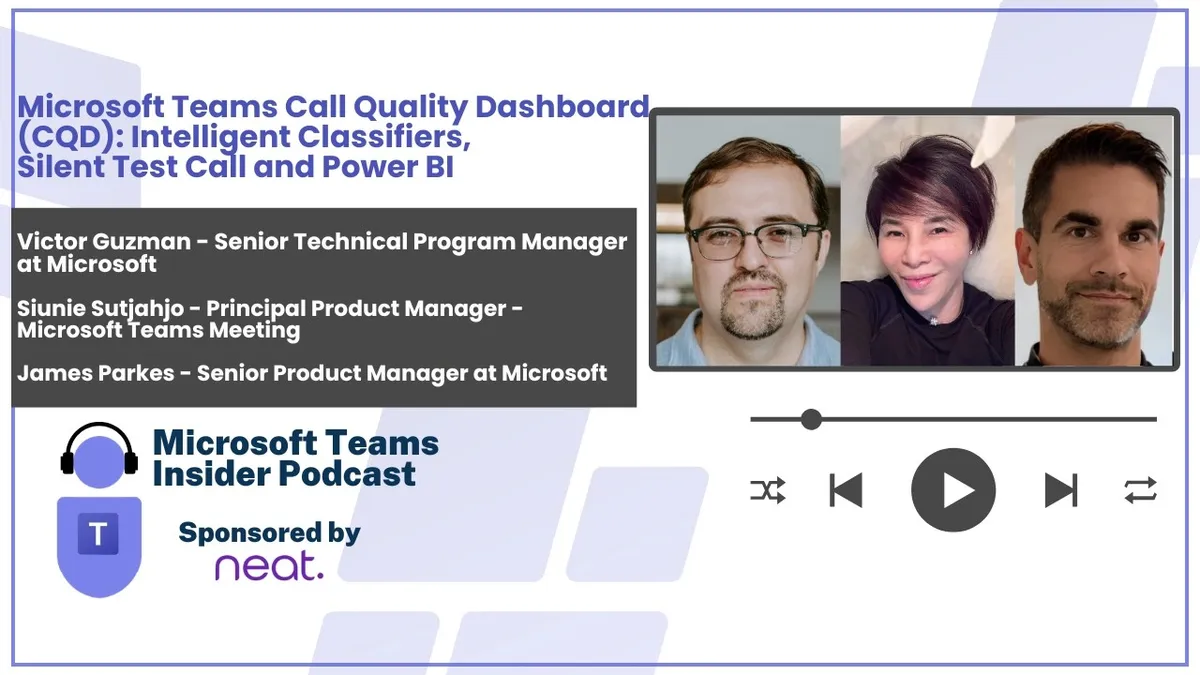
Microsoft Teams Call Quality Dashboard (CQD): Intelligent Classifiers, Silent Test Call and Power BI
James Parkes, Siunie Sutjahjo and Victor Guzman from Microsoft walk through the current state of Teams call quality tooling, from the history of CQD on-premises to the new intelligent classifiers, the v5.3 Power BI QER report pack, silent test call and admin-initiated remote log collection.
Prefer audio?
Who should listen: Microsoft 365 service owners, Teams voice and meeting admins, and support/UC engineers who own call quality reporting or are preparing a network for Teams meetings and calling.
Guest: James Parkes, Siunie Sutjahjo & Victor Guzman — Senior Product Manager, Call Quality Management; Principal Product Manager, Teams Meetings; Senior Technical Program Manager (CAPE / Get to Green), Microsoft
James Parkes, Siunie Sutjahjo and Victor Guzman from Microsoft walk through the current state of Teams call quality tooling, from the history of CQD on-premises to the new intelligent classifiers, the v5.3 Power BI QER report pack, silent test call and admin-initiated remote log collection. Victor also gives a live tour of the reports he uses daily on Get to Green engagements with large customers.
Many thanks to Neat, sponsor of this episode.
Key insights
- The legacy audio classifier (jitter, packet loss, latency thresholds) had a high false-positive rate because the Teams media stack now mitigates poor networks well. Around 40 new "intelligent classifiers" are trained instead on end-user survey ratings as ground truth — which is a practical reason to encourage users to answer the one-to-five star / thumbs prompt. ▶ 13:22
- In CQD, any dimension name containing "detected" is an intelligent classifier output. "Detected media modality problem" is a true/false flag for whether the user would likely have perceived poor quality; the local model then narrows it to their network, elevated compute stealing resources from the Teams app, or their device. ▶ 14:23
- The old classifiers worked on call averages, which caused arguments with customers — 1% packet loss over an hour can hide 90% loss for three minutes. The new models score real in-call events, including peaks and disconnect/reconnect, rather than averages. ▶ 15:55
- Remote models and a dominant-participant flag stop admins chasing red herrings: if the presenter or main talker had a problem, that is stamped on every other stream so the complaining user's own perfect telemetry no longer sends you down the wrong path. ▶ 16:56
- The Power BI QER pack is now at v5.3 with roughly 45 pages. The tabs marked hidden are not deprecated — they are drill-through targets reached by right-clicking a value; they are hidden deliberately so admins don't open a user-scoped page with no user selected and pull the whole organisation's data. ▶ 19:29
- Two starting points: for a reported incident use the Search report, then drill through to User Health Details (device history, wired vs wireless, network location, per-stream classifier columns and CPU/memory maxima); for proactive work start at Media Health and drill into Media Setup for setup failures, Media Reliability for drops, or Audio Health. Transport shows who is still not on UDP, plus there are VPN and VDI reports. Some customers publish country-filtered copies for regional network admins. ▶ 31:12
- Silent test call is not the old Lync/Skype synthetic handshake — it is a full bi-directional media exchange with a bot in a Microsoft datacentre, minimum 60 seconds and 500 packets. Bi-directional audio today, video and VBSS coming; Windows and Mac native clients supported, with mobile and MTR on Android/Windows in the backlog. It uses virtual devices only, so no mic, camera or speaker is activated. ▶ 36:51
- Silent test call practicalities: you target subnets (building targeting is coming for tenants with an uploaded building file) and recruit Teams Premium licensed users on them; the client must be signed in; a maximum of two tests per day is allowed because these are full media payloads; tests won't run during a call and end gracefully if the user starts one. Results use the legacy network classifiers, not the intelligent ones, as there is no user rating for a headless call. Good practice: schedule a test after a network or firmware change goes through your change advisory board. ▶ 38:51
- Admin-initiated remote log collection lets IT pull fresh client logs from the Teams Admin Centre without asking an executive to reproduce and upload — solving the case of the transient issue (the internal example was a user whose office shared a wall with the cafeteria microwaves at 10:30 every day) and giving admins control over what telemetry reaches Microsoft. ▶ 50:03
Insights summarised by AI from the episode transcript, reviewed by the Empowering.Cloud team.
Listen: Apple Podcasts · Spotify · Other platforms


Comments ()