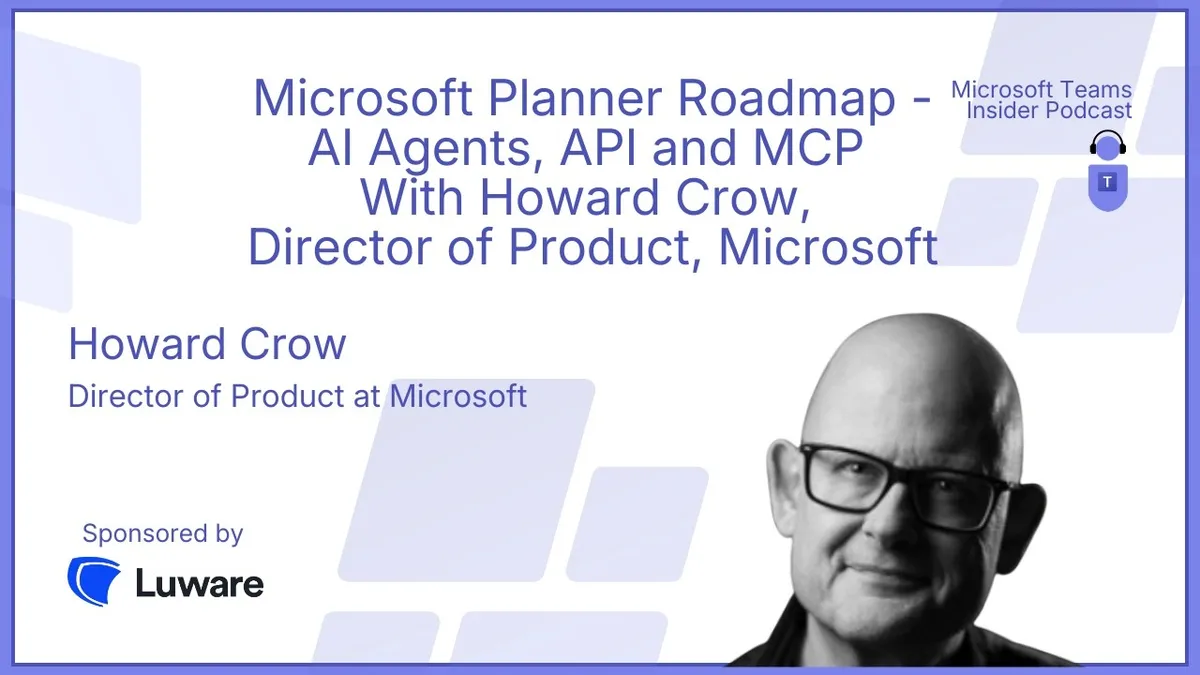
Microsoft Planner Roadmap - AI Agents, API and MCP With Howard Crow, Director of Product, Microsoft
Howard Crow, Director of Product at Microsoft, has spent nearly 30 years at the company, writing the original Web Parts code for SharePoint before moving on to lead the Project, Planner and To Do teams.
Prefer audio?
Who should listen: Microsoft 365 service owners planning for the To Do and Planner Premium consolidation, and developers or ISVs looking at Planner's API, MCP and Copilot Studio surfaces for agent-based task tracking.
Guest: Howard Crow — Director of Product, Microsoft
Howard Crow, Director of Product at Microsoft, has spent nearly 30 years at the company, writing the original Web Parts code for SharePoint before moving on to lead the Project, Planner and To Do teams. He sets out how Planner is being unified into a single product, how its multi-agent runtime works, and why MCP and a visual planning surface will matter when teams are made up of humans and agents.
Many thanks to Luware, sponsor of this episode.
Key insights
- Planner sits inside the Teams engineering org because the bulk of its usage comes from Teams: users pinning the Planner app to the left-hand nav or creating plans inside channels, with further integration across meetings, channels and chats. ▶ 6:06
- To Do, Planner and Planner Premium are being consolidated under a single Planner brand and architecture. A new My Task experience modelled on To Do has shipped, and To Do users will be migrated into Planner over the next couple of years, removing the confusing basic vs premium plan split. ▶ 8:40
- Planner Premium came from Project for the Web and still runs on the original Project scheduling engine, so dependency management and critical path analysis carry forward into the unified Planner. ▶ 10:42
- The Planner agent is built on MARS, the Multi-Agent Runtime Service, which came out of Microsoft Research and was, per Crow, the first production multi-agent harness Microsoft shipped. The Teams meeting @facilitator recap flow uses it: a Planner task is created, the transcript handed to a writer agent and an editor agent that loop before returning the document into the meeting. ▶ 12:44
- The Planner agent is available in Copilot to Frontier tenants ahead of GA, is @mentionable, renders plans as rich goal-and-task cards rather than text, and uses Work IQ to ground plans in the user's OneDrive and SharePoint content rather than generic internet-trained output. ▶ 16:21
- Planner's MCP server is being connected to Cowork with evaluation work underway, and newly released capabilities such as custom columns and custom fields will be exposed through MCP as they ship. ▶ 20:31
- The first thing engineers do with the Planner MCP in Codex, Claude or GitHub Copilot is create a Kanban board to track their agents' work, and tasks in Planner can already be assigned to an agent and executed the same way as to a human. ▶ 21:33
- Crow's prediction: the shift from single-player (one person plus a couple of agents in a CLI) to multiplayer teams of, say, three humans and 12 agents will need visual surfaces showing agent status and help-needed notifications, and he expects that to land for knowledge workers within roughly six to seven months. ▶ 24:04
Insights summarised by AI from the episode transcript, reviewed by the Empowering.Cloud team.
Listen: Apple Podcasts · Spotify · Other platforms


Comments ()