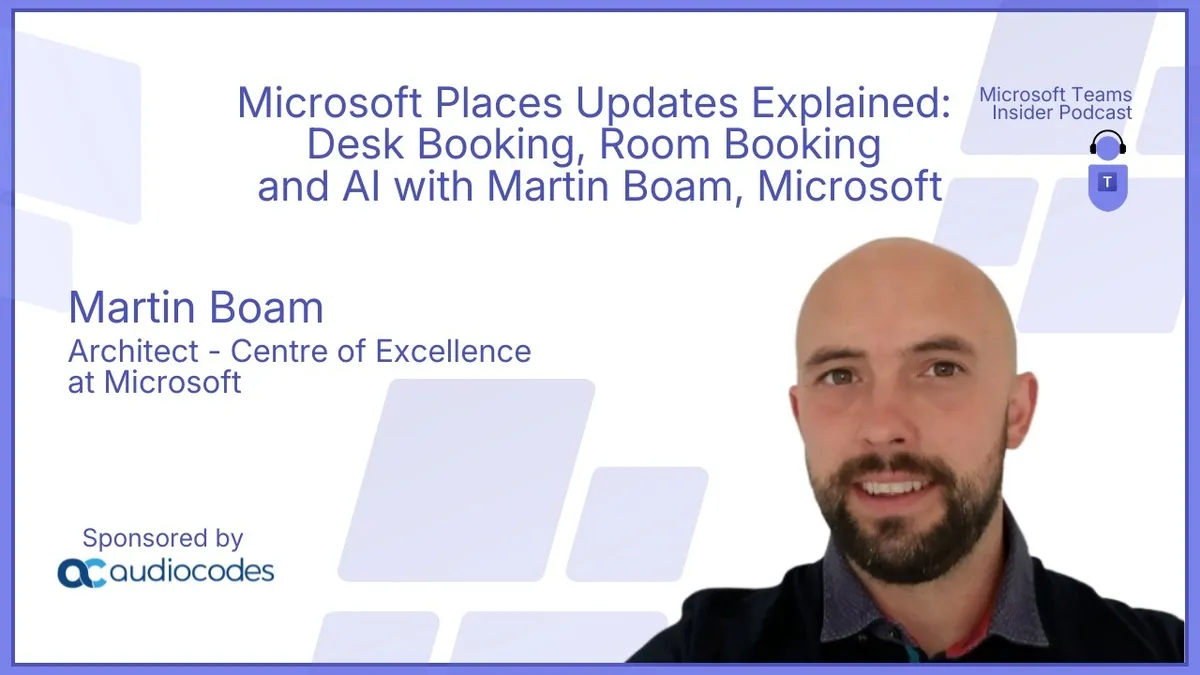
Microsoft Places Updates Explained: Desk Booking, Room Booking and AI with Martin Boam, Microsoft
Martin Boam, an Architect in Microsoft's Field and Partner Centre of Excellence, walks through the current state of Microsoft Places, covering the April 2025 licensing changes, room and desk booking demos, Wi-Fi-based work location, the new admin portal and where Copilot and Work IQ fit in.
Prefer audio?
Who should listen: Microsoft 365 service owners, workplace and facilities leads, and UC/AV professionals evaluating Places for hybrid working, room and desk booking, or trying to work out what the new Shared Spaces licensing means for them.
Guest: Martin Boam — Architect, Field and Partner Centre of Excellence, Microsoft
Martin Boam, an Architect in Microsoft's Field and Partner Centre of Excellence, walks through the current state of Microsoft Places, covering the April 2025 licensing changes, room and desk booking demos, Wi-Fi-based work location, the new admin portal and where Copilot and Work IQ fit in. He also shares the deployment resources and community sessions worth following for anyone rolling Places out.
Many thanks to Jabra, sponsor of this episode.
Key insights
- From 1 April 2025, the end-user Places features that previously sat behind Teams Premium — Places Finder and the Places app, including the map-based experiences — are included in Teams Enterprise licences, so most business and enterprise customers already have them. ▶ 8:46
- The old Teams Shared Device licence has been renamed the Shared Spaces licence. It covers four desks or spaces per licence and adds desk booking, space management and analytics — roughly $8 per licence, or about $2 per desk per month. ▶ 10:47
- Automatic work location updates from corporate Wi-Fi are now generally available but off by default: admins must enable it, there are Windows-side settings, and each user must individually opt in — an organisation cannot force it as policy. ▶ 23:35
- Simply enriching the room directory pays off before any advanced feature: Places Finder surfaces room photos, occupancy, whether the room is Teams Rooms enabled, the in-room device (a Logitech MeetUp in the demo) and custom metadata tags, all inside the Outlook scheduling form. ▶ 15:54
- Ad hoc desk check-in works by plugging into a peripheral at a bookable desk — the peripheral is mapped to the desk in the directory, so connecting reserves the space with no user action. ▶ 22:34
- Desk booking supports bookable, assigned, drop-in and offline desk modes, desk pools (the demo showed 10 of 12 free on floor two), multi-day and shorter-increment bookings, and searching for a colleague to grab a neighbouring desk — with each person controlling whether their desk location is shared. ▶ 25:36
- Copilot with Work IQ can handle booking conversationally in Outlook or chat — resolving a first-name-only contact, spotting an out-of-office, checking live room availability and proposing an alternative room and slot — but it requires a Microsoft 365 Copilot licence. ▶ 29:10
- The Places admin portal now replaces PowerShell for viewing the directory (buildings, floors, sections, rooms, desks), changing desk modes and assignments, setting auto-release policies (for example release after 10 minutes without check-in) and reviewing occupancy and no-show analytics — though some PowerShell is still required for other tasks. ▶ 32:12
- For rollout, use Matt Slonker's Places deployment guide with its worked example building and maps, the Places partner directory for discovery, design and mapping help, and the weekly Thursday office hours plus monthly demo day with the engineering team. ▶ 36:52
Insights summarised by AI from the episode transcript, reviewed by the Empowering.Cloud team.
Listen: Apple Podcasts · Spotify · Other platforms


Comments ()