Microsoft Mesh, Real-world Use cases and AI Futures
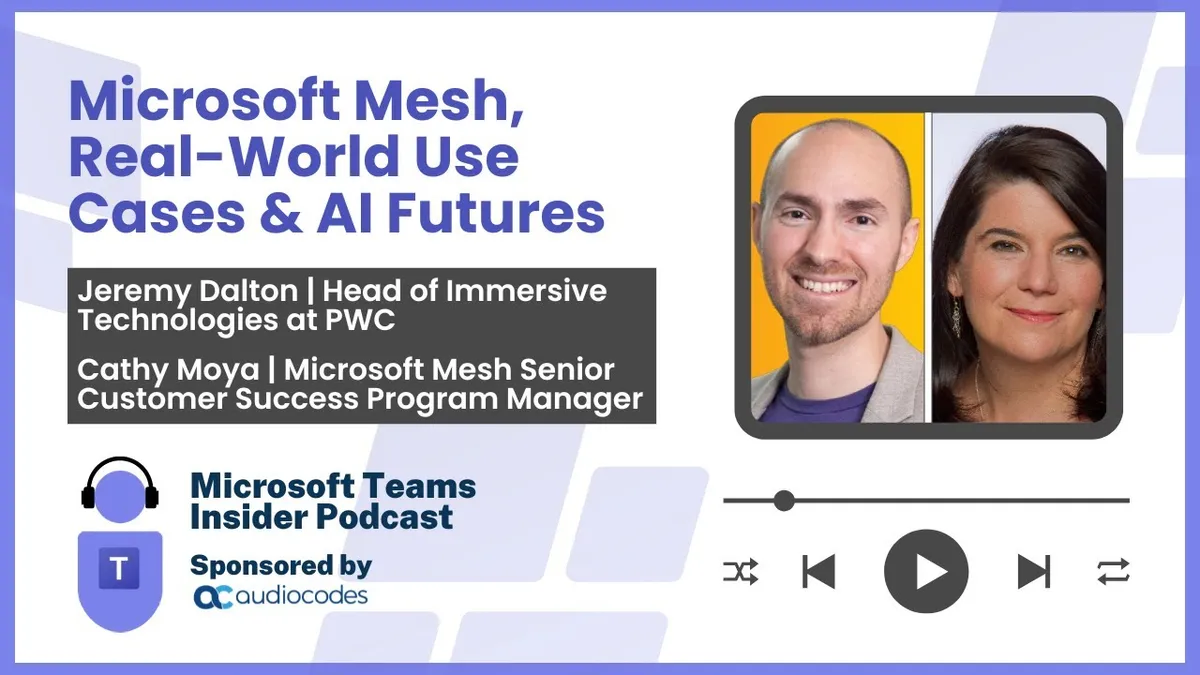
Jeremy Dalton, Head of Immersive Technologies at PwC, and Cathy Moya, Senior Customer Success Program Manager on the Mesh team at Microsoft, unpack what Mesh actually delivers today — avatars, immersive spaces, custom worlds and the licensing line between Teams core and Teams Premium.
Prefer audio?
Who should listen: Microsoft 365 service owners weighing whether to enable Mesh, licensing leads trying to pin down what needs Teams Premium, and collaboration and adoption specialists looking for credible immersive use cases beyond novelty.
Guest: Jeremy Dalton and Cathy Moya — Head of Immersive Technologies (PwC) and Senior Customer Success Program Manager, Mesh Team (Microsoft), PwC / Microsoft
Jeremy Dalton, Head of Immersive Technologies at PwC, and Cathy Moya, Senior Customer Success Program Manager on the Mesh team at Microsoft, unpack what Mesh actually delivers today — avatars, immersive spaces, custom worlds and the licensing line between Teams core and Teams Premium. They cover real customer deployments, research data on VR versus video conferencing, and where AI could take world-building next.
Many thanks to AudioCodes, sponsor of this episode.
Key insights
- Avatars and immersive spaces are reachable from the View menu inside an existing Teams meeting — no separate onboarding, two clicks, and it runs on a standard PC with keyboard and mouse rather than requiring a headset (Mac support was still to come). ▶ 2:35
- The licensing line is simple: anything built into the Teams client (avatars, immersive space) sits in core commercial licences including Business Basic, E3 and E5; the standalone Mesh app with custom worlds and customisation requires Teams Premium. Admins still need the app allowed and the right ports open. ▶ 13:22
- At launch Mesh was commercial-only — no EDU, no GOV, and frontline worker licences are not in scope because frontline staff are already in the physical environment. ▶ 13:53
- PwC's study with the University of Münster and the Ministry of Internal Affairs in Lower Saxony compared VR to video conferencing for deep remote collaboration such as agile planning: 16% increase in communication, 58% greater sense of togetherness, 11% higher satisfaction with workshop results and 15% greater psychological comfort — offset by greater fatigue, so reserve VR for deep collaboration rather than simple presentations. ▶ 7:46
- Psychological comfort is a repeatable benefit, not a nice-to-have: PwC's UK student recruitment programme found candidates felt less scrutinised and more able to engage when represented by an avatar they controlled, and it removed the need to be physically present at a campus stand. ▶ 11:49
- Custom environments are a three-tier build: ship-with defaults, a low-code path using the Mesh Toolkit uploaded from Unity (a Unity licence and basic familiarity needed), or a full Unity development effort with a partner for data-driven or digital twin scenarios. ▶ 15:25
- A cost case can beat the novelty case — an energy company built a virtual operations centre with dozens of virtual screens that would have cost roughly a quarter of a million pounds to build physically, and gave globally distributed operations staff a shared space to work incidents. ▶ 19:00
- Mercy Ships worked with partners to build a digital twin of its hospital ship for crew training, fundraising and access to secured areas such as the bridge — a reference point for organisations that cannot move a physical asset to their audience. ▶ 10:19
- AI-generated worlds are aspirational rather than shipping: the Ignite video on mesh.com showing environments spoken into existence is explicitly "not product truth", and the wider value comes from converging AI with AR and IoT rather than AI alone. ▶ 20:32
Insights summarised by AI from the episode transcript, reviewed by the Empowering.Cloud team.
Listen: Apple Podcasts · Spotify · Other platforms


Comments ()