Microsoft 365 Agents Explained - Declarative, Copilot Studio, Pro-Code or Skills in Copilot Cowork?
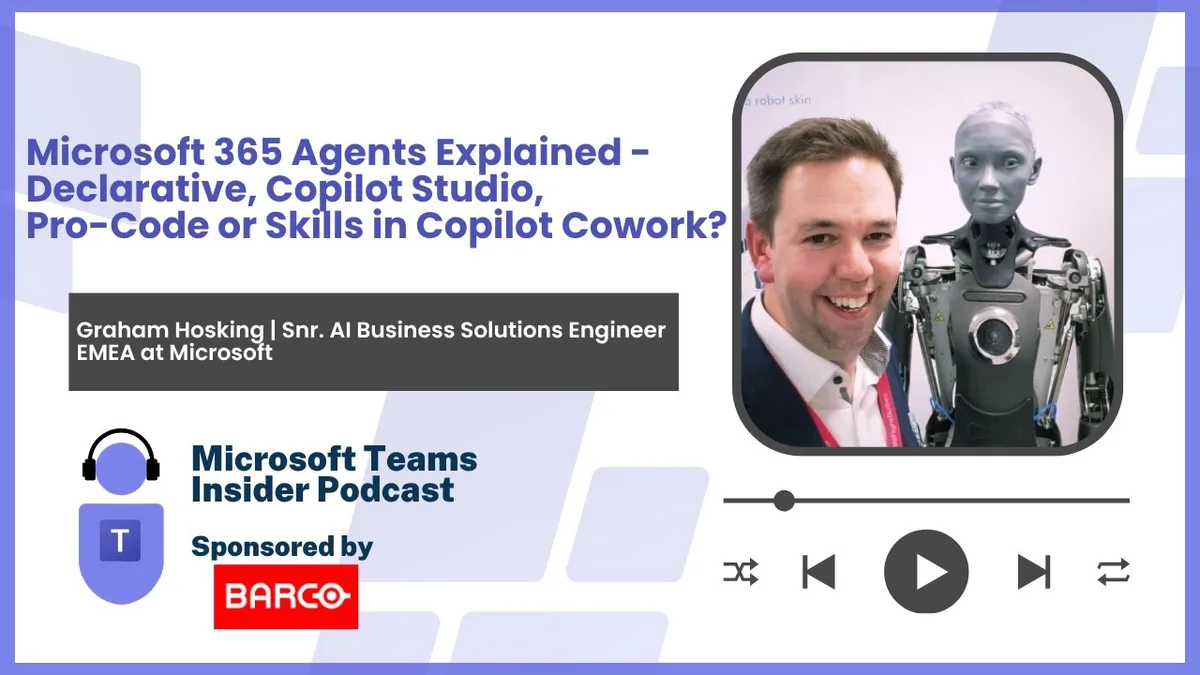
Graham Hosking, Senior AI Solutions Engineer at Microsoft covering around 54 ISV customers across Europe, unpacks the agent options in the Microsoft stack — from declarative Agent Builder through Copilot Studio to pro-code on Foundry — and explains where the new Skills and Copilot Cowork…
Prefer audio?
Who should listen: Microsoft 365 service owners, Copilot and Power Platform admins, and solution architects deciding between declarative agents, Copilot Studio, pro-code Foundry builds and the new Skills/Cowork approach for real business process automation.
Guest: Graham Hosking — Senior AI Solutions Engineer, Microsoft
Graham Hosking, Senior AI Solutions Engineer at Microsoft covering around 54 ISV customers across Europe, unpacks the agent options in the Microsoft stack — from declarative Agent Builder through Copilot Studio to pro-code on Foundry — and explains where the new Skills and Copilot Cowork capabilities change the calculus. He walks through a complex RFP automation he originally scoped as seven or eight agents and ended up delivering as four or five skills.
Many thanks to Barco, sponsor of this episode.
Key insights
- Generative AI is only the 'brain' of an agent — Hosking's car analogy: knowing how to drive is useless without wheels, an engine and steering. The AI doesn't do the job; it decides which deterministic tools are right and executes them, so knowledge and tooling matter as much as the model. ▶ 5:34
- Choose the tier by the workload, not by preference: Agent Builder for slider-driven declarative agents, Copilot Studio for no/low-code, and Foundry pro-code when you need things the UI can't express. One customer's RFP process needed recursive looping, which pushed it out of Copilot Studio and into Foundry agents combined with Studio. ▶ 7:38
- Pro-code has become the easier option for complex orchestration because agent frameworks give more flexibility and GitHub Copilot and Claude do the heavy lifting — Hosking now builds things he'd previously never have attempted because of time cost. ▶ 9:42
- The practical split: Copilot for a quick single-threaded answer, Cowork for multi-threaded work — culling meetings, reprioritising and filing email, drafting and actually sending, and scheduled runs. Hosking has Cowork build a single HTML dashboard every day at 17:00 covering all 54 of his customers, pulled from email, meetings, transcripts, recordings and OneNote via Work IQ. ▶ 15:48
- Skills are reusable markdown blocks of instructions, not static files — you can tell Cowork the process has changed and it will rewrite the skill and associated assets. They can also call deterministic actions such as Python scripts, and only the relevant skill loads into context rather than every agent's full instruction set. ▶ 24:26
- The trade-off on skills vs enterprise agents: skills let the two or three SMEs who own a process iterate without queueing for developer time, but a regulated, audited process (pharma was the example) still wants rigid agents nobody can casually edit. Skills are also a fast way to prove a process out before committing development effort. ▶ 24:57
- Plugins have just landed in Cowork, with custom plugins and MCP servers next — that opens line-of-business systems such as Salesforce via customer-hosted MCP servers. Windows 365 plugins also bring computer use to Cowork, which matters for the long tail of internal apps that will never get an API or MCP wrapper. ▶ 18:52
- Anthropic models are off by default in the UK and EU: there is a Microsoft–Anthropic DPA covering training on business data, but the sub-processor may sit outside your sovereign region. You need them enabled to use Cowork and the Word/Excel/PowerPoint agents, and per-subset-of-users enablement is now on the roadmap. ▶ 36:11
Insights summarised by AI from the episode transcript, reviewed by the Empowering.Cloud team.
Listen: Apple Podcasts · Spotify · Other platforms



Comments ()