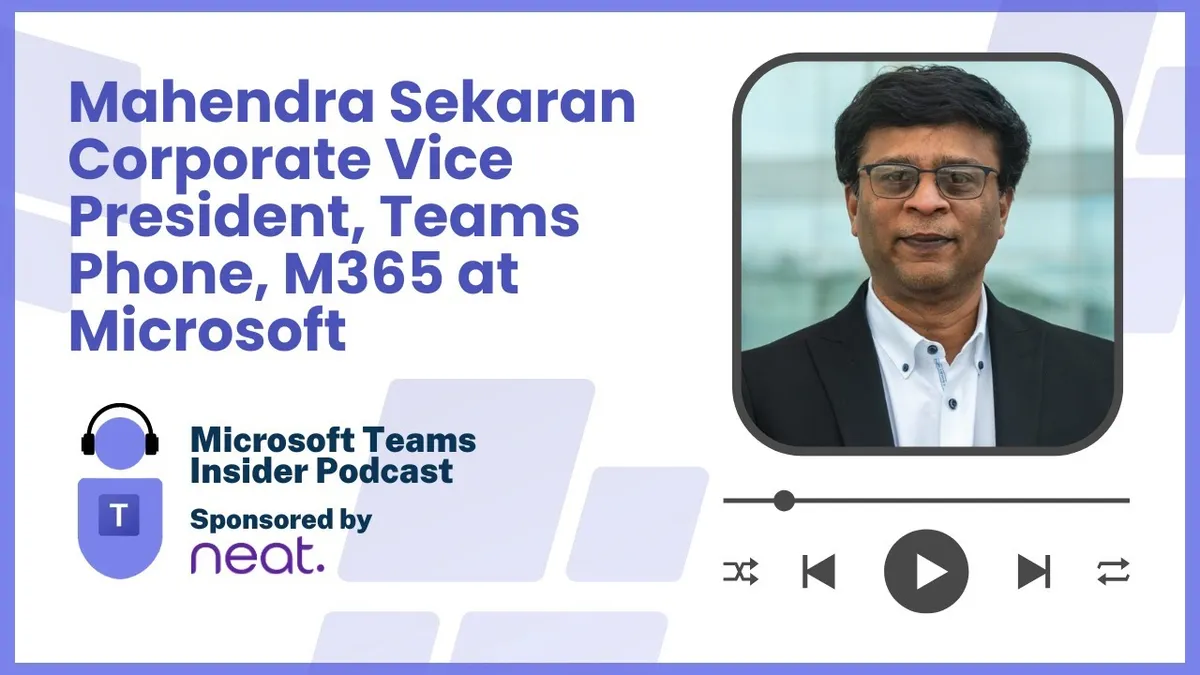
Mahendra Sekaran, Corporate Vice President Teams Phone, M365 at Microsoft
Mahendra Sekaran is Corporate Vice President for Teams Phone in Microsoft 365, leading the IC3 (Intelligent Conversations and Communications Cloud) organisation as well as Microsoft's global telco strategy, after 19 years working on unified communications from Live Communications Server onwards.
Prefer audio?
Who should listen: Microsoft 365 service owners running or planning Teams Phone, telco and Operator Connect partners, and anyone weighing calling plans versus direct routing, Shared Calling or Teams Phone Mobile.
Guest: Mahendra Sekaran — Corporate Vice President, Teams Phone, M365, Microsoft
Mahendra Sekaran is Corporate Vice President for Teams Phone in Microsoft 365, leading the IC3 (Intelligent Conversations and Communications Cloud) organisation as well as Microsoft's global telco strategy, after 19 years working on unified communications from Live Communications Server onwards. He explains how IC3, Azure Communication Services and the Teams client fit together, where PSTN connectivity and Teams Phone Mobile are heading, and what FY25 investment looks like across reliability, delegated administration and AI in the calling experience.
Many thanks to Neat, sponsor of this episode.
Key insights
- IC3 is best understood as the service half of a client-server split: a shared set of microservices for calling, messaging and meetings, plus the media and codec stack, built on the Substrate and powering both Teams and consumer Skype. Teams is where those services light up as an experience. ▶ 5:37
- ACS plays two roles: a third-party extender that lets developers embed calling, SMS and video into line-of-business apps (his example: a healthcare app where nurses never switch to Teams), and a first-party connector giving those apps interop with Teams so staff can still reach subject matter experts on Teams. ▶ 7:42
- Offering first-party calling plans in 35 countries means Microsoft is a regulated telco in each of them — a team works with legal and local regulators on outage reporting, taxation and compliance. Sekaran describes Microsoft as having a broader telco footprint than most carriers, alongside 90-plus (now 97) Operator Connect partners, with no stated preference between calling plans, Operator Connect and direct routing. ▶ 10:44
- Teams Phone has moved from three nines to four nines to five nines reliability, and Sekaran is blunt that going from four to five is orders of magnitude harder. His internal push is 'zero customer-reported incidents' — not zero incidents, but detecting and mitigating them before a customer opens a support ticket. ▶ 13:47
- AI Ops work over the past 18 months uses LLMs to read the reported problem, auto-resolve from the knowledge base and troubleshooting guides, or route to the correct engineering team. The 'time in engineering' metric — ticket routing from support to engineering — has been cut by half. ▶ 14:49
- He concedes admins do not get enough depth from Teams admin centre analytics to see how their users actually experience the product, particularly with an aggregate view across direct routing, calling plans and multiple Operator Connect providers. Tom's ask: AI that says 'spend your time on this Wi-Fi at this site' instead of trawling 30 Power BI reports. ▶ 16:20
- Teams Phone is at 20 million users, and VoIP calling growth counts as phone system value — users chat and hit call rather than dialling through a PBX for internal calls. ▶ 17:53
- Shared Calling was built in direct response to customers hunting IT budget to fund AI and auditing users who made one PSTN call last month: it cuts per-user number cost while keeping 911/local regulatory compliance and inbound reachability. Sekaran also expects a five-year shift away from fixed lines, with emerging markets like India and Indonesia mobile-first and some Scandinavian markets targeting 100% mobile around 2028. ▶ 24:03
- FY25 priorities: AI in the core calling flow (Copilot inferring which 'Stephanie' to add to a call rather than typing a name), better delegated administration so partners can manage a tenant without global admin — building on administrative units — and in-product capability to demystify PBX-to-cloud migration for customers who see the value but do not know where to start. ▶ 26:08
Insights summarised by AI from the episode transcript, reviewed by the Empowering.Cloud team.
Listen: Apple Podcasts · Spotify · Other platforms


Comments ()