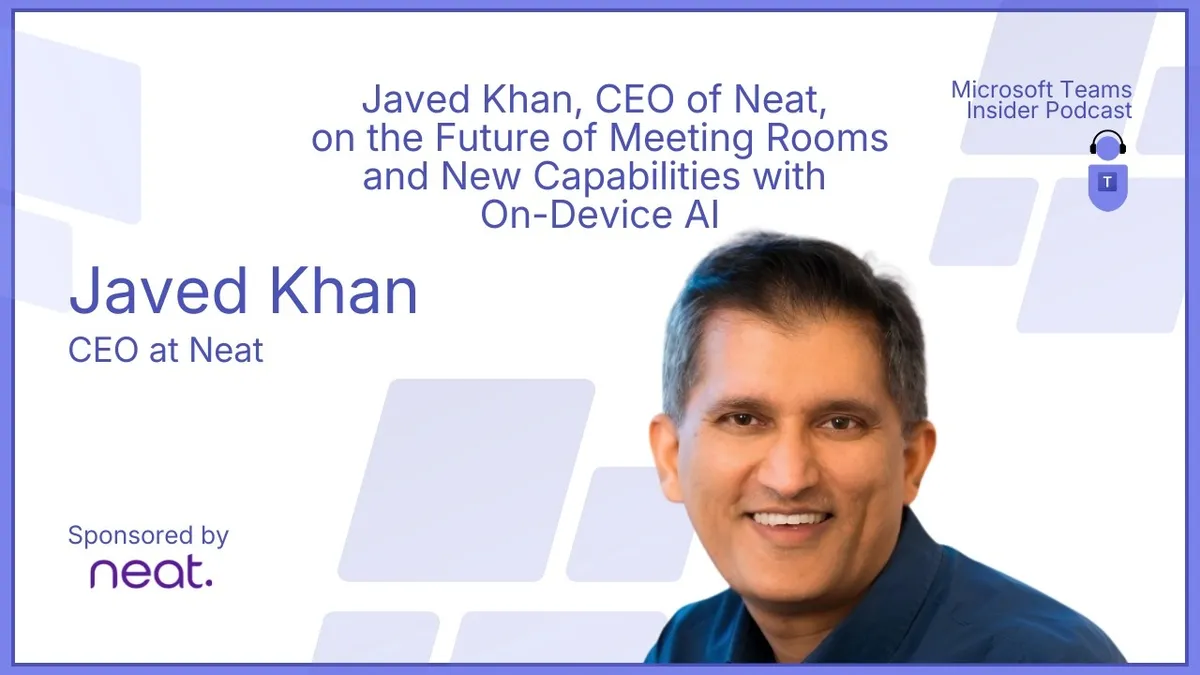
Javed Khan, CEO of Neat, on the Future of Meeting Rooms and New Capabilities with On-Device AI
Javed Khan, four months into the CEO role at Neat and previously head of Cisco's collaboration business and a stint at autonomous driving software firm Aptiv, sets out his view on where meeting room technology goes next.
Prefer audio?
Who should listen: Microsoft 365 service owners, AV and UC managers running multi-platform room estates, and anyone evaluating on-device AI, MDEP migration or agent-driven device management.
Guest: Javed Khan — CEO, Neat
Javed Khan, four months into the CEO role at Neat and previously head of Cisco's collaboration business and a stint at autonomous driving software firm Aptiv, sets out his view on where meeting room technology goes next. The conversation covers on-device AI and edge compute, room management via Neat Pulse and a new MCP server, multi-platform neutrality, and Neat's work with Microsoft on MDEP.
Many thanks to Neat, sponsor of this episode.
Key insights
- The shift Khan sees is not AI itself but the amount of compute and the size of models that can now be packed into a room device — work that previously had to run in a data centre, if it could run at all, can now run locally on the endpoint. ▶ 3:41
- Running AI on the device solves three things at once: capability, latency (no round trip to the cloud) and privacy. Khan argues customers who were nervous about real-time transcription and translation in the cloud can now be told content never leaves the campus. ▶ 5:13
- Customers have largely made their platform decisions; the friction they now report is moving between platforms during the day and still needing an extra click or a phone call when walking into an unfamiliar room. Khan is blunt that the industry has not done enough here. ▶ 7:16
- Room devices are increasingly used for non-meeting workloads — wayfinding, internal messaging — which adds to the management burden across a multi-vendor estate. ▶ 8:19
- Neat's MCP server exposes Neat Pulse data to agents and is being built as two-way, so an agent can take action (send a message to a device, reboot it) rather than just read telemetry — with access control and security wrapped around it. ▶ 12:54
- MCP lets Neat skip point-to-point integrations: Pulse data and alerts can be bridged to ServiceNow, Salesforce or another ticketing system via the protocol rather than a direct build for each. ▶ 11:24
- Khan's view on management UI: rather than surfacing jitter and latency metrics that some admins want and others ignore, a conversational layer should abstract them away entirely — use AI to eliminate the complexity, not just re-skin it. ▶ 13:54
- Install cost, not hardware cost, is the pressure point — Khan cites spending an extra $30,000 to commission a $10,000 device, which is why Neat pushes an all-over-IP, distributed AI room architecture. ▶ 17:55
- Neat has committed to MDEP across its portfolio as new devices ship; the payoff Khan expects is answering the customer question of which Android/OS version is running and how it gets patched, plus a standardised base OS that means building functionality once for the whole Microsoft ecosystem. ▶ 19:26
Insights summarised by AI from the episode transcript, reviewed by the Empowering.Cloud team.
Listen: Apple Podcasts · Spotify · Other platforms


Comments ()