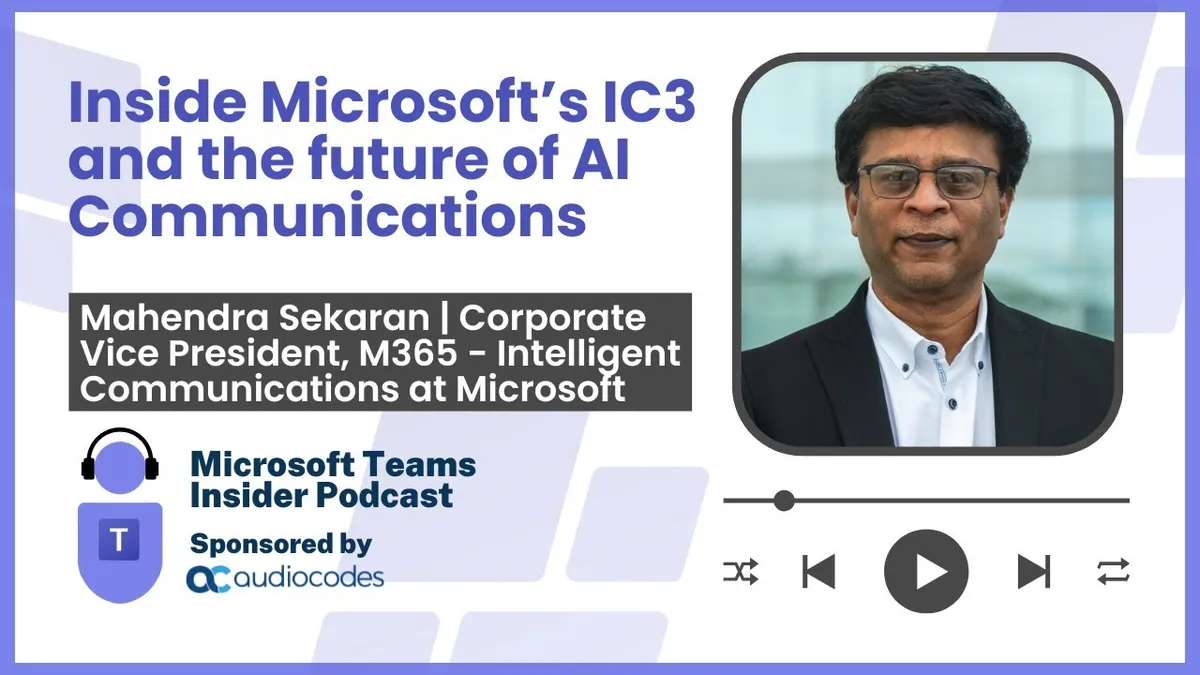
Inside Microsoft’s IC3 and the future of AI Communications with Microsoft CVP Mahendra Sekaran
Mahendra Sekaran is the Microsoft CVP responsible for product management and data science across IC3 (Intelligent Conversations and Communication Cloud), the media, messaging, calling and PSTN platform beneath Teams, Dynamics and Copilot.
Prefer audio?
Who should listen: Microsoft 365 service owners, Teams Phone and voice architects, and UC product and partner teams who want a view of Microsoft's platform-level AI direction for calling and comms, and of how AI tooling is changing engineering and operations behind the service.
Guest: Mahendra Sekaran — Corporate Vice President, product management and data science for IC3, Microsoft
Mahendra Sekaran is the Microsoft CVP responsible for product management and data science across IC3 (Intelligent Conversations and Communication Cloud), the media, messaging, calling and PSTN platform beneath Teams, Dynamics and Copilot. He talks to Tom Arbuthnot about reimagining the phone experience with AI, agentic scaling in 2026, and how AI tooling is reshaping engineering, operations and product management inside Microsoft.
Many thanks to AudioCodes, sponsor of this episode.
Key insights
- IC3 is the core comms and collab platform for the whole of Microsoft — media stack, messaging, calling and PSTN connectivity — underpinning the 320 million monthly active Teams users and 26 million PSTN users, plus Dynamics, Copilot and Copilot Studio multimodal interactions. ▶ 2:05
- Sekaran's candid view on Microsoft's own AI adoption: asked whether IC3 has fully reimagined itself as AI-native engineers and product managers, "the answer is no" — progress is a series of incremental wins rather than a wholesale change, and internal resistance is habit-driven muscle memory, not technical. ▶ 5:41
- Microsoft's bet is that frontier models will not be the differentiating moat; the differentiation sits in the experiences and layers built on top. Evals and evaluation frameworks are where IC3 is investing heavily, because LLMs are inherently probabilistic — one leader calls the eval work "crawling over glass". ▶ 7:45
- IC3 provides the core media technology behind Copilot voice mode, including voice isolation and noise suppression, and runs evals that deliberately inject environmental noise to test how the system behaves. ▶ 8:16
- Expect every part of the phone experience to be reimagined with AI. Copilot for Phone transcription is described as "table stakes"; the work in flight is intelligence wrappers around customer engagement, call queues and individual call handling, with comms becoming part of a workflow rather than a point-in-time activity. ▶ 8:47
- 2026 is framed as the year of scaling agentic AI across the industry, with Teams evolving from the hub where humans connect into the place where agents interact with humans and where work actually gets done. ▶ 11:51
- On the 10x engineer ambition for large, decades-old distributed systems: coding is only 5–10% of a developer's time on a pull request — the rest is security tokens, environments, validation and flighting to a production ring. Optimising the pipeline matters more than optimising code generation, and startup-style throughput is not a realistic benchmark. ▶ 13:53
- AIOps in production: IC3 has built an on-call engineer agent that correlates a new incident with similar past incidents and suggests (or, with human confirmation, executes) remedial action, plus a repair item agent tracking follow-ups. A problem management discipline stood up three years ago to theme customer support requests produced a noticeable drop in ticket volume, and agents now mine M365 customer voice feedback for actionable themes. ▶ 15:56
- Self-serve data agents over a centralised data lake have collapsed the PM analytics cycle from a two-week ask to a data engineer into near-real-time conversation — letting PMs drill from one answer into three more questions before presenting a view. ▶ 18:30
- A likely next theme is granular personalisation of the UI itself: for a heavy calling user, Teams could navigate automatically to the right surfaces and pre-assess intent, cutting clicks by multiple factors. ▶ 20:32
Insights summarised by AI from the episode transcript, reviewed by the Empowering.Cloud team.
Listen: Apple Podcasts · Spotify · Other platforms



Comments ()