How to RFP for Global Microsoft Teams Migration and Managed Services
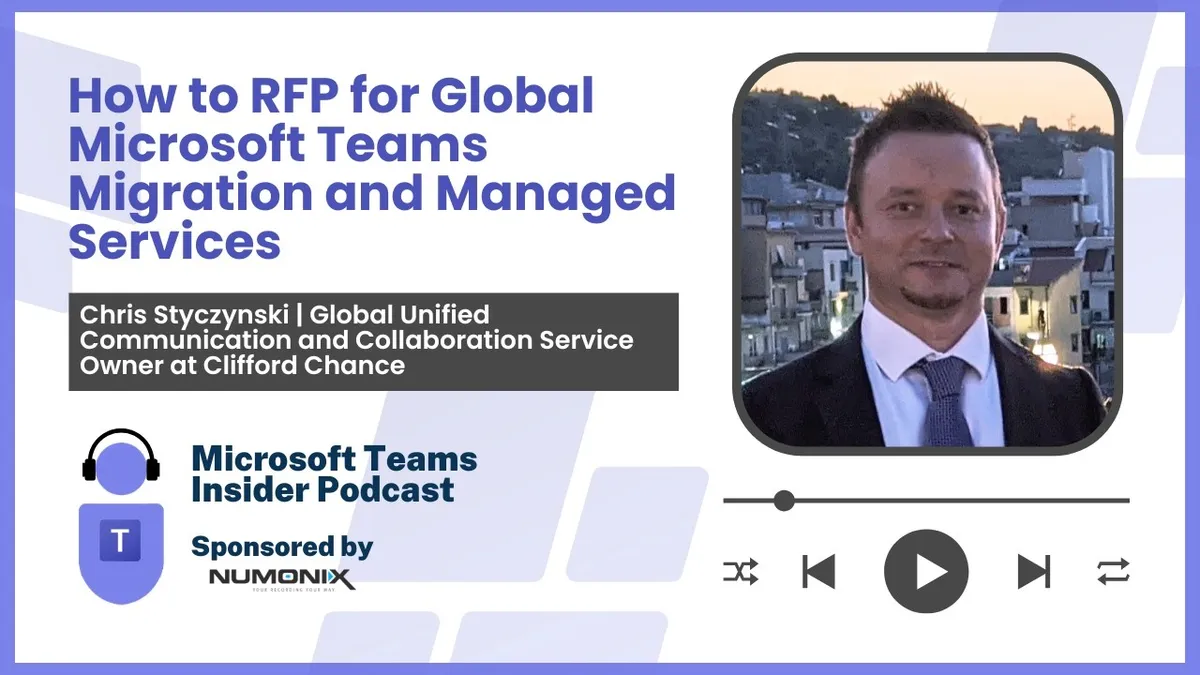
Chris Styczynski owns unified communications and collaboration at global law firm Clifford Chance, covering email, telephony, Teams and meeting rooms for around 8,000 users across 20-plus countries.
Prefer audio?
Who should listen: Microsoft 365 and UC service owners planning a PBX-to-Teams Phone migration, particularly in multinational organisations, plus procurement leads and partners responding to large collaboration RFPs.
Guest: Chris Styczynski — Service Owner, Unified Communication and Collaboration, Clifford Chance
Chris Styczynski owns unified communications and collaboration at global law firm Clifford Chance, covering email, telephony, Teams and meeting rooms for around 8,000 users across 20-plus countries. He walks through the firm's six-lot RFP to move from Cisco on-prem telephony to Teams Phone, from the initial RFI and vendor shortlisting to Operator Connect coverage gaps, proof-of-value gates and choosing a partner for an 18-month migration plus managed service.
Many thanks to Numonix, sponsor of this episode.
Key insights
- The RFP was deliberately split into six lots so the firm could mix suppliers: (1) Cisco on-prem to Teams Phone migration including run books, training and change management, (2) switchboard and office reception numbers, (3) contact centre, (4) Operator Connect/PSTN, (5) on-site support, (6) managed services. The aim was to avoid being forced into a single partner for everything. ▶ 7:17
- Switchboard was pulled out as its own lot, separate from both telephony and contact centre, because the main office number is the front door for prospective clients and the product market for it is distinct and worth understanding properly. ▶ 7:47
- An RFI was run first, kept deliberately high level so neither side wasted effort, across three categories: large telcos, multinational integrators, and smaller UK partners from Microsoft's partner directory. It revealed that some big providers did not consider an 8,000-seat law firm large enough to bid — a useful filter, since "you want to be important to your partner". ▶ 4:41
- Operator Connect was specified by name rather than generic PSTN connectivity, with direct routing and on-prem SBCs accepted only as a transitional step. Where Operator Connect is unavailable — Middle East, China, India — the plan is direct routing as a service to fill the gaps. ▶ 16:36
- For switchboard and contact centre, the RFP and statement of works include a proof-of-value gate before any contractual commitment, with operators and contact centre agents involved in the evaluation, rather than buying on the paper response alone. ▶ 18:37
- Requirements gathering ran from September to a decision a few weeks before recording, with shortlisted partners brought into the London office to present their proposed solution. Copilot helped analyse the very detailed written responses, but Styczynski warns you still have to put your own time in to do it properly. ▶ 13:00
- Managed services was the hardest lot because it was extended to cover the meeting room estate — a mix of native Cisco video devices and Teams Rooms, integrated with Crestron and Extron control and Sennheiser microphones — and the firm wanted a partner product and support structure to manage that multi-vendor estate better than it does today. ▶ 14:34
- Partner fit was scored on more than technical skill: culture, location, communication style and flexibility, on the basis that a project of roughly 18 months cannot be fully agreed up front and a cookie-cutter supplier will resist change. ▶ 20:38
- Business analysis with users before going to market was essential: telephony has become less important to some users and requirements have shifted with AI and collaboration tooling, so understand what to complement Teams with — switchboard, recording, AI agents — before writing the questionnaire. ▶ 19:38
Insights summarised by AI from the episode transcript, reviewed by the Empowering.Cloud team.
Listen: Apple Podcasts · Spotify · Other platforms


Comments ()