How to be More Efficient whilst Staying Compliant: Considerations for Teams Meeting Recordings & Transcripts
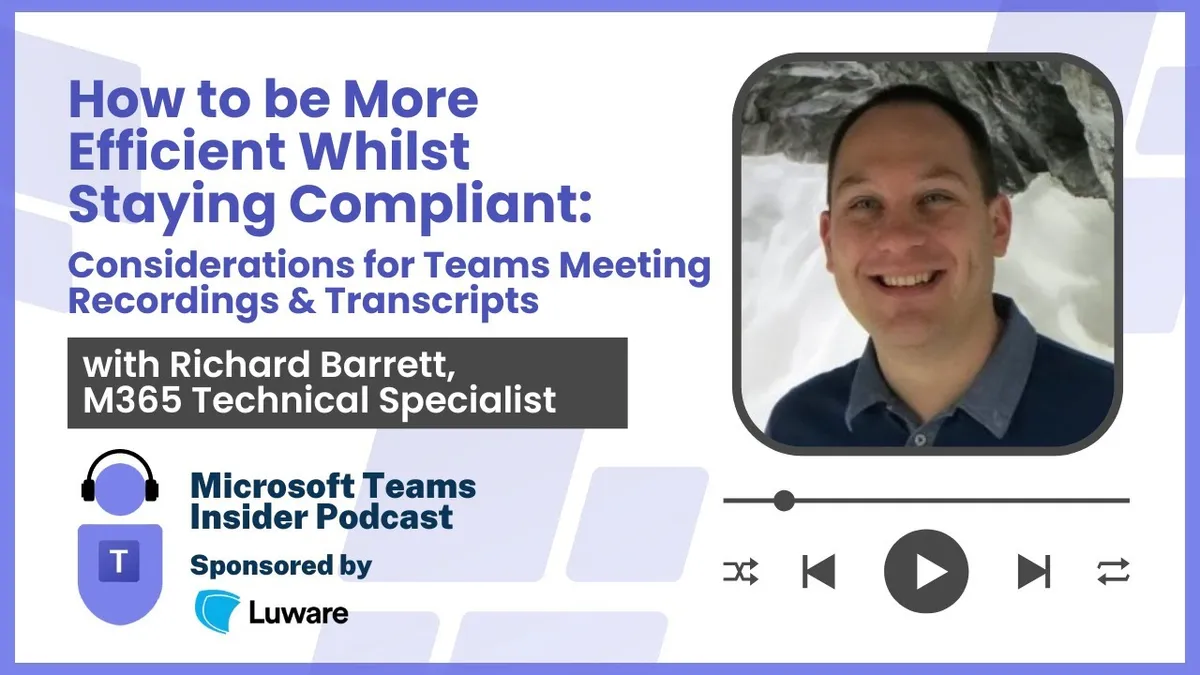
Richard Barrett, a Microsoft 365 technical specialist at Microsoft UK working with professional services customers such as law and accountancy firms, joins Tom Arbuthnot to unpack the recording and transcription controls available in Teams today and what is arriving on the roadmap.
Prefer audio?
Who should listen: Microsoft 365 service owners, compliance and IT leads in regulated or professional services organisations, and anyone building the governance case for enabling Teams recording, transcription, Teams Premium or Copilot.
Guest: Richard Barrett — Microsoft 365 Technical Specialist, Microsoft
Richard Barrett, a Microsoft 365 technical specialist at Microsoft UK working with professional services customers such as law and accountancy firms, joins Tom Arbuthnot to unpack the recording and transcription controls available in Teams today and what is arriving on the roadmap. The conversation covers explicit consent, transcript access controls, recording ownership, download blocking, and where Teams Premium and Copilot actually deliver value in highly regulated sectors.
Many thanks to Luware, sponsor of this episode.
Key insights
- Copilot and Intelligent Recap have changed the recording conversation: customers who previously ruled out recording are now asking what controls they can wrap around it so they can record or transcribe rather than blocking outright. ▶ 2:00
- Explicit consent for recording shipped around March and is part of core Teams — no Teams Premium licence needed. Participants are effectively locked out of engaging in the meeting until they give consent or leave, and Barrett advises reading the detailed documentation because there are nuances. ▶ 4:33
- Explicit consent for transcription is following recording consent onto the roadmap. Both Tom and Barrett report customers who don't want the video at all but do want transcripts for Copilot — transcription is perceived as a 'lighter ask' than recording. ▶ 3:30
- Convenience recordings currently land in the OneDrive of whoever pressed record, which creates a sharing headache as much as a compliance one. A roadmap change moves where recordings are saved so ownership isn't tied to the person who hit the button. ▶ 5:33
- A June roadmap item gives meeting organisers control over who can view meeting assets — for example, only the organiser sees the transcript. This solves the board-meeting scenario where a guest joins for ten minutes and would otherwise get the transcript of everything discussed before they arrived. ▶ 6:33
- Copilot already works on transcript only with no recording, and Intelligent Recap with transcript only is on the roadmap for June. ▶ 8:35
- Downloading of meeting recordings can be blocked with a single PowerShell command, though it requires the SharePoint Advanced Management licence — useful where organisations are happy to record but don't want local copies leaving OneDrive. ▶ 11:39
- In professional services, meeting branding via Teams Premium is a genuine differentiator — clients receiving meeting invites from four competing firms otherwise see identical lobby screens. Watermarking is used selectively, and mostly on shared content rather than video, since it can't stop a phone camera but does identify the source of a leak. ▶ 13:09
- The Copilot apps that resonate most in these industries are Outlook, Teams, graph-grounded Chat and Word — not PowerPoint or Excel. Barrett highlights 'master prompts' in Word that review an NDA against a fixed list of five or six clauses as a concrete time-saver, and notes that in time-and-materials firms every hour saved on admin converts to billable time. ▶ 18:12
Insights summarised by AI from the episode transcript, reviewed by the Empowering.Cloud team.
Listen: Apple Podcasts · Spotify · Other platforms


Comments ()