How Microsoft, Zoom, and Cisco Are Approaching AI Differently With Kevin Kieller, enableUC
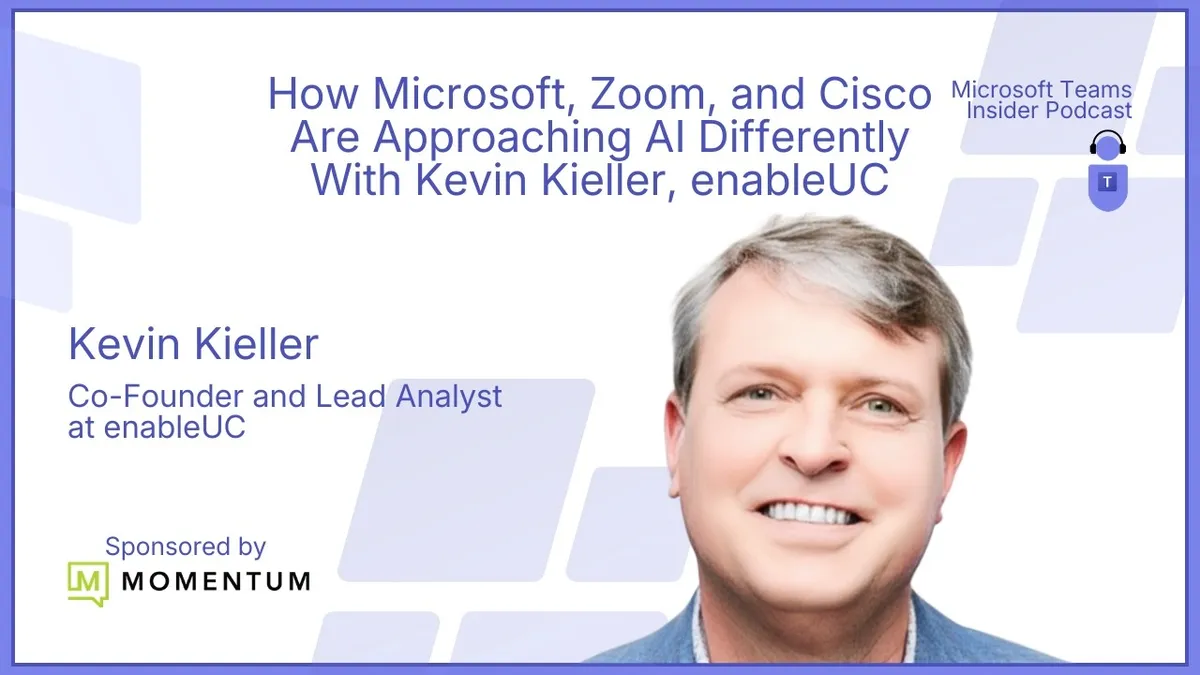
Kevin Kieller, co-founder and lead analyst at enableUC, splits his time between enterprise consulting and advising vendors on competitive positioning. He compares how Microsoft, Zoom and Cisco are each approaching AI, and where pricing, data context and agentic hype are heading next.
Prefer audio?
Who should listen: Microsoft 365 service owners, UC and AV architects and IT leaders weighing vendor AI strategies, AI consumption pricing and how the admin role changes as end users get agentic tooling.
Guest: Kevin Kieller — Co-Founder and Lead Analyst, enableUC
Kevin Kieller, co-founder and lead analyst at enableUC, splits his time between enterprise consulting and advising vendors on competitive positioning. He compares how Microsoft, Zoom and Cisco are each approaching AI, and where pricing, data context and agentic hype are heading next.
Many thanks to Momentum, sponsor of this episode.
Key insights
- The three big vendors have distinct AI philosophies: Microsoft went for maximal deployment at speed (Copilot bolted onto every product, some of it initially poor, now consolidating into a common context layer via Work IQ), Zoom took a simplicity-first line with AI Companion at no extra cost, and Cisco leans on ambient, proactive AI — noise cancellation, detecting you left frame and offering a seven-minute catch-up, or a polling agent that suggests a poll when it hears a debate. ▶ 7:12
- Feature parity is real on core UCaaS: all top-tier and even second and third-tier platforms handle meetings well, and feature growth has outpaced adoption — Kieller reckons it is closer to a 60/40 rule than 80/20 on features actually used, so RFP feature lists are a weak basis for selection. ▶ 6:10
- The counter to feature bloat (Kieller counted around 20 icons in a Teams chat bar versus five or six in Zoom's) is AI that acts proactively — auto-blurring a busy background or auto-muting the noisy participant in a 250-person webinar rather than exposing another dropdown. ▶ 11:19
- Flat-rate AI cannot last: Zoom Mate (launched early June) ships with consumption-based AI credits, Microsoft already meters certain agent scenarios, and Cisco's agents mix credits and included capacity. Arbuthnot argues Cowork and Scout cannot stay inside a flat plan past the current Microsoft financial year, pointing at OpenAI and Anthropic moving enterprise customers to pure consumption while consumer $100/$200 plans stay loss leaders. ▶ 14:54
- Consumption pricing creates a message conflict — telling staff to use AI to be more competitive, then adding "but not too much". Kieller sees a commercial opening for whoever can offer a predictable fixed-cost plan, in the way pooled 3,000-minute Microsoft calling plans were effectively unlimited. Guidance like Zoom's support-page advice to write detailed prompts and avoid regenerating whole documents is asking too much of end users. ▶ 20:00
- Context beats model quality: the risk is not the model but not knowing what it looked at. Chat summaries default to roughly 30 days back, SharePoint queries hit a 300-document limit, and Teams once used different lookbacks for meeting chat, channel chat and 1:1 chat. Kieller praises Zoom's UI for prompting week/month/quarter and letting you deselect specific meetings, and calls for vendors to surface the boundaries in the answer. ▶ 26:10
- Access to the semantic index is becoming the next billing battleground — Microsoft is adding an API charge to Work IQ (free if you use first-party Copilot, chargeable for ServiceNow, ChatGPT or Claude agents), and Salesforce and ServiceNow are looking at API charges as per-seat models break when one seat is being hammered by 50 agents. Arbuthnot questions whether Graph stays free given it was never designed for that query volume. ▶ 28:43
- Rooms are the strongest case for edge AI: with multi-camera AI direction you cannot stream four or five concurrent feeds to the cloud and process every frame at scale, which is why Cisco is putting NVIDIA silicon in room devices — also better for latency and keeping content out of the cloud. ▶ 23:05
- Vendors have search-and-replaced "AI" with "agentic"; Kieller's advice is to start from the business outcome (more sales, lower cost) rather than the technology, and to make sure whoever is experimenting shares findings with peers in the same role, because the measurable benefits come from specific departmental use cases rather than horizontal features. ▶ 31:48
Insights summarised by AI from the episode transcript, reviewed by the Empowering.Cloud team.
Listen: Apple Podcasts · Spotify · Other platforms


Comments ()