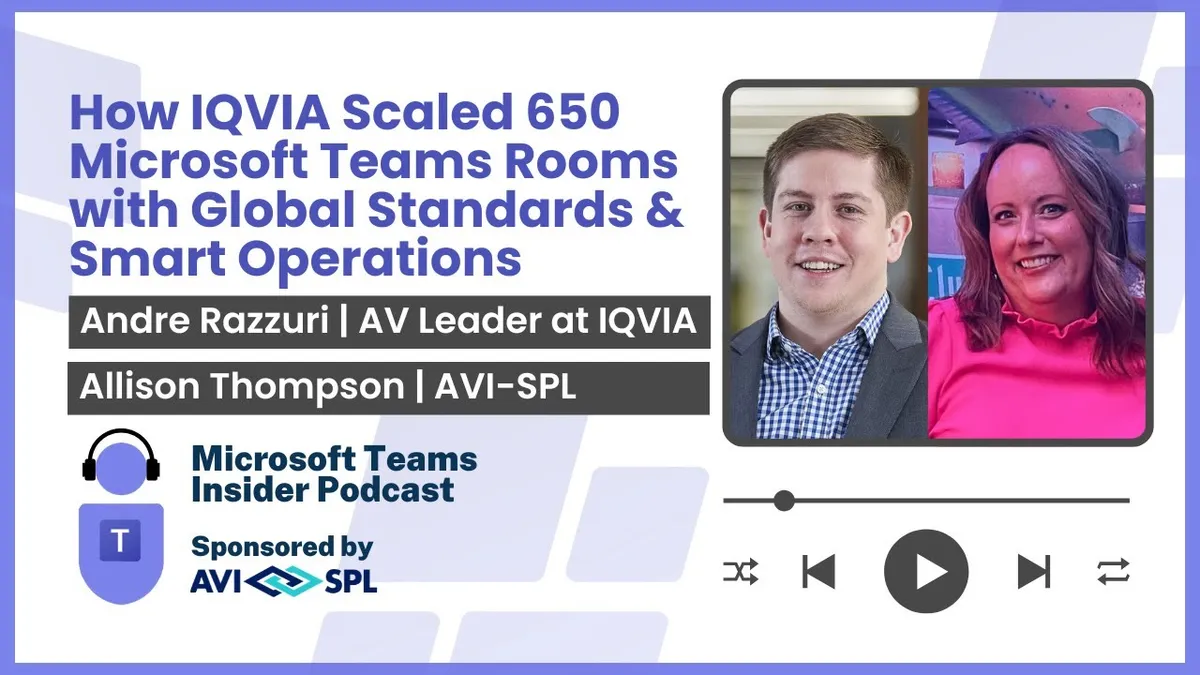
How IQVIA scaled 650 Microsoft Teams Rooms with Global Standards & Smart Operations
Andre Razzuri, Associate Director at IQVIA, describes how a five-person core team has taken the global pharma services business from Cisco, HP Poly and Lifesize SIP endpoints to roughly 650 Lenovo Windows 11 Teams Rooms at around 200 rooms a year.
Prefer audio?
Who should listen: Microsoft 365 service owners, UC/AV managers and workplace technology leads planning or scaling a multi-hundred-room Teams Rooms estate, particularly those weighing in-house deployment against integrator support and trying to hold global standards across regions.
Guest: Andre Razzuri — Associate Director, IQVIA
Andre Razzuri, Associate Director at IQVIA, describes how a five-person core team has taken the global pharma services business from Cisco, HP Poly and Lifesize SIP endpoints to roughly 650 Lenovo Windows 11 Teams Rooms at around 200 rooms a year. He is joined by Allison Thompson of AVI-SPL, who explains how the partner handles the higher-end boardrooms and regional rollouts alongside IQVIA's in-house deployments.
Many thanks to AVI-SPL, sponsor of this episode.
Key insights
- The cost case did most of the persuading: IQVIA's legacy SIP rooms ran $75,000–$100,000 for a 12-person space, so moving to Lenovo Windows MTRs delivered a step change in savings and let video move out of VIP rooms into every space. ▶ 6:40
- Scaling was deliberately incremental — 15 systems in the London office in 2021 for rooms of 12 people and under, then boardrooms, training rooms, ceiling mic grids, wireless mics and projectors only once the small/medium estate was proven. Roughly 200 rooms a year since. ▶ 4:38
- IQVIA keeps sign-off privileges and builds the material lists itself, then hands them to local teams to execute with vendors. Andre's view: outsourcing standards to consultants is pointless if nobody enforces them. ▶ 8:42
- Global parity sits at about 99.8–99.9%; the only routine deviation is substituting network switches in APAC regions where specified hardware is hard to source. ▶ 8:42
- A core team of five — North Carolina, Kansas City, Singapore and Shanghai — supports the estate because supportability was the first selection criterion: two routes to remote into any touch panel, RDP that can be enabled and disabled, and full remote support of the systems. ▶ 9:44
- Rather than accept vendor-locked DSP programming, IQVIA standardised on remotely administrable DSPs (Yamaha Adecia, a 16x16 platform taking up to 16 wired mics plus ceiling and wireless options) now in about 20% of rooms, configured through the MTR's browser. One boardroom was cabled by AVI-SPL on the Friday, DSP-programmed remotely over the weekend and live for business on Monday. ▶ 10:46
- The governance test for any new tool is simply whether it is on the Microsoft certified list — if not, assume there is a reason. Andre's rule for Windows MTR is to stay inside the Microsoft sandbox rather than recreate the API-level tinkering that legacy SIP codecs allowed. ▶ 16:56
- Before certified peripherals existed for larger spaces, IQVIA pushed back on complex room requests and bought time with flexibly configured mobile carts — a stopgap Andre says is no longer needed given today's certified device range. ▶ 18:28
- Leadership buy-in came from placing early systems with people who genuinely cared about collaboration and letting word of mouth spread, then evidencing it with usage and adoption data comparing Teams Rooms against the legacy estate. ▶ 15:22
Insights summarised by AI from the episode transcript, reviewed by the Empowering.Cloud team.
Listen: Apple Podcasts · Spotify · Other platforms


Comments ()