From Tetris to Minecraft, the Gen-Z Changing Work Mindset
Richard Trestain, EMEA product marketing manager at Jabra, walks through Jabra's annual hybrid work research and this year's Gen Z cohort study. He and Tom Arbuthnot cover where office attendance has settled, why Gen Z's expectations of work are formed differently, and what that means for meeting…
Prefer audio?
Who should listen: Microsoft 365 service owners, UC/AV professionals and workplace-experience leads who need data to justify meeting room and personal device standards, plus HR and IT leaders shaping hybrid working and retention policy for younger employees.
Guest: Richard Trestain — Product Marketing Manager, EMEA, Jabra
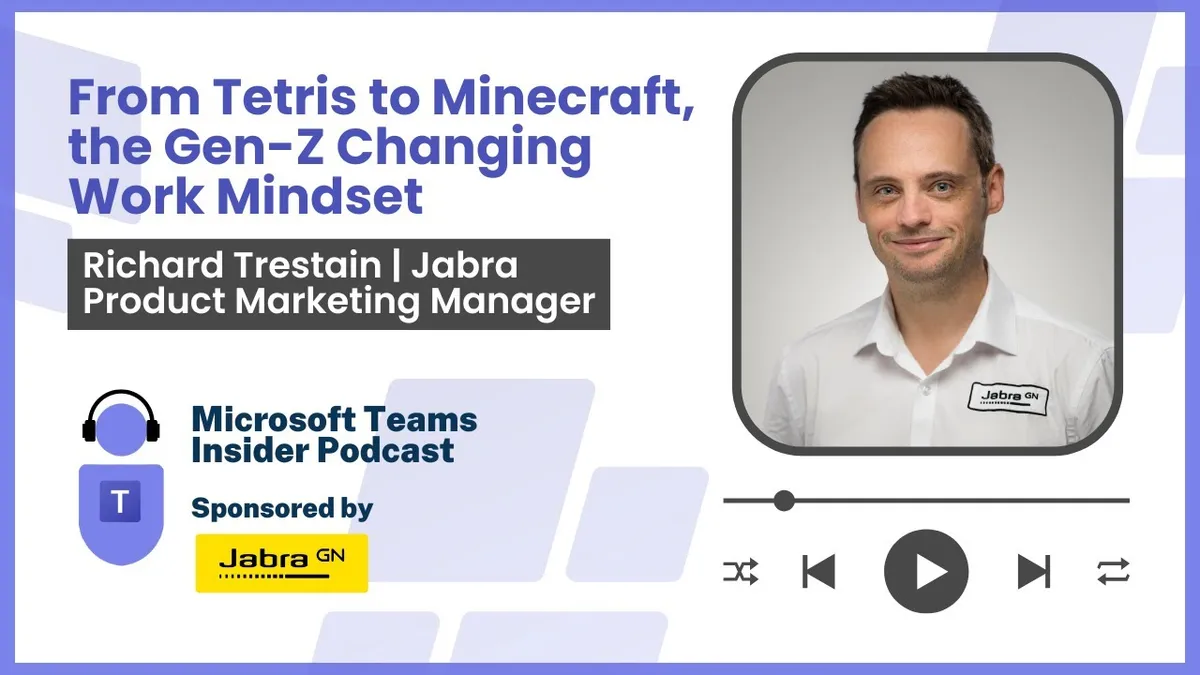
Richard Trestain, EMEA product marketing manager at Jabra, walks through Jabra's annual hybrid work research and this year's Gen Z cohort study. He and Tom Arbuthnot cover where office attendance has settled, why Gen Z's expectations of work are formed differently, and what that means for meeting room and personal device standards.
Many thanks to Jabra, sponsor of this episode.
Key insights
- Jabra's annual study surveys roughly 4,500 knowledge workers across 14–15 countries, repeating the same core questions each year with a fresh themed section — this year a deliberately large Gen Z cohort, benchmarked against all other knowledge workers. ▶ 2:03
- The split has plateaued at around 6% fully remote, 43% fully in office and 51% hybrid (defined as at least one day a week in the office). Trestain went on record predicting 43% fully in office is about as high as return-to-office gets. ▶ 4:06
- Meeting dynamics have inverted: it is often the senior person or meeting leader who stays remote because they have a well-equipped home office, while junior staff without that setup come into the office — so geography no longer maps to seniority in a meeting. ▶ 5:09
- Home setups improved enough during the pandemic that remote participants now look and sound good; the weak link is the room. Pre-pandemic the meeting room was the best seat in the house, now an unequipped room is the worst experience for everyone. ▶ 6:10
- 89% of Gen Z respondents are in jobs allowing full flexibility, and flexibility now out-ranks salary and other benefits for knowledge workers generally — Gen Z simply over-index on it further. ▶ 7:12
- Trestain's Tetris versus Minecraft framing: older generations treat work as Tetris, rotating a pre-defined block into a pre-defined gap; Gen Z, raised on social media examples of self-made careers, treat it as a Minecraft sandbox — tell me the outcome and I'll work out how to get there. ▶ 8:12
- 52% of Gen Z report being burnt out within five years of entering the workplace, over half expect to change jobs immediately and 75% see job-hopping as the route to progression. They also rate managers on support and motivation, with industry experience and subject knowledge far down the list. ▶ 11:18
- Every reason Gen Z gave for frustrating meetings was technical — audio quality, video quality, internet connection — not behavioural issues like talking over each other or poor agendas. Yet only around 8% use a headset and 18% a webcam, so the equipment gap is the obvious fix. ▶ 15:19
- Multi-stream for the Panacast 50 is coming soon, sending separate speaker streams to Teams so people and voice recognition can attribute contributions in the transcript and improve Copilot output. Jabra also announced at Enterprise Connect it will be first to ship a video bar on MDEP, Microsoft's Android flavour. ▶ 16:50
- The Gen Z report runs to 28 pages and is free to find by searching "Jabra Gen Z" — useful benchmark data for organisations building hybrid policy or retention cases. ▶ 19:25
Insights summarised by AI from the episode transcript, reviewed by the Empowering.Cloud team.
Listen: Apple Podcasts · Spotify · Other platforms



Comments ()