From PBX to Microsoft Teams and Voca Contact Centre at the Chartered Institute of Housing
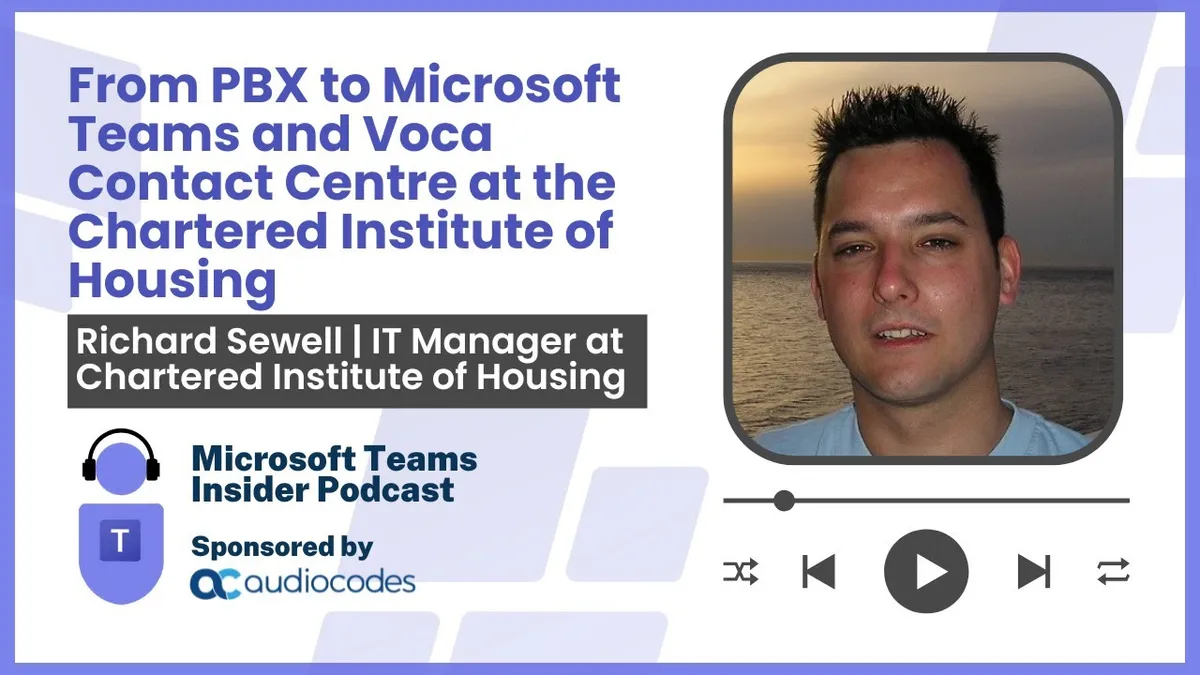
Richard Sewell, IT Manager at the Chartered Institute of Housing, walks through a decade of telephony change at a 100-user membership body — ISDN30 PBX, hosted VoIP handsets, a third-party UCaaS soft client, and finally Teams Phone with direct routing and AudioCodes Voca for contact centre.
Prefer audio?
Who should listen: Microsoft 365 service owners and IT managers in small to mid-sized organisations (roughly 100–500 users) planning a move off hosted VoIP or UCaaS to Teams Phone, especially where a lightweight contact centre and multi-discipline IT team are involved.
Guest: Richard Sewell — IT Manager, Chartered Institute of Housing
Richard Sewell, IT Manager at the Chartered Institute of Housing, walks through a decade of telephony change at a 100-user membership body — ISDN30 PBX, hosted VoIP handsets, a third-party UCaaS soft client, and finally Teams Phone with direct routing and AudioCodes Voca for contact centre. He is candid that the technical migrations were the easy part and that training, assumed knowledge and reporting culture caused most of the pain.
Many thanks to AudioCodes, sponsor of this episode.
Key insights
- Hot-desking on the legacy hosted VoIP handsets was the trigger for change: staff could take up to 10 minutes to be call-ready because sign-in forced multiple handset reboots — assuming they remembered to sign in at all. ▶ 4:36
- During COVID the old platform could only divert calls off-net to personal mobiles, which lost transfer capability, masked CLI and all analytics, and left staff exposed to out-of-hours calls with no queue handling. ▶ 5:07
- The biggest wrong assumption of the Teams migration was that COVID-era Teams familiarity would transfer to voice; users did not grasp that the Teams toast could be a PSTN call from the phone system rather than a Teams call. ▶ 8:12
- "Transfer doesn't work" tickets turned out to be users still dialling four-digit extensions that no longer existed — the fix was deskside observation and telling them to type the person's name instead. ▶ 12:20
- Teams assumes a user's extension is the last three digits of their DDI, which broke on a 20-year-old numbering plan; normalisation rules were needed to map historic extensions to the right DDIs. ▶ 13:22
- Split of users was by shift pattern rather than volume: three of the largest teams sit in Voca because they need sign-in/sign-out, in-meeting status and wrap-up codes across staggered 8-4 and 10-6 shifts, while fixed teams like events and finance stay on standard hunt groups and IVR. ▶ 9:13
- Making line managers Voca supervisors — read access to dashboards and analytics but no config rights — pushed "we're getting loads of missed calls" queries out of IT; one team then shared the presence dashboard link with staff deliberately so everyone knew logins and unavailable status were visible. ▶ 16:57
- Voca's IVR builder looks harder than it is: anyone comfortable with network diagrams or Power Automate drag-and-drop flows can pick it up, but a partner escalation path into AudioCodes engineering matters for the oddities. ▶ 19:04
- AI was scoped as a future enabler, not a requirement — conversational AI IVR is still on the whiteboard, while meeting assistant licences went from a 20-user trial to a managed expansion based on who actually runs external meetings. ▶ 22:41
- The organisation now runs zero physical desk phones; the only handset left is the door-entry security phone on reception, which cannot yet be routed via AudioCodes. ▶ 26:49
Insights summarised by AI from the episode transcript, reviewed by the Empowering.Cloud team.
Listen: Apple Podcasts · Spotify · Other platforms


Comments ()