Explaining Microsoft Work IQ, Agent Types and the Road to the Frontier Firm in Microsoft 365 Copilot
Alev Tamer and Chris Wheeler, both Copilot specialists at Microsoft, unpack what sits behind the current agent terminology — the spectrum from declarative agents to Copilot Studio and pro-code builds in AI Foundry, the frontier firm maturity model, and how Work IQ grounds responses in…
Prefer audio?
Who should listen: Microsoft 365 service owners, Copilot and Power Platform admins, and IT leads who need to translate agent marketing terminology into deployment, licensing and governance decisions.
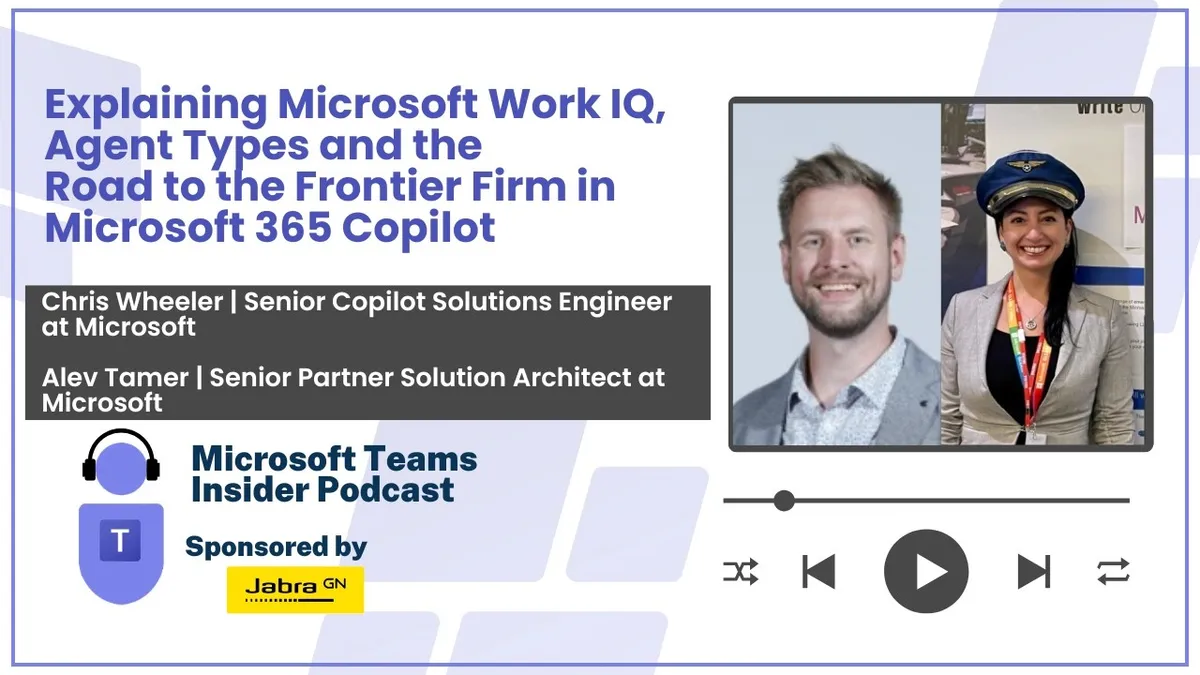
Guest: Alev Tamer and Chris Wheeler — Senior Partner Solution Architect for AI Business Solutions; Senior Copilot Solution Engineer, Microsoft
Alev Tamer and Chris Wheeler, both Copilot specialists at Microsoft, unpack what sits behind the current agent terminology — the spectrum from declarative agents to Copilot Studio and pro-code builds in AI Foundry, the frontier firm maturity model, and how Work IQ grounds responses in organisational context. They also share agents they have built themselves, from a Teams pub quiz bot to autonomous complaint triage in the NHS, and the governance work needed once agent numbers grow.
Many thanks to Jabra, sponsor of this episode.
Key insights
- There are effectively three build routes for agents: declarative no-code agents created inside Copilot, low-code agents in Copilot Studio, and pro-code solutions in AI Foundry. Choosing the wrong tier is the most common early mistake — most business scenarios never need to leave Copilot Studio. ▶ 12:23
- The 'frontier programme' and the 'frontier firm' are two different things and get conflated: the programme is a preview channel for agents that may or may not reach general availability, while the frontier firm is a three-level maturity model running from personal AI assistant, to team-level agents, to agent-operated but human-led organisations. ▶ 17:32
- An NHS complaint-handling workflow was automated end to end: as soon as an email lands in the complaints mailbox, agents triage and route it without human intervention — a good example of where autonomous rather than conversational agents pay off. ▶ 9:20
- Shared agents in Teams meetings behave differently to personal chat — if one person prompts the agent, everyone in the meeting sees the same answer. Chris built a pub quiz agent on this behaviour, which also means it cannot be used covertly for private answers mid-meeting. ▶ 7:49
- Work IQ is more than Graph data — it combines Graph, memory, personalisation and inferencing. Users can explicitly teach Copilot preferences (British English, preferred output formats) and it will apply them across responses. ▶ 22:11
- Agent governance largely falls back on existing Power Platform and Azure controls today: identity, access control, reporting, lifecycle and billing. Agent 365 is Microsoft's answer to agent sprawl once organisations are running hundreds or thousands of agents. ▶ 30:22
- Azure AI Foundry now carries roughly 11,000–12,000 models, and non-Microsoft models such as DeepSeek can be brought in to drive an agent — useful when a specific model outperforms the default for a given task. ▶ 27:49
- Many organisations have missed that the Copilot included tier now reaches the latest models, so some agentic capability is available without every user being on a paid Microsoft 365 Copilot seat. ▶ 20:09
- Agent proliferation is already visible internally at Microsoft — there are agents to brainstorm agents, agents to optimise agent instructions, even agents to write the marketing materials for an agent. Anything built 12 months ago probably has a better option now, so lifecycle review matters. ▶ 16:28
Insights summarised by AI from the episode transcript, reviewed by the Empowering.Cloud team.
Listen: Apple Podcasts · Spotify · Other platforms


Comments ()