Enhancing Efficiency at Century Communities with Microsoft Teams Phone
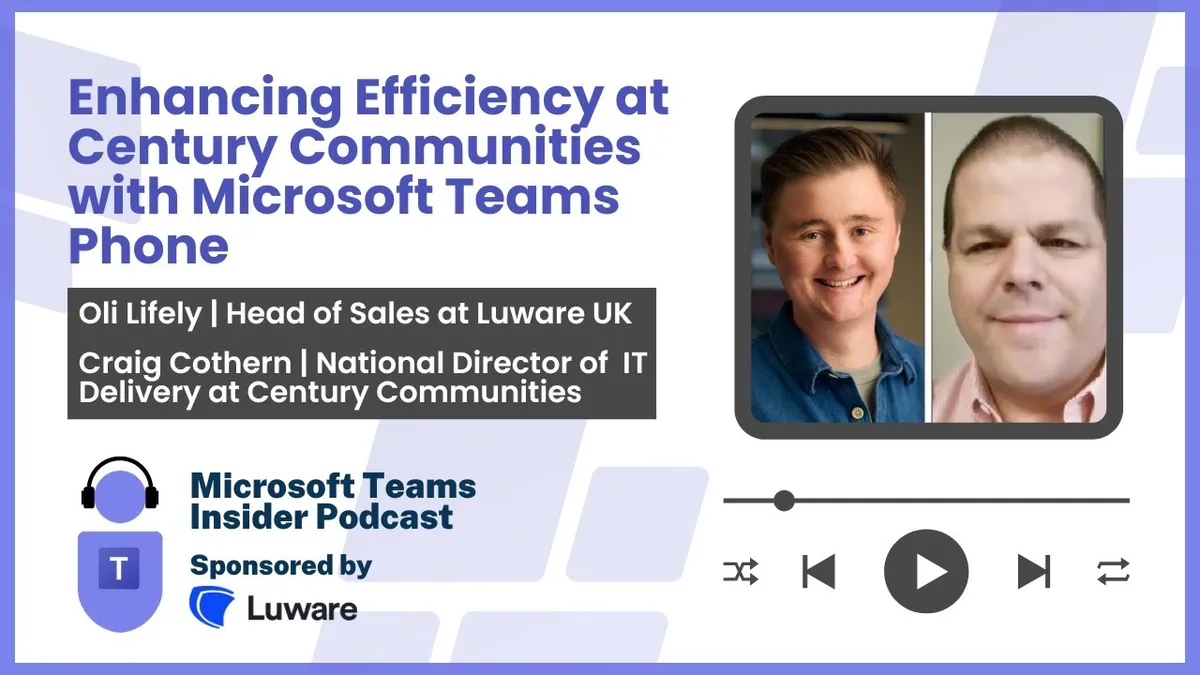
Craig Cothern, National Director of IT Delivery at US top-10 home builder Century Communities, joins Oli Lifely, Head of Sales at Luware UK, to explain how a distributed sales operation moved from traditional PBX to Skype for Business to Teams Phone, and why native call queues could not deliver the…
Prefer audio?
Who should listen: Microsoft 365 service owners and UC leads running Teams Phone in geographically distributed, non-desk-based organisations, and anyone weighing native Teams call queues against a Teams-embedded contact centre for reporting and agent availability.
Guest: Craig Cothern — National Director of IT Delivery, Century Communities
Craig Cothern, National Director of IT Delivery at US top-10 home builder Century Communities, joins Oli Lifely, Head of Sales at Luware UK, to explain how a distributed sales operation moved from traditional PBX to Skype for Business to Teams Phone, and why native call queues could not deliver the reporting they needed. The conversation covers the Luware Nimbus deployment, agent availability control for staff out showing homes, and internal use cases such as purchase-order call queues.
Many thanks to Luware, sponsor of this episode.
Key insights
- Century Communities runs Teams Phone entirely on Microsoft cloud calling with no on-premises session border controllers, which Cothern credits for consistency of support and deployment across all brands and regions. ▶ 4:35
- The trigger for buying a contact centre layer was reporting, not routing: native Teams resource accounts and call queues handled the complex IVRs, but gave no usable call metrics. Easier queue configuration via templates was the unexpected bonus. ▶ 5:06
- This is a non-traditional contact centre — sales teams of one to three people per community, with around 50 staff in a division spread across 30 communities, plus online sales counsellors as a virtual front line routing calls onward. ▶ 7:10
- Queues are cascaded so that if online sales counsellors are unavailable, calls ring the community sales agents directly, prioritising first-call answer over long hold queues. ▶ 8:11
- The biggest gap in native Teams was agent availability: agents showing homes had no way to sign out, so queues kept ringing unanswered. Nimbus sign-in/sign-out made the queue route intelligently to people who could actually take the call. ▶ 10:15
- Reporting exposed adoption gaps — sales agents using personal mobiles for calls and texts produced no call rate or frequency data, prompting an onboarding and licensing audit; licence count has roughly doubled in the first year. ▶ 11:16
- Deployment took a few short weeks and was largely gated by requirements gathering; as a bolt-on to Teams there was no number porting, no carrier change and no loss of service. A US-based partner, LoopUp, was used to satisfy a legal requirement to contract with a US entity. ▶ 12:47
- A proof of concept was run on the internal service desk, testing call queue manipulation, IVR options and schedule-based routing before committing. ▶ 13:47
- Two later additions: call recording for training online sales counsellors, and an escalating internal queue for field staff requesting purchase orders that rings a group then escalates to managers until answered — replacing voicemail and email chasing. ▶ 16:48
- Heat map reporting is used to staff by time of day across three to four time zones, showing that purchase-order calls concentrate early in the morning. ▶ 18:52
Insights summarised by AI from the episode transcript, reviewed by the Empowering.Cloud team.
Listen: Apple Podcasts · Spotify · Other platforms


Comments ()