Dynamics 365 Contact Center Explained with Alpana Bajaj, at Microsoft
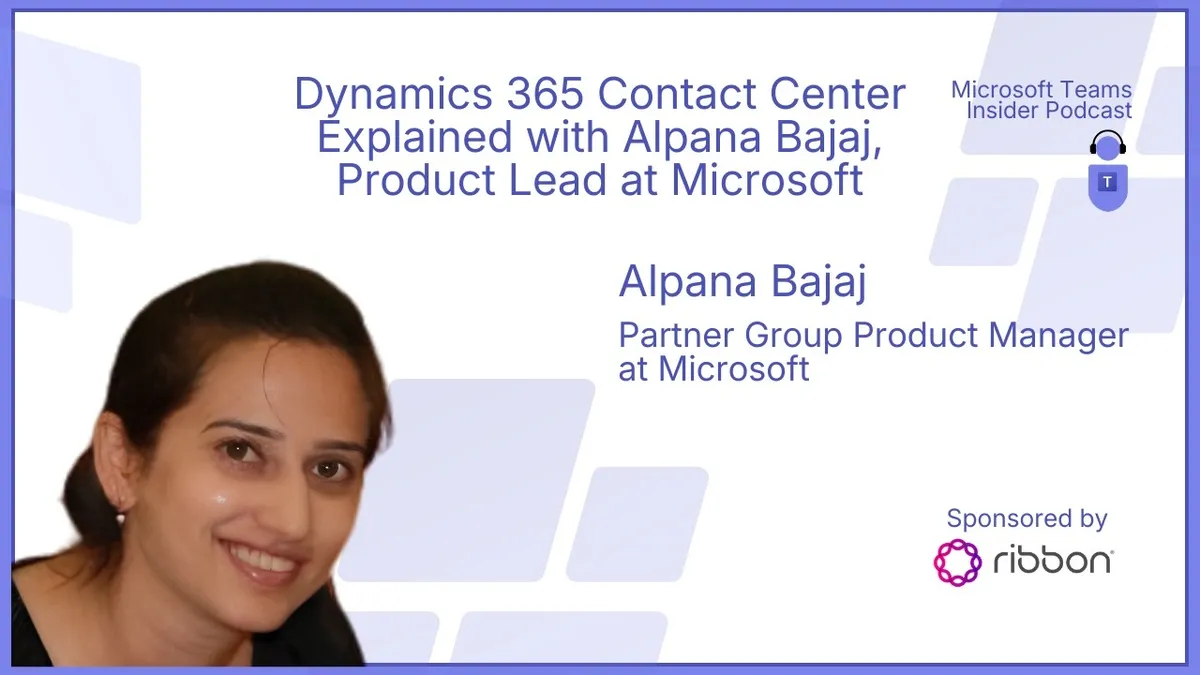
Alpana Bajaj leads the growth and product charter for Dynamics 365 Contact Center and Conversation AI at Microsoft, having worked on the product since its omnichannel and customer service days.
Prefer audio?
Who should listen: Microsoft 365 and contact centre service owners evaluating Dynamics 365 Contact Center, plus partners and SIs building agentic customer service practices who need to explain licensing, pilots and ROI to a business audience.
Guest: Alpana Bajaj — Partner Group Product Manager, Dynamics 365 Contact Center and Conversation AI, Microsoft
Alpana Bajaj leads the growth and product charter for Dynamics 365 Contact Center and Conversation AI at Microsoft, having worked on the product since its omnichannel and customer service days. She decodes how the standalone, CRM-agnostic contact centre is built, what the five out-of-the-box AI agents actually do, how licensing splits between per-seat and consumption, and how to build a credible ROI case.
Many thanks to Ribbon, sponsor of this episode.
Key insights
- The product's lineage matters when positioning it: live chat omnichannel launched in 2019, social channels (Facebook, WhatsApp) followed, voice arrived around late 2021/early 2022, and in 2024 the stack was repackaged as Dynamics 365 Contact Center to work with any CRM — third-party or homegrown — so customers can layer it in without ripping and replacing. ▶ 3:06
- Bajaj's argument for differentiation is that models will become commodity, so the value sits in context-aware AI trained on structured business application data plus unstructured conversation data, with trust, security and compliance baked in rather than bolted on. ▶ 7:11
- A customer had spent 10-12 months and millions building a conversational IVR, only to find a significant share of calls escalating to human agents within the first 30 seconds; a replacement agentic voice agent was built in three to four weeks and delivered double-digit improvement on order status enquiries. ▶ 11:49
- The case management agent pre-populates the case form after a call so the agent only reviews and edits — piloted on 10% of call volume with a subset of agents, it cut after-call wrap-up from four and a half to five minutes down to under a minute, and improved case description quality for back-office handover. ▶ 15:22
- Quality audit ratios of one supervisor to 20 — and in one large enterprise, one to 80 — mean only sampling is possible and audits happen after the fact; the quality assurance agent gives 100% coverage in real time, with configurable questions, per-question weightings and execution plans by industry or compliance need. ▶ 17:56
- Licensing is deliberately split two ways: per-seat for human agents, and consumption-based Copilot Studio credits for all AI agents and AI capabilities, since every agent is built on the Copilot Studio stack. ▶ 24:40
- An SI partner used the Service Ops agent conversationally to stand up a contact centre and its agents, then compiled the natural-language instructions into a single large instruction per industry and geography — reusable by copy-paste for each new customer in that segment, shifting the partner's value to domain and process expertise. ▶ 28:16
- Judge ROI across three pillars — customer experience, operational efficiency, and turning the contact centre from cost centre to revenue engine — because a single-KPI lens misleads: one customer optimising only average handle time missed CSAT, while another moving from 9-to-5 to 24/7 took a small AI cost increase for a fraction of the human equivalent, double-digit CSAT percentage point gains and new upsell revenue. ▶ 33:24
Insights summarised by AI from the episode transcript, reviewed by the Empowering.Cloud team.
Listen: Apple Podcasts · Spotify · Other platforms



Comments ()