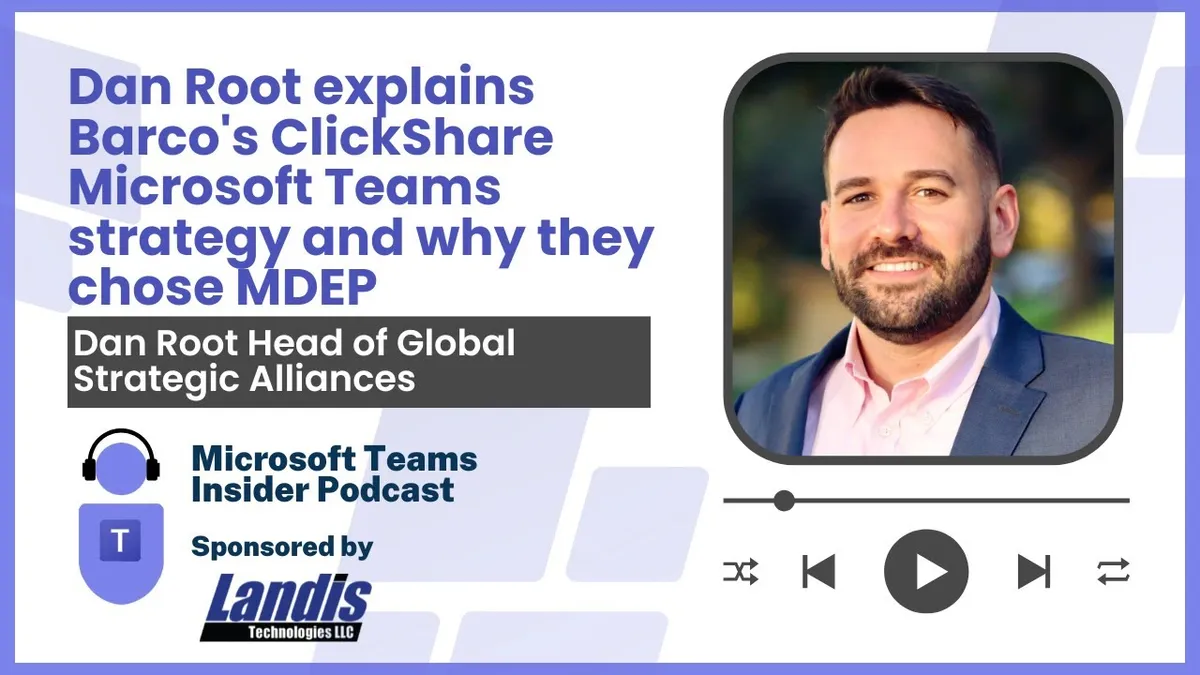
Dan Root explains Barco's ClickShare Microsoft Teams strategy and why they chose MDEP
Dan Root, Head of Global Strategic Alliances for ClickShare by Barco and a former Wainhouse Research analyst, sets out Barco's move from multiple Linux builds to Microsoft's MDEP platform.
Prefer audio?
Who should listen: Microsoft 365 service owners, AV integrators and UC architects evaluating MDEP-based room compute, mixed Teams Rooms/BYOD estates, or wireless presentation and conferencing standards.
Guest: Dan Root — Head of Global Strategic Alliances, Barco (ClickShare)
Dan Root, Head of Global Strategic Alliances for ClickShare by Barco and a former Wainhouse Research analyst, sets out Barco's move from multiple Linux builds to Microsoft's MDEP platform. He covers the new ClickShare Hub Core and Pro compute units, the certified peripheral bundles announced at InfoComm, and why Barco wants MDEP for non-Teams devices too.
Many thanks to Landis, sponsor of this episode.
Key insights
- Barco's data across roughly 250,000 active conferencing devices and over 1.3 million casting devices shows most enterprise customers are Microsoft-aligned but not running Teams Rooms in every space — training rooms and guest-heavy spaces still lean towards wireless BYOD. ▶ 10:19
- The driver for MDEP was consolidation: Barco was running multiple versions of Linux across its portfolio, which made it hard to release feature sets at parity. MDEP gives a single target platform, and Barco was late to Android compared with OEMs that built their own Android ecosystems. ▶ 11:52
- MDEP's move from the AI Cloud group to Windows brought support for building it out beyond Teams Rooms; Root expects far more non-Teams device types on the platform as the first wave ships. ▶ 12:53
- The new product is the ClickShare Hub, in Core and Pro variants — Pro adds dual display output and ships with two buttons rather than one. Both include a base unit plus the new Generation 5 button doing bidirectional 4K with ultra-low latency. Shipping is targeted for Q4. ▶ 18:28
- Teams Rooms ships first on the Hub with the ClickShare BYOD experience; wireless conferencing arrives in a software update shortly after launch. Zoom Rooms is in discussion since Zoom is not certifying operating systems. ▶ 13:55
- ClickShare is already part of the Teams BYOD programme — it appears in the Pro Management Portal, can use a Teams shared device licence, and delivers speaker and room attribution when the button is plugged in. ▶ 16:58
- Certified room bundles at launch pair the Hub with Sennheiser TeamConnect bars (chosen for Dante ports and expandability), Logitech including the MeetUp 2, and a Huddly plus Shure ceiling-audio combination for larger rooms. ▶ 23:04
- Android is not plug-and-play like Windows MTR: every peripheral combination needs certification work, and Root reckons a blanket spec allowing any MDEP compute to work with any certified peripheral is still one to two years away. Barco is pushing Microsoft to reduce retesting where sibling devices share the same chipset. ▶ 25:08
- Barco's ask of Microsoft from the start was not to be locked to Teams — the intent is that all next-generation ClickShare devices run MDEP, including pure ClickShare units for customers who refuse room systems but sit on Microsoft infrastructure, with on-prem XMS and REST API access retained for higher-security government work. ▶ 29:43
Insights summarised by AI from the episode transcript, reviewed by the Empowering.Cloud team.
Listen: Apple Podcasts · Spotify · Other platforms


Comments ()