CTO of LabourNet on Microsoft Teams Phone and Contact Centre with a Dispersed National Workforce
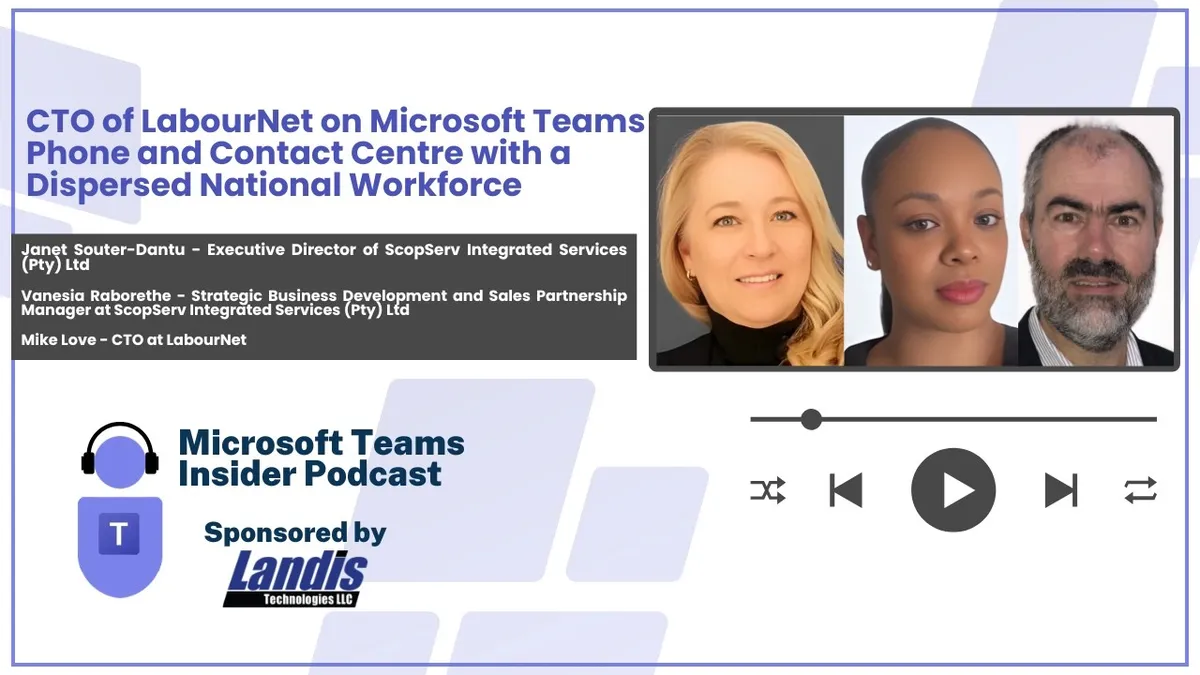
Mike Love, CTO at LabourNet — a South African HR, payroll and legislative compliance firm operating from major cities down to remote regional offices — explains why the business standardised on Microsoft Teams Phone and added Landis Contact Centre for availability-based routing.
Prefer audio?
Who should listen: Microsoft 365 service owners and UC leads planning a move from PSTN/GSM and legacy telephony to Teams Phone with a Teams-native contact centre, particularly those supporting geographically dispersed branch networks or small-team regional offices.
Guest: Mike Love — CTO, LabourNet
Mike Love, CTO at LabourNet — a South African HR, payroll and legislative compliance firm operating from major cities down to remote regional offices — explains why the business standardised on Microsoft Teams Phone and added Landis Contact Centre for availability-based routing. He is joined by Janet Souter-Dantu and Vanesia Raborethe of deployment partner ScopServ to cover the proof of concept, adoption lessons and a data-first stance on AI.
Many thanks to Landis, sponsor of this episode.
Key insights
- LabourNet's calls are almost all crisis calls — a labour inspector arriving on site or a disciplinary incident — so the platform decision was driven by the need for a human, ideally the client's own consultant, within seconds rather than by cost or feature checklists. ▶ 7:08
- The service target is a human answering with empathy within one minute, and no phone ringing longer than 15 seconds. Love is openly transparent that they don't consistently hit it yet, but the targets drive the roadmap. ▶ 15:55
- With one branch administrator per small regional office, a single local incident generating ten calls swamps the branch. Landis queues plus Teams presence let calls overflow nationally on an availability basis rather than a skills basis — who can actually take the call now. ▶ 14:52
- Supervisors gained the ability to see that four agents were rostered but only three are available with ten calls queued, and to dynamically pull in consultants who have a gap before heading out to a client site — visibility they simply did not have before Teams and Landis. ▶ 28:24
- The biggest adoption barrier was people and process, not technology. Front-line staff, who are not qualified consultants, were most helped by being able to hold the voice call while whispering to a specialist over Teams chat — it removed the strain of being out on a limb. ▶ 25:17
- Enabling Teams outbound calling for the entire organisation was a misstep — it competed with WhatsApp and mobile, the desk phone no longer exists because people are at home or on client sites, and LabourNet is now consolidating outbound. ▶ 32:00
- The step that actually moved the needle on service quality was making every senior manager ring the contact centre daily posing as a client under duress; automated monitoring alone did not surface the real experience problems or trigger retraining. ▶ 34:36
- AI is deliberately being held back until the data foundation is right — LabourNet holds payroll data that is ideal for identity theft, and Love's view is that AI turned on prematurely will find holes at the rate of millions of people at a time. First use case is an AI summary of the caller so an inexperienced first responder can hold an informed conversation. ▶ 39:13
- Multi-vendor deployments usually fail on finger-pointing; here ScopServ coordinated line migrations and codec providers, and Landis' US team took 10pm South African calls, so the 'not my problem' risk never materialised. ▶ 13:22
Insights summarised by AI from the episode transcript, reviewed by the Empowering.Cloud team.
Listen: Apple Podcasts · Spotify · Other platforms



Comments ()