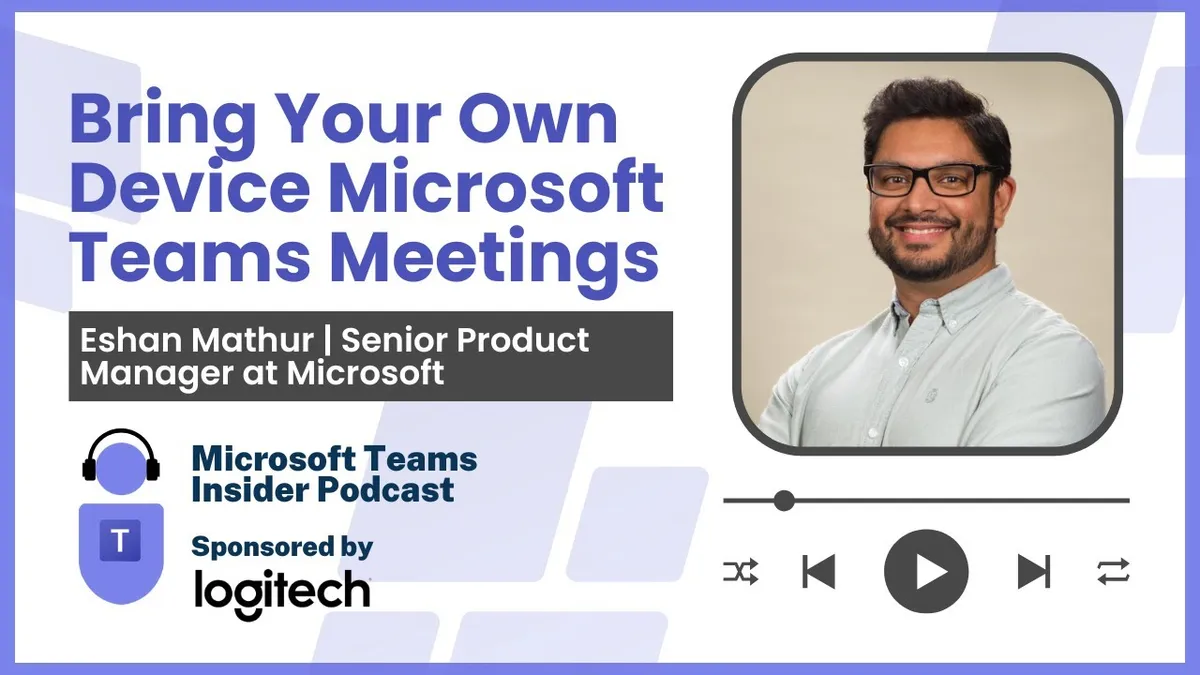
Bring Your Own Device Microsoft Teams Meetings with Eshan Mathur, Senior Product Manager
Eshan Mathur, Senior Product Manager at Microsoft, owns BYOD end user and IT admin experiences for Teams. He explains how Microsoft defines a BYOD space, the new client behaviours that trigger when a shared peripheral is plugged in, and how Auto Association aims to populate a BYOD room inventory in…
Prefer audio?
Who should listen: Microsoft 365 service owners, UC/AV managers and meeting room estate owners who have a mix of BYOD spaces and Teams Rooms and need to know what Teams and the Pro Management Portal will and won't do for un-computed rooms.
Guest: Eshan Mathur — Senior Product Manager, Microsoft
Eshan Mathur, Senior Product Manager at Microsoft, owns BYOD end user and IT admin experiences for Teams. He explains how Microsoft defines a BYOD space, the new client behaviours that trigger when a shared peripheral is plugged in, and how Auto Association aims to populate a BYOD room inventory in Teams Rooms Pro Management Portal without manual work.
Many thanks to Logitech, sponsor of this episode.
Key insights
- Microsoft's working definition of BYOD is any space without a meeting-enabled compute — from rooms with no tech at all, to rooms with a display or audio device only, to rooms with a full AV suite but no compute to drive it. Room size is deliberately not part of the definition. ▶ 4:35
- The positioning is explicit: MTR remains the best experience and the recommendation, but Microsoft accepts most rooms in the world have no compute and is filling that gap rather than waiting. Roughly 90% of rooms still have no MTR-equivalent. ▶ 7:11
- BYOD mode addresses concrete failure modes practitioners see daily: the laptop's own mic and speaker being used instead of the plugged-in AV bar, and Windows dropping into display mirroring instead of extend and exposing private content to the room. ▶ 11:48
- Room-aware client behaviours include auto-selecting the connected USB audio device, enabling speaker attribution so Copilot can attribute who said what in the room, and automatically disabling voice isolation (which would otherwise suppress other in-room voices) then re-enabling it when disconnected. ▶ 15:52
- Shared display mode splits the Teams window in two: presenter controls, notes and private content stay on the laptop while a clean stage — shared content, video gallery, permitted notifications — goes to the room display. ▶ 17:56
- The whole BYOD management model depends on peripherals reporting unique serial numbers up through Windows and Teams to the Pro Management Portal. Cheap non-certified hardware often has garbage serials; Jabra, Logitech, Yealink and HP Poly work with Microsoft directly to get this right. ▶ 21:31
- A personal device filter keeps home peripherals out of the admin's inventory — a serial must be reported by many distinct users before it surfaces, and unused entries age out via TTL. ▶ 23:03
- Auto Association, announced at Ignite, will infer device location from signals such as which room the user booked, correlated across multiple users reporting the same serial — replacing the current PowerShell-script-and-spreadsheet import. Manual import via a vendor-supplied serial list at install time is still the most accurate method. ▶ 26:05
- Practical advice: non-MTR customers should provision the Pro Management Portal now (one Teams Shared Device or Pro licence anywhere in the tenant is enough) so telemetry is already flowing when Auto Association ships. MTR customers already have BYOD data collecting. ▶ 35:16
- BYOD management has hard limits versus MTR: no real-time monitoring, no remote look-through for diagnostics, and firmware updating via a user's Windows Update is not realistic. Expect utilisation and inventory data, not device configuration. ▶ 29:07
Insights summarised by AI from the episode transcript, reviewed by the Empowering.Cloud team.
Listen: Apple Podcasts · Spotify · Other platforms


Comments ()