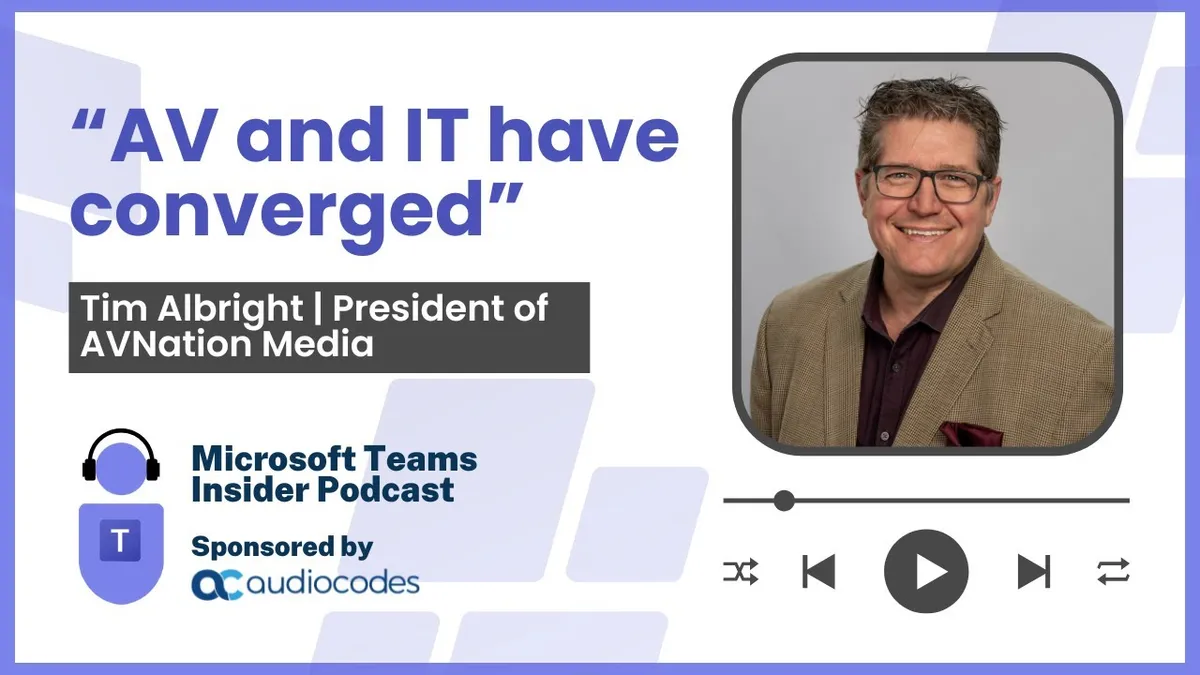
"AV and IT have converged", Tim Albright AVNation
Tim Albright, founder of AVNation Media, has spent 13 years covering the audiovisual industry for tech managers in higher education and corporate estates.
Prefer audio?
Who should listen: Microsoft 365 service owners and IT pros who now own meeting rooms and want to understand where AV expertise actually adds value, plus AV integrators and designers trying to work more effectively with IT and security teams.
Guest: Tim Albright — Founder and President, AVNation Media
Tim Albright, founder of AVNation Media, has spent 13 years covering the audiovisual industry for tech managers in higher education and corporate estates. He talks to Tom Arbuthnot about why the AV/IT convergence argument is over, what device certification really buys you, why audio should always be specified before video, and where multi-camera rooms genuinely earn their keep.
Many thanks to AudioCodes, sponsor of this episode.
Key insights
- Convergence stopped being a debate long ago — Albright points to an InfoComm show banner from 2004 announcing it. His argument: stop discussing whether AV and IT have merged and start working out how each side leverages the other's strengths in real rooms. ▶ 6:11
- Certification is a support boundary, not just a badge. If you call Microsoft or Zoom with a broken room built on uncertified cameras and mics, the conversation ends there — you have taken yourself off the supported path. Staying in the ecosystem simplifies vendor support and, in practice, gives users a better experience. ▶ 8:12
- Albright likens Microsoft's certification programme to the Starbucks model: a deliberately commoditised, repeatable experience so a room in London behaves like a room in St Louis. He uses "commoditised" as a compliment, not a criticism. ▶ 9:44
- A concrete illustration of how far costs have fallen: an early-2000s Tandberg deployment connecting a college to three rural high schools cost $50,000 per system — $200,000 for four endpoints — and rooms had to be booked. The shift of the codec onto the PC removed the single biggest line item and freed audio specialists to build products like Shure's MXA ceiling arrays and Sennheiser's TeamConnect. ▶ 11:47
- The AV/IT silo failure has a classic symptom: AV asking for "all the ports open" because the manufacturer said so, and IT refusing outright. Albright's view is that both sides carry just enough knowledge of their own vertical to be dangerous and need to educate themselves on the other's constraints. ▶ 15:55
- Specify in order: microphone first, so the far end can hear everyone in the room; then loudspeakers, so the room can hear the far end; only then video. Albright's position is that without audio there is no video conferencing system at all. ▶ 17:27
- Soundbars are over-deployed — "everybody and their brother has one" and half of them are not any good. They have legitimate use cases, but room size, room shape and wall, ceiling and floor materials have to be understood before any gear is ordered. Arbuthnot adds that he has seen bars installed well beyond their spec because IT assumed that if the camera can see someone the mic will hear them. ▶ 18:28
- Multi-camera setups belong in large conference rooms only — overkill in huddle spaces — and their value is entirely for the remote participant: switching and framing the active speaker so gesture and expression survive the trip to the far end. Albright notes that even AI sceptics concede that automated camera direction is a genuinely useful application. ▶ 20:01
- Return-to-office mandates do not remove the need for video. Albright's counter: a company with 37 locations will never get everyone in one room, and even Apple and Amazon — the loudest RTO voices in the US — run only a handful of campuses each. ▶ 21:35
Insights summarised by AI from the episode transcript, reviewed by the Empowering.Cloud team.
Listen: Apple Podcasts · Spotify · Other platforms



Comments ()