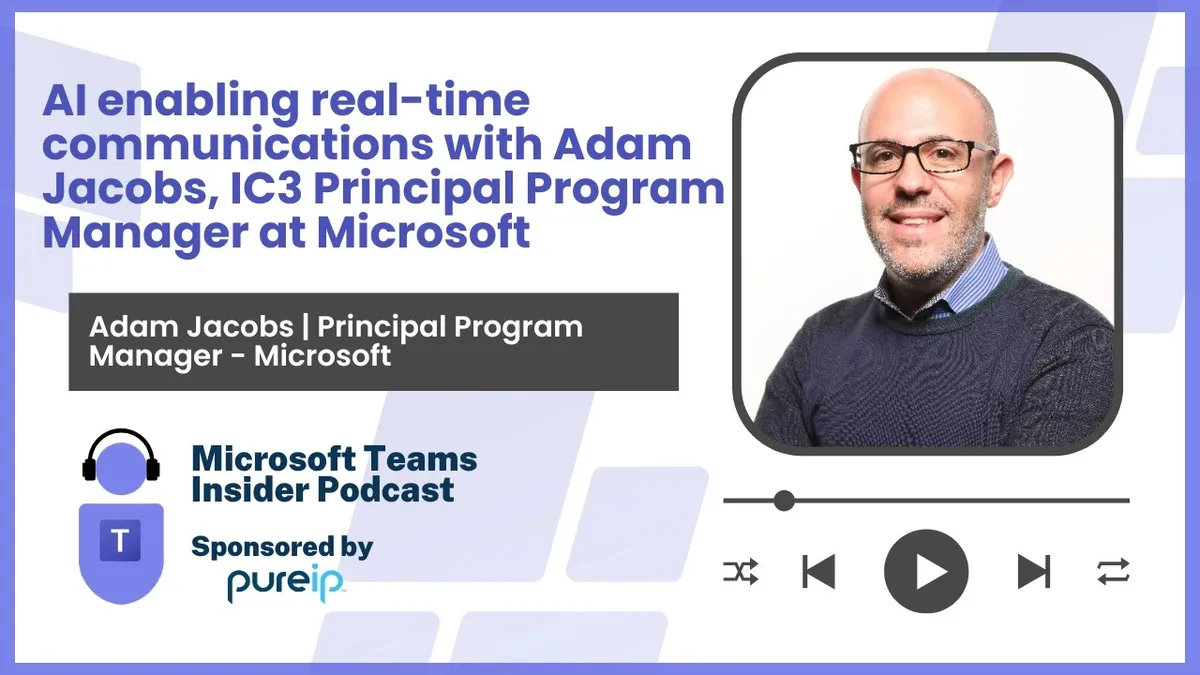
AI enabling real-time communications with Adam Jacobs, IC3 Principal Program Manager at Microsoft
Adam Jacobs is a Principal Program Manager in Microsoft's IC3 team, the real-time communications platform behind Teams, having previously been an IT Director in UK financial services and spent a decade at Polycom.
Prefer audio?
Who should listen: Microsoft 365 service owners, UC architects and AV professionals who want to understand the platform and cost mechanics behind Teams AI features, transcription and Cloud Video Interop.
Guest: Adam Jacobs — Principal Program Manager, IC3 (real-time communications platform), Microsoft
Adam Jacobs is a Principal Program Manager in Microsoft's IC3 team, the real-time communications platform behind Teams, having previously been an IT Director in UK financial services and spent a decade at Polycom. He explains how AI features are re-shaping platform and cost decisions at Teams scale, the surprising longevity of Cloud Video Interop, and the trade-offs in moving transcription to a new, more scalable platform.
Many thanks to Pure IP, sponsor of this episode.
Key insights
- IC3 owns the platform behind Teams rather than the client, so nearly every client-side experience the Teams product groups want requires matching backend and platform work to light up end to end. ▶ 1:38
- Every feature release — even adding a new internal partner to an existing feature — goes through a cost impact review at an internal 'Cogs council' chaired by the CVP. AI features sit at the upper end of costs, so Adam is a regular attendee. ▶ 3:47
- Multiply any feature by roughly 320 million monthly active users and the compute economics change the design: the early AI land-grab was built for speed, not efficiency, and the platform is now being re-engineered to remove duplication between teams doing the same work. ▶ 7:28
- Cloud Video Interop was expected to be a two-to-three-year band-aid but traffic has not materially declined; large financial services customers still rely on it, and features are still shipping — PowerPoint Live content support was added recently. ▶ 5:23
- Transcripts are being moved to a new platform that scales further and can surface insights beyond the transcript itself, and the migration brings transcription to clouds where it was previously unavailable. Transcripts are the biggest single piece of grounding data in meetings and now one of IC3's largest costs. ▶ 8:32
- Facial and voice recognition are layered on top of the transcription service, which is why Cloud IntelliFrame can both frame people in rooms without intelligent cameras and identify who is present to update the roster — it is all extra metadata on the same pipeline. ▶ 10:37
- IC3 currently processes almost everything in real time rather than batching post-meeting work, even though customers often do not need recordings and recaps immediately — that may change as efficiency work progresses. ▶ 12:09
- For conversational AI you need transcription faster than today's model, which writes out a complete utterance for context. Going faster costs accuracy, so the approach is a fast first pass plus later correction — visible when live captions rewrite themselves mid-meeting. ▶ 13:11
Insights summarised by AI from the episode transcript, reviewed by the Empowering.Cloud team.
Listen: Apple Podcasts · Spotify · Other platforms



Comments ()