AI, AV, and the Evolving Role of the Integrator
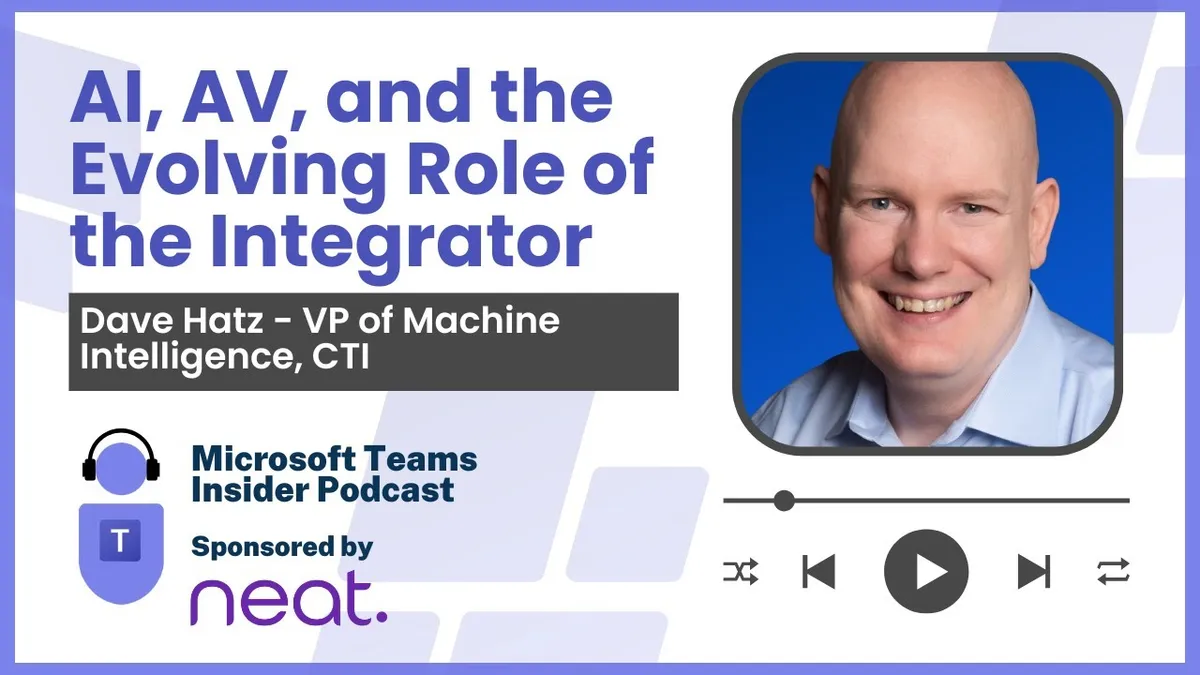
Dave Hatz is VP of Machine Intelligence at CTI, a large US-based AV integrator and events company, where he leads a team of software developers and business analysts building the firm's AI practice.
Prefer audio?
Who should listen: AV integrators, systems designers and Microsoft 365 service owners responsible for meeting room estates who are working out where AI fits into room strategy, refresh cycles and customer conversations.
Guest: Dave Hatz — VP of Machine Intelligence, CTI
Dave Hatz is VP of Machine Intelligence at CTI, a large US-based AV integrator and events company, where he leads a team of software developers and business analysts building the firm's AI practice. He traces his route from AV programming and electrical engineering into Microsoft Teams Rooms and AI, and sets out where integrators can still add value as AV shifts from bespoke hardware to software-defined, experience-led solutions.
Many thanks to Neat, sponsor of this episode.
Key insights
- The word 'integration' originally meant stitching disparate proprietary systems together, and the AV programmer sat at the glue point seeing every layer — a skill set that now transfers to integrating at the software rather than the cable layer. ▶ 3:32
- Hatz's route into UC came via automating multi-endpoint executive broadcasts around 2010 — calling three or four Cisco/Polycom endpoints into a single meeting to pull independent full-screen feeds of each executive into a broadcast system, then automating it so a producer could act as technical director. ▶ 4:34
- AV integrator resistance to Microsoft Teams Rooms broke when end users, not integrators, said the simplicity story resonated; the answer is not to discount the complex path but to start from what the room is actually used for — financial reviews versus product demos where colour accuracy genuinely matters — rather than leading with a kit list. ▶ 7:07
- With both Android and Windows form factors plus certified OEM devices, DSPs and ceiling tiles, there is now a Teams Rooms form factor for the vast majority of spaces; Hatz's rule is to avoid building custom solutions that a forthcoming OEM product will make redundant, while not being flat-footed by simply waiting. ▶ 8:08
- Treat device-level 'AI' claims sceptically — echo cancellation has been machine learning in UC for 30 years — and focus instead on two distinct layers: personal skilling and productivity, and organisational workflows. ▶ 13:45
- CTI is building agents that generate a first-draft statement of work from everything known about a customer engagement, precisely so design engineers and consultants don't need to learn consistent prompt engineering to get value. ▶ 14:46
- Customers split into risk-averse organisations running AI on default-deny with exceptions, and more progressive ones piloting openly while holding compliance, data security and risk mitigation checks before production rollout. ▶ 15:16
- The AI conversation gives integrators a reason to fix room fundamentals: everyone must be picked up by the microphones and recognised by the camera for speaker attribution and transcription to work, and poor acoustics in glass 'fishbowl' rooms leave people drained after long meetings. ▶ 12:14
- Refresh cycles are changing — three, five or seven-year rip-and-replace was driven by fixed chipsets, but Teams Rooms deployed four or five years ago have gained AI capabilities via software, extending asset life and supporting sustainability goals (though sustainability is rarely the deciding factor in purchase). ▶ 20:21
Insights summarised by AI from the episode transcript, reviewed by the Empowering.Cloud team.
Listen: Apple Podcasts · Spotify · Other platforms



Comments ()