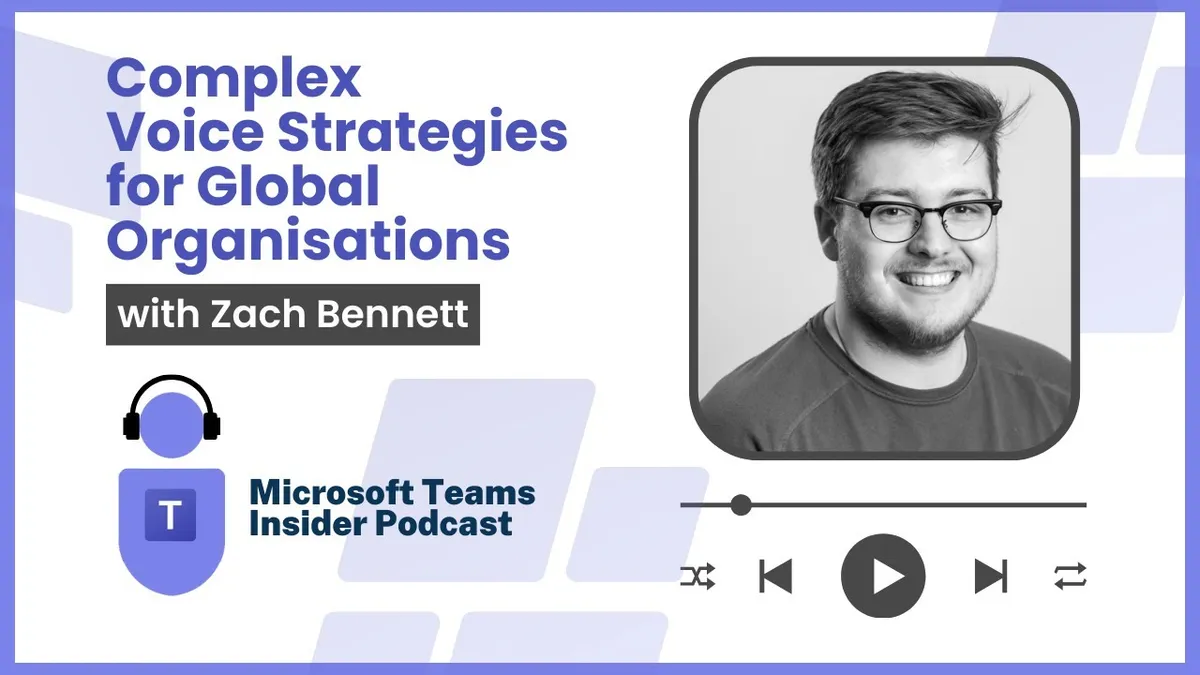
Complex Voice Strategies for Global Organisations
Zach Bennett, Principal Architect at LoopUp, works with global organisations migrating from disparate legacy PBX estates to Teams Phone. He and Tom Arbuthnot dig into the awkward end of Teams voice: closed telephony markets like the UAE and China, LATAM porting lead times, keeping legacy Cisco…
Prefer audio?
Who should listen: Microsoft 365 service owners, UC architects and telephony leads planning Teams Phone rollouts across multi-country estates, particularly those facing closed markets, non-portable number ranges, legacy gateways or large analogue device populations.
Guest: Zach Bennett — Principal Architect, LoopUp
Zach Bennett, Principal Architect at LoopUp, works with global organisations migrating from disparate legacy PBX estates to Teams Phone. He and Tom Arbuthnot dig into the awkward end of Teams voice: closed telephony markets like the UAE and China, LATAM porting lead times, keeping legacy Cisco voice gateways in play, and when analogue endpoints should simply become common area phones.
Many thanks to LoopUp, sponsor of this episode.
Key insights
- Global rollouts rarely have neatly aligned PBX and carrier contract end dates, so don't hold the whole programme back — move each location to Operator Connect when it's ready and handle the hard sites separately rather than waiting for a single cutover. ▶ 4:06
- Dubai is effectively a closed market: the financial investment required to become a fully regulated cloud carrier is prohibitive, so the practical answer is to keep the customer's Etisalat or Du numbers (often on PRI) and deploy a managed session border controller on site to serve Teams users locally. ▶ 5:09
- China has no number porting at all — not between the three national carriers (China Telecom, China Mobile, China Unicom), and not even PRI-to-SIP or analogue-to-SIP. Plan on issuing new numbers unless you keep a local SBC fronting the existing lines. ▶ 6:43
- A practical workaround for new-number-only countries: ask the incumbent carrier to forward old numbers to the new ones for six months, then monitor inbound hits on the old range to prove nobody is still calling before dropping them. ▶ 7:46
- LATAM's difficulty is logistics rather than regulation — porting lead times are very long, and Colombia is a new-number-only country because porting isn't regulated there. Raise those sites at the very start of a project. ▶ 9:16
- With 79 Operator Connect providers, country coverage alone isn't a differentiator — assess whether the provider can also deliver direct routing as a service and plain SIP trunks terminating on customer-owned kit for the on-premises edge cases. ▶ 12:49
- Where internal policy forbids ripping out sunk-cost hardware (in one case a fleet of old Cisco analogue voice gateways, not CUBEs), SIP trunks can be terminated directly onto those gateways — the customer retains the operational risk for the device. ▶ 11:47
- Certified ATA support on Teams SIP Gateway changes the analogue conversation, but the first question should be whether a licensed Teams common area phone removes the need for the analogue device entirely; reserve ATAs for genuinely specialised endpoints such as lift phones. ▶ 13:51
Insights summarised by AI from the episode transcript, reviewed by the Empowering.Cloud team.
Listen: Apple Podcasts · Spotify · Other platforms


Comments ()