Decoding Dynamics 365 Contact Center: Microsoft Teams Voice, New AI Agents, and Licensing
Adam Ball, Co-founder and Vice President at Cloud Revolution and Microsoft MVP, Marcus Schmidt, Principal Program Manager, Dynamics 365 Product Team at Microsoft, and Taimoor Husain, M365 Telco Strategy Manager at Microsoft, discuss the what, why and how of Dynamics 365 Contact Center.
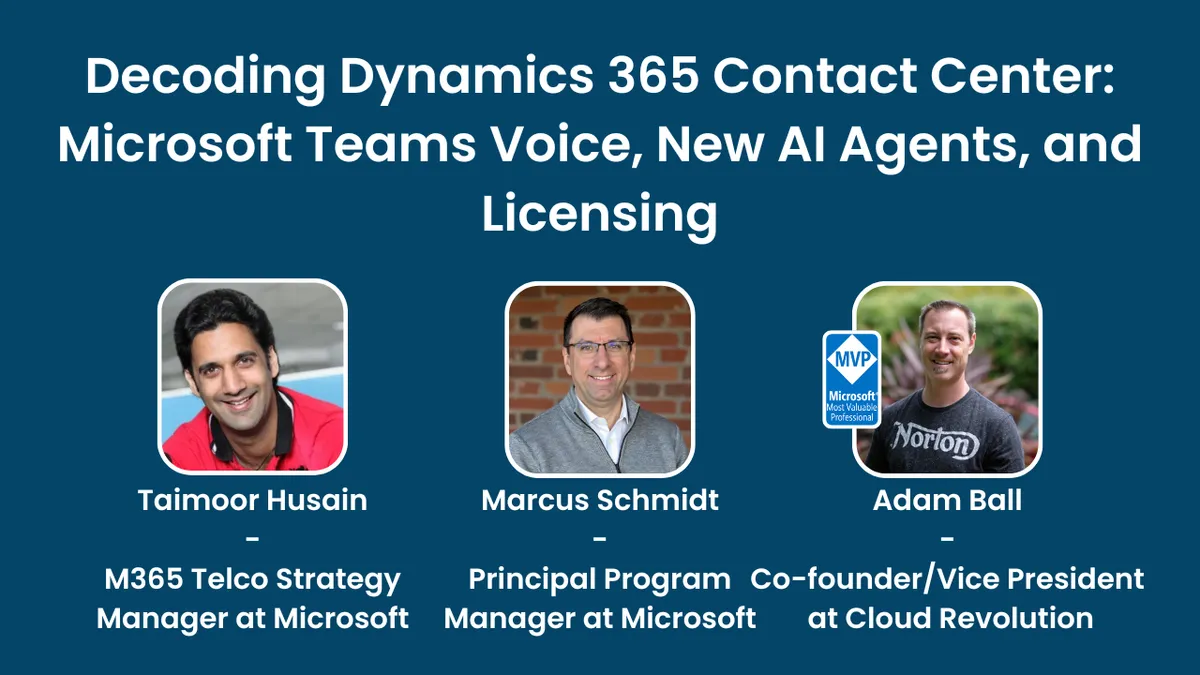
Adam Ball hosts Microsoft's Marcus Schmidt and Taimoor Husain on Dynamics 365 Contact Center: its origins in Dynamics 365 Customer Service omni-channel add-ins, the move of the voice channel from ACS to Teams Phone using direct routing, Operator Connect and calling plans, and the three new AI agents announced on 27 April. Licensing, agent experience options and B2E use cases are also covered.
Adam Ball, Co-founder and Vice President at Cloud Revolution and Microsoft MVP, Marcus Schmidt, Principal Program Manager, Dynamics 365 Product Team at Microsoft, and Taimoor Husain, M365 Telco Strategy Manager at Microsoft, discuss the what, why and how of Dynamics 365 Contact Center.
• Where Dynamics 365 Contact Center came from and how it evolved from Dynamics 365 Customer Service omni-channel add-ins
• You don't need any other Dynamics products to get started with Contact Center
• The shift from ACS to Microsoft Teams for voice connectivity, leveraging direct routing, Operator Connect and calling plans
• How the platform is built on Azure, Power Platform and Copilot Studio, with Microsoft Teams voice integration
• The new agentic era: Customer Assist Agent, Quality Assurance Agent and Service Operations Agent
• Real-time voice agents with natural conversation and live language switching
• Licensing: per-user Dynamics licence, Microsoft Teams Phone licence for voice agents and Copilot credits for AI capabilities
• Use cases beyond traditional contact centres, including B2E scenarios for HR, IT and Facilities
Chapters
- 0:00 Introductions and format
- 2:45 Where Dynamics 365 Contact Center came from
- 5:10 Do you need other Dynamics products?
- 6:09 From ACS to Teams for voice connectivity
- 7:00 What ACS is still used for
- 13:12 The platform: Azure, Power Platform, Copilot Studio
- 15:28 First party versus Connect, Extend and Unify partners
- 20:13 Agent experience: workspace, Teams and Copilot
- Who it suits, sizing and B2E scenarios
- 28:38 Deployment effort and avoiding like-for-like
- 34:26 Licensing: Dynamics, Teams Phone and Copilot credits
- 41:10 April announcements: three agents and real-time voice
Key insights
- Dynamics 365 Contact Center was announced two years ago at CCW in Las Vegas, but the voice channel dates back to Ignite in November 2021.
- No other Dynamics product is required; Contact Center can be deployed standalone alongside a third-party CRM or telephony platform.
- Voice connectivity has shifted to Teams, reusing direct routing (available since 2018), Operator Connect and Microsoft calling plans for predictable cost.
- ACS is not being retired; it still underpins SMS and WhatsApp connectivity while Teams becomes the primary voice path.
- Every agent handling voice needs a Teams Phone licence; chat-only agents in other modalities do not.
- Licensing is a per-user-per-month Dynamics licence, plus Teams Phone, plus Copilot credits for generative and agentic AI.
- Customer Service Premium includes 1,000 Copilot credits per user per month, pooled at tenant level, with extra credit plans recommended.
- The 27 April announcements added the Customer Assist Agent, Quality Assurance Agent and Service Operations Agent, plus real-time voice agents with live language switching.
Insights summarised by AI from the episode transcript, reviewed by the Empowering.Cloud team.

Comments ()